Top News
Electrochemistry Foundry launches innovation hub to bridge battery manufacturing gap

Solar Manufacturing USA 2026: Production and technology at the heart of U.S. solar

SEIA: Local solar bans threaten the economic survival of family farms
pv magazine Awards 2026
It’s time to submit your application!
Entries for the pv magazine Awards 2026 are now open from April 1 to August 31 across seven key categories: Modules, Inverters, BESS, BoS, Sustainability, Manufacturing, and Projects.
Don’t miss your chance to showcase your innovation globally.

Your monthly PV industry update
pv magazine’s global monthly edition offers authoritative reporting, market-driven analysis, and expert perspectives on the technologies, policies, and investments transforming global power systems.
Available in print and digital

pv magazine Webinar
pv magazine Webinar
pv magazine Webinar

Ann Arbor launches first-of-its-kind city direct purchase of residential solar and storage
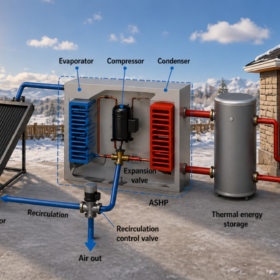
Solar-assisted air-source heat pump for radiant floor heating
ESS Tech to add 8.5 GWh of U.S.-made sodium‑ion batteries to its portfolio
California sets precedent by overriding local blockade for Soda Mountain
More than 67 GW storage, 14 GW solar seek interconnection in PJM’s reopened queue
Press Releases
Bila Solar Achieves ISO 9001:2015 Certification, Validating Quality Systems and Operational Maturity
Renewable Properties Secures 118 MW of Domestically Manufactured First Solar Modules for Executing on Its Solar Pipeline
pv magazine USA and Finlay Colville launch Solar Manufacturing USA 2026 to put production and technology at the heart of U.S. solar manufacturing
Sunhub Expands State Marketplace with Live Solar Rankings and Localized Procurement Insights
Installations
Featured
Clean power captures 91% of new U.S. grid capacity as 2025 installations hit 50 GW
Solar and storage to lead 86 GW capacity surge in 2026
New federal data shows solar and battery assets will comprise nearly 80% of all new utility-scale power additions planned for the U.S. electric grid this year.
RFP Alert: NYSERDA seeks RECs from eligible land-based renewable energy projects
The state agency has launched its tenth annual solicitation for Tier 1 Renewable Energy Certificates, seeking proposals from mature wind, solar and hydroelectric facilities, with a focus on eligible projects seeking to access expiring federal tax credits.
Tesla energy storage deployments down 15% on ‘clumpy’ first quarter
After peaking at over 14 GWh and accounting for 15% of Tesla’s revenue in the fourth quarter of 2025, energy storage saw a seasonal decline to 8.8 GWh accounting for 10.8% of the company’s revenue.
CleanCapital and Energix announce deal for 120 MW Ohio brownfield solar development
The long-delayed Nottingham Solar project, located on a former coal strip mine in Harrison County, is now under construction with an expected energization date of January 1, 2027.
Tenaska, TVA sign agreement for 225 MW battery project in Tennessee
Tenaska and the Tennessee Valley Authority have reached a long term agreement for a 225 MW battery energy storage system in Hawkins County, Tennessee, marking a $300 million investment in regional grid reliability.
Manufacturing
Featured
Enphase announces distributed solid-state transformer for AI data centers, targets 2028 for volume deliveries
Boviet Solar sells U.S. PV module factory to Indian manufacturer Inox Solar
The divestment, already partially secured via escrow, reflects regulatory pressure from U.S. FEOC policy changes. Boviet Solar also continues negotiations to sell a separate U.S. cell project.
Manufacturing partnership brings new PV technology to U.S.-sourced solar
Solx’s Aurora hybrid module with Caelux’s perovskite glass aims to compete on performance beyond federal tax sunsets.
Solx and Caelux announce partnership to offer domestic perovskite-silicon tandem solar modules
The companies say they will supply 3 GW of Solx Aurora modules — which combine domestic silicon cells from Suniva and a top layer of Caelux “Active Glass” to reach 28% efficiency — with commercial volumes available in the U.S. market by 2027.
Tandem PV launches commercial perovskite-silicon manufacturing in California
Tandem PV has opened a 40 MW commercial demonstration factory in Fremont, California, marking a significant transition for perovskite-silicon technology from laboratory development to repeatable manufacturing at scale.
Suniva to build 4.5 GW solar cell factory in South Carolina
The expansion will bring the company’s total domestic cell capacity to 5.5 GW, cementing its position as the largest merchant solar cell manufacturer in the United States.
Markets & Policy
Featured
Republican legislators seek to restore clean energy tax credits
Maine becomes the 11th state to allow community choice aggregation
The state joins a growing list of places that allow municipalities to form local energy groups, giving residents more control over electricity costs and a faster path to 100% renewable energy goals.
Stem acquires raicoon to automate solar asset monitoring
The Houston-based energy software company has acquired the assets of the startup to integrate autonomous fault detection and work order generation into its PowerTrack platform for the United States solar market.
Medium duration endures woes, while Form’s long duration grows, and lithium overflows (part 2)
U.S. medium and long duration manufacturers EOS and ESS are showing stress, while Form Energy is outpacing projections and now must scale – all while being stalked by lithium’s ever widening use profile.
Soltec appoints Alejandro Moreno as its President of North America
Moreno, who brings more than two decades of solar experience to the tracker manufacturer, will oversee operations from Soltec’s Miami headquarters as the company targets growth in utility-scale solar and AI data center markets across North America.
Beatbot launches solar-powered autonomous pool skimmer
The iSkim Ultra utilizes a 24 W monocrystalline solar array and a 10,000 mAh battery to provide 24/7 surface cleaning through an autonomous dual-path navigation system.
Technology
Featured
For solar advocacy work, it’s “AI or die,” says leader of Puerto Rico solar group
Meta signs with Overview Energy to power AI datacenters with space-based solar
The agreement aims to bypass terrestrial grid constraints by beaming near-infared light from space to terrestrial solar plants to power high-density AI workloads.
Prepare for launch: Solar powers the $600 billion space industry
Human activities in space have been solar powered for more than 70 years. Now, as the space industry accelerates, new opportunities are emerging for specialized solar manufacturers, writes Jake Veloza of Eternal Sun Wavelabs. The extreme and unforgiving conditions of space demand a high level of performance and durability, and accurate testing methods will be needed to get these new solutions off the ground.
Forecasting solar irradiance in urban environments with just one 360° image
U.S. scientists have developed a method to forecast solar irradiance at any location using a single high-resolution hemispherical image captured on-site. By extracting sky, sun, and surrounding scene information from visual cues, the approach enables accurate long-term energy prediction without relying on detailed 3D city models.
No evidence of PFAS leaching from solar panels, study finds
Researchers in the United States reviewed claims about PFAS in solar panels and found that while fluoropolymers may be used in limited components like backsheets or coatings, there is no confirmed evidence of PFAS leaching from commercially deployed modules. The study highlights widespread confusion between different PFAS types and emphasizes the need for clearer communication and transparency around fluoropolymer use in PV technologies.
Solar PV led world energy demand growth in 2025, but the U.S. turned to fossil fuels, says IEA report
The International Energy Agency’s latest Global Energy Review shows solar PV accounted for 27% of all energy demand growth, while demand grew 62% faster in the U.S. than the world total, largely driven by a 10% increase in coal use, as the world enters what the report’s authors call the “Age of Electricity.”