





Form Energy launched what may be the world’s largest battery, ESS is functionally out of cash, and EOS is missing revenue. In short, the medium and long duration energy storage market is in flux, and it’s being casually hunted by competitive innovation and lithium ion.
As far as medium duration is concerned, EOS and ESS are attempting to shift the market. The “longer than four hours and non-lithium tier” space these companies originally stepped into is suddenly overflowing with lithium products at highly competitive pricing.
Though Form Energy, the third manufacturer, has been gaining traction. The company’s 100 hour battery far out paces lithium battery’s single digit durations; however, Form Energy is still working to deliver on its $20kWh promise–a number which once felt impossibly far from lithium prices.
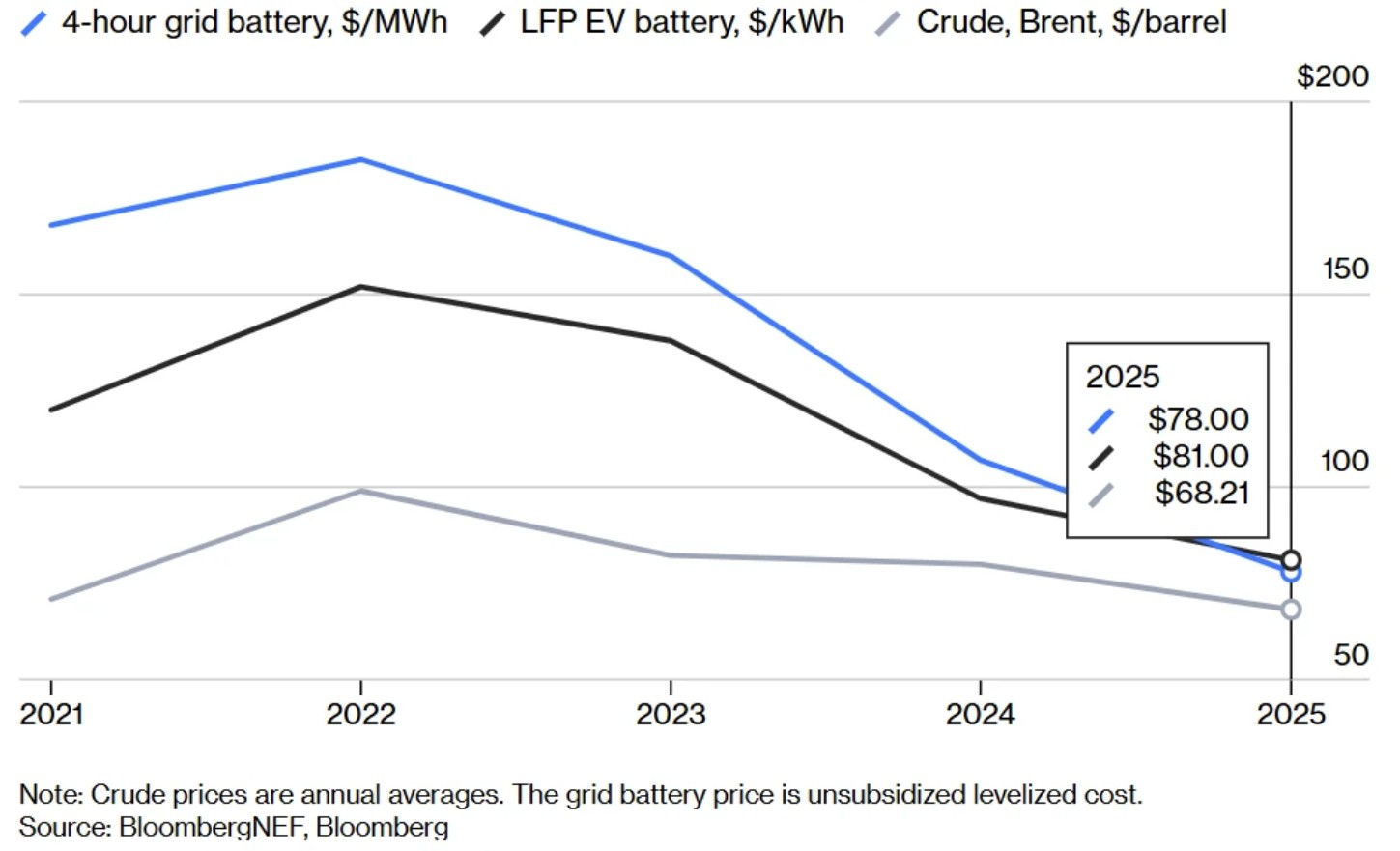
Source – BloombergNEF
Today, the global average floats just below $80/kWh for four hour energy storage – still a full 400% above Form Energy’s goals. However, lurking about are batteries selling below $60/kWh, with cheaper more advanced products coming!
As battery and repowering techniques continue to evolve, the long term effective pricing(also known as levelized cost of electricity) of lithium is getting cheaper.
100-Hour duration grows
In a significant development, Form Energy recently announced what could be the world’s largest battery. Google, using Form Energy’s technology, has reached a definitive agreement with Xcel Energy to deploy a massive 300 MW / 30 GWh iron-air battery system in Minnesota.
Since October 2025, Form Energy’s project pipeline has grown 375%
According to reporting by The Information, the project’s price is approximately $1 billion. If this were the total price, it would mean Form Energy’s battery is $33/kWh delivered. However, there are other variables that could affect this price.
For instance, Google will get the default 30% energy storage tax credit. Additionally, they will receive a 10% domestic content tax credit added as Form Energy manufactures in West Virginia. Last, Google will be able to depreciate 100% of the project in year one.
A backwards calculation would suggest the initial price Google paid being closer to $2.3 billion, or $77.17/kWh of energy storage.
From Form Energy’s perspective, the company will receive a massive tax credit. Energy storage receives an up to $45/kWh tax credit due to the Inflation Reduction Act. Adding the $45/kWh to Google’s $77/kWh, a total of $123/kWh, we might gain insight on the company’s current pricing.
With a 300 MW powerplant now on the books, Form Energy’s manufacturing facility in West Virginia scaling toward 500 MW a year of capacity comes into a lot more focus. The Google battery will occupy 60% of the factory’s annual capacity. This expansion is expected to complete in 2028.
In October of 2025, Form Energy’s CEO Mateo Jaramillo said the company had more than 200MW / 20GWh of batteries contracted.
In the same interview the CEO said they’re far outpacing projections. The company had already signed “more than what we were projecting building as a company for 2028, 2029, and 2030.”
Since then, including the Google project and other more recent accounts such as a newly signed 12 GWh portfolio, they now have 750 MW / 75 GWh of capacity under development.
At a stated long term goal of $20/kWh, this would represent $1.5 billion in revenue, and take its 500 MW facility about a year and a half to fulfill, once it completed construction in 2028. If actual pricing is more than double the $33/kWh, that revenue more than triples.
Medium duration woes
ESS Inc and EOS Energy are both in more precarious positions, though the latter has a bit more runway.
The company launched an 8-hour iron flow battery, with some key amazing specifications. No degrading, or minimal warranty work amongst the key items.
The initial release of the 8-hour iron flow battery did not result in the growth of the company, and thus the company pivoted to alternative measures. For 2025, the company showed a net loss of $63.4 million. Revenues were $1.6 million for the year. To start 2026, the company has announced a new CEO and CTO.
The company is shifting away from its 8-hour duration energy storage product to its new 12 to 24 hour Energy Base line. They believe this product will more appropriately meet the market’s longer term energy needs. Moving to this new product is why 2025 showed essentially no revenue, and a massive spend on research.
In positive news, ESS announced a $9.9 million deal with Concurrent Technologies Corporation and the US Air Force Research Laboratory supporting a 27MWh microgrid. Congruently, the company announced a 50MWh opportunity with a utility in Arizona.
However, they also announced a $15 million cash raise, as they were down to $1 million in their bank accounts.
Stay tuned for part 2 of this pv magazine USA report.
This content is protected by copyright and may not be reused. If you want to cooperate with us and would like to reuse some of our content, please contact: editors@pv-magazine.com.




By submitting this form you agree to pv magazine using your data for the purposes of publishing your comment.
Your personal data will only be disclosed or otherwise transmitted to third parties for the purposes of spam filtering or if this is necessary for technical maintenance of the website. Any other transfer to third parties will not take place unless this is justified on the basis of applicable data protection regulations or if pv magazine is legally obliged to do so.
You may revoke this consent at any time with effect for the future, in which case your personal data will be deleted immediately. Otherwise, your data will be deleted if pv magazine has processed your request or the purpose of data storage is fulfilled.
Further information on data privacy can be found in our Data Protection Policy.