U.S. solar policy risks multiply as reconciliation speculation and financing friction rise
As the U.S. solar industry continues to adjust to life under the One Big Beautiful Bill Act (OBBBA), Jesse Pichel and Lev Seleznov of Roth Capital Partners note two risks that are drawing attention across the market. These include the potential for a second reconciliation bill that could reopen elements of solar policy, and continued friction in tax equity and tax credit transfer markets tied to unresolved Foreign Entity of Concern (FEOC) and Prohibited Foreign Entities (PFE) guidance. Taken together, these issues show that policy risk has not disappeared for US solar – in some respects, it is evolving.

Oil in turmoil, solar stays stable
Soaring energy costs have grabbed headlines around the world the past two months, but prices across the solar supply chain are marching to their own beat, writes Hanwei Wu of OPIS. Oversupply in Asia continues to distort markets, with either sharp price falls or tepid price gains.

Keeping the GHG Protocol an engine of corporate PPA growth
As the World Resources Institute prepares to revise its highly influential Greenhouse Gas (GHG) Protocol by late 2026 or early 2027, a heated debate has emerged between tech giants advocating for stricter time- and geographic-matching rules and industry advisors warning that such complex mandates could stifle the corporate Power Purchase Agreements (PPAs) vital to scaling global renewable energy.
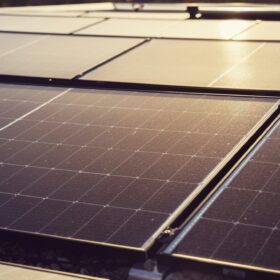
States rethink solar rules as affordability and grid constraints reshape the market
The U.S. distributed solar market is entering a more complicated policy era, according to a report from the North Carolina Clean Energy Technology Center.

U.S. House wants to tax EV $130/year – equal to an 18.3 MPG car
The fee would rise $5 every two years starting in 2029, topping out at $150/year for EVs and $50 for plug-in hybrids.
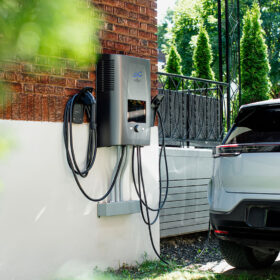
Bi-directional EV charging company dcbel nears 200 installations in California, plans for thousands more
The Montreal-based company is working through phase 1 of a project partially funded by the California Energy Commission, and has just began serving the Quebec market. As it works to prove its technology can support the California grid and its homeowner customers, the company is planning for phase 2.
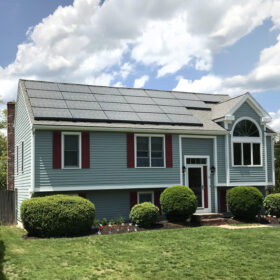
Massachusetts distributed solar potential reaches 92 GW as electrification demand rises
A report from the Applied Economics Clinic reveals that Massachusetts possesses 92 GW of technical potential for distributed solar, a capacity nearly four times higher than the state projected peak electricity demand for 2050. The report explores program design for more equitable access to the benefits of distributed solar and storage.
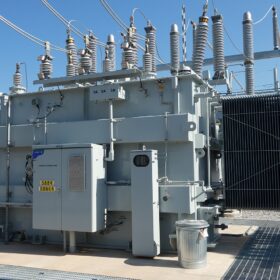
U.S. transformer market faces severe supply constraints as lead times extend to four years
Severe shortages of power transformers are stalling grid expansion as developers face skyrocketing prices and four year wait times for critical equipment.
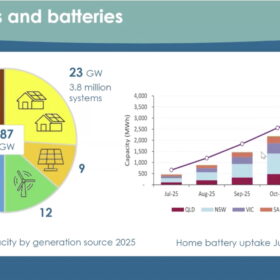
Lessons from Australia for scaling rooftop solar and home batteries
Rooftop solar in Australia has reached a high system capacity and is prompting rapid growth in home batteries. To explore how to transfer that success to the U.S., a study group of U.S. regulators met with energy sector leaders in Australia.

Western grid enters new era as CAISO launches Extended Day-Ahead Market
The May 1 go-live of the Extended Day-Ahead Market (EDAM) marks the first time Western utilities can coordinate large-scale solar and storage resources 24 hours in advance, a move projected to significantly slash curtailment and boost regional reliability.