




At the close of his comments on his company’s Q1 2026 earnings call, Enphase CEO Badri Kothandaraman had what might be described as a “one more thing” moment a la Steve Jobs.
The call had previously covered data on the company’s top-line earnings and shipments, which showed a steep decline of nearly 20.6% in year-over-year quarterly revenue, the company’s first negative quarterly net income in two years and lower guidance for Q2.
Despite the disappointing numbers, Kothandaraman kept a positive tone throughout the call. He noted the company’s revenue in Europe had grown by 36% in Q1 compared to Q4 2025, discussed the rollout to four states of the Enphase-exclusive Propel prepaid lease product in the U.S. and provided information about the latest iterations of the company’s residential and commercial batteries and microinverters.
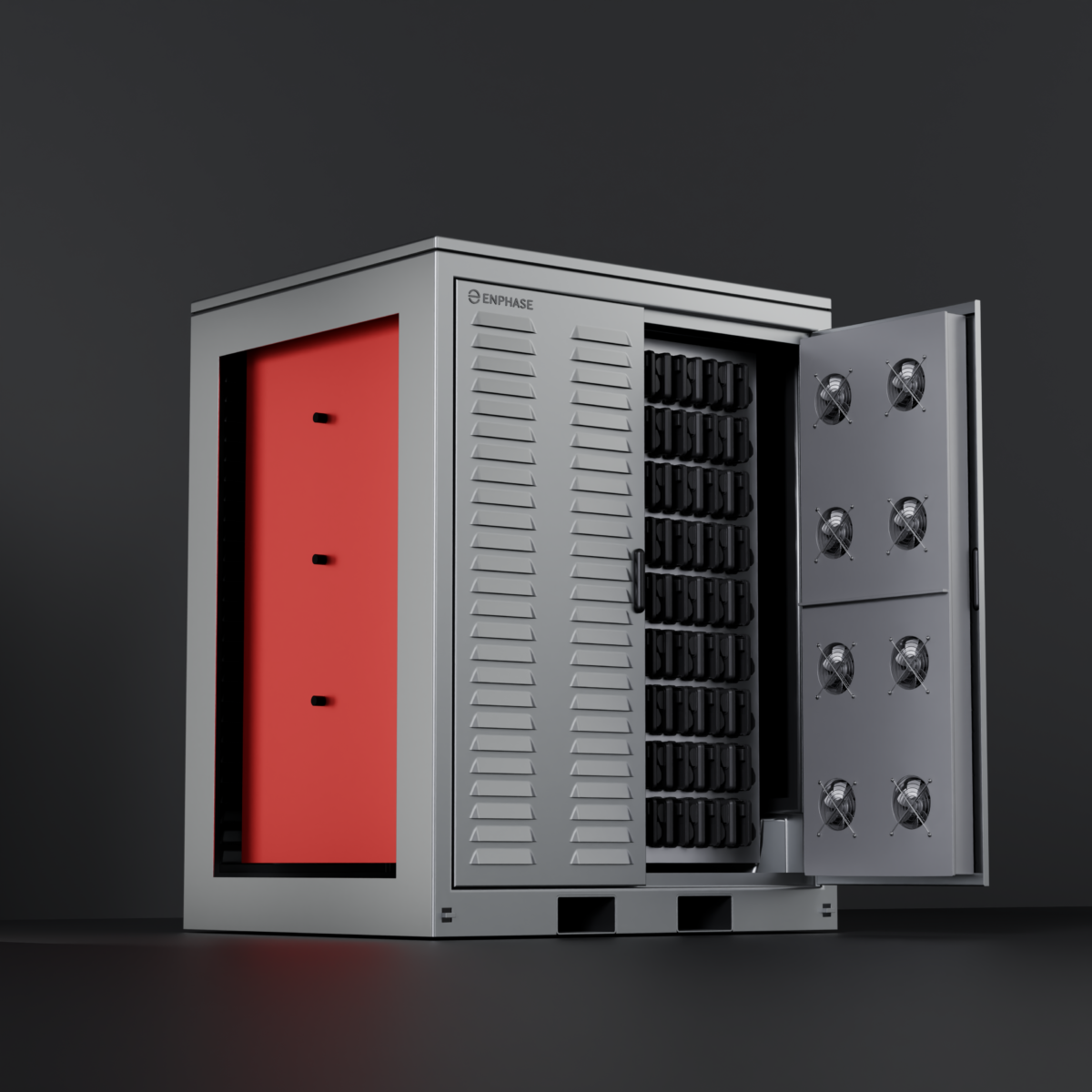
But he saved the biggest news for last, announcing the company’s development of the new IQ Solid-State Transformer (SST), a modular, 1.25 MW “supercluster” consisting of 342 hot-swappable power modules that can deliver 800V DC power directly to the latest NVIDIA computing architecture.
“AI is changing how power must be delivered to compute infrastructure,” said Kothandaraman in a statement accompanying the announcement. “For two decades, Enphase has built distributed, semiconductor- and software-defined power conversion systems at scale. As AI racks move toward 800 VDC (±400 VDC) architectures and megawatt-scale densities, we believe that distributed architecture is well suited to this transition, and it is what we are building.”
Despite the relatively poor numbers in the Q1 2026 announcement, at least one analyst sees long-term upside from the SST announcement.
“This opportunity, in our view, is exciting and potentially meaningful in the coming years, but investors will need to be patient,” said Philip Shen, managing director and senior research analyst for Roth Capital Partners, adding that Enphase stock could be “one to watch” for investors seeking a solar stock that can give them exposure to data centers.
How the technology works
The IQ SST is designed to convert medium-voltage AC directly into 800V DC power in a single conversion stage, scaling up from 1.25 MW to 5 MW per skid..
The company says this single-stage conversion allows for sub-millisecond response times to accommodate dynamic AI training loads, which can swing from idle to full power several times per second.
The power module technology is based on Enphase’s existing microinverter technology. Each module contains one of the company’s fifth-generation 22 nanometer control ASIC, dubbed “Kestrel,” alongside bi-directional gallium nitride (GaN) power-switching technology.
Enphase says it expects the system to deliver 98.5% peak efficiency and 99.999% availability. This reliability metric relies on built-in distributed redundancy, enabling the system to continue operating even if only 90% of the power modules are participating.
The modular design also allows for hot-swapping, meaning units can be serviced or replaced without a complete system shutdown. Enphase says the system is built with 10% redundancy to allow this hot-swapping ability.
Enphase said its engineers have built functioning samples of the power modules and that it intends to conduct full system demonstrations later this year, with customer pilots in 2027 and volume shipments in 2028.
On the earnings call, Kothandaraman said he expects the addressable market for the IQ SST to reach 11 GW by 2031.
This content is protected by copyright and may not be reused. If you want to cooperate with us and would like to reuse some of our content, please contact: editors@pv-magazine.com.




Solid-state transformers sound like a game changer for data centers. Wonder how they plan to integrate these by 2028.