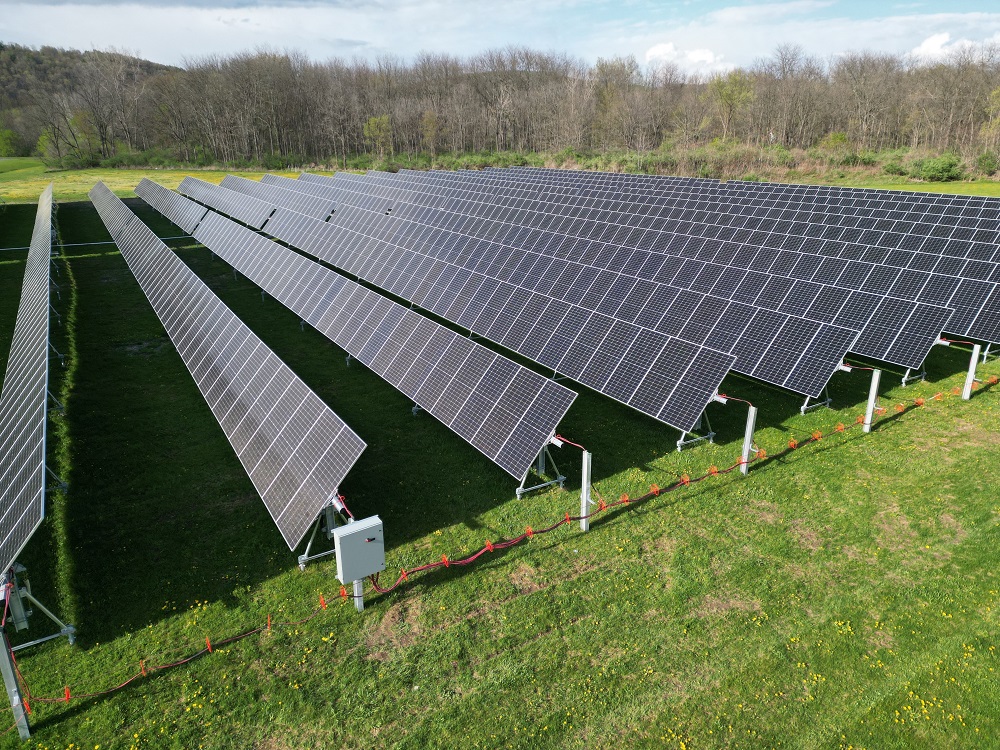





A new geospatial modeling framework demonstrates that utility-scale solar buildouts can avoid critical ecological habitats with a virtually negligible impact on project economics.
The study, “Sustainability trade-offs at the nexus of solar energy, agriculture, and biodiversity,” published in the journal Geography and Sustainability, presents a transferable optimization framework to navigate the increasingly contentious intersections of clean energy deployment, agricultural preservation, and wildlife conservation. Led by researchers from Cornell University, The Nature Conservancy, the U.S. Geological Survey, and Central Michigan University, the team used New York State as a case study to model how competing land-use priorities alter the geography and financials of decarbonization.
The research team used a specialized computer mapping program that evaluates choices in a strict order of importance to analyze the land-use footprint under three distinct deployment strategies, which included minimizing capital costs, prioritizing agricultural preservation, and maximizing biodiversity conservation. Proximity to existing transmission lines, road access, slope, and local soil configurations were integrated to evaluate realistic developer constraints.
To build a rigorous framework, the researchers adopted the most aggressive utility-scale solar development projection from the New York State Energy Research and Development Authority (NYSERDA), which mandates the deployment of 46,216 MWdc of utility-scale solar capacity, a buildout requiring approximately 107,700 acres (43,584 hectares) of land.
The model revealed significant regional trade-offs depending on which stakeholder metric was prioritized. When developers optimize strictly for a least-cost scenario focused on the lowest capital expenditures and shortest interconnection distances, the model disproportionately clusters solar arrays on flat, cleared land, targeting more than 40,000 hectares of pasture and hay fields.
Nearly half of this land directly overlaps with critical grassland bird habitats, creating severe biodiversity conflicts. Conversely, enforcing a strict agricultural preservation scenario successfully spares about 80% of prime farmland, but pushes the solar footprint into alternative open spaces, resulting in the projected deforestation of over 41,000 hectares of timberland.
Finally, prioritizing a biodiversity-conscious scenario that avoids sensitive ecosystems forces the conversion of more pasture, hay fields, and cultivated croplands to fill the capacity deficit.
“There’s land-use conflict associated with solar energy development because there are different people interested in biodiversity, agriculture and energy, but in reality those things are interacting in a nexus,” said Steve Grodsky, the paper’s senior author and assistant professor at Cornell University. “This modeling gives us an opportunity to forecast potential interaction points and potential conflict zones, and allows communities and agencies to make more-informed choices in siting decisions.”
The study’s most significant finding challenges the industry assumption that stringent environmental constraints will derail project economics.
Restricting development on ecologically sensitive lands to prioritize biodiversity increased the annualized total system costs by a mere 0.17%. The finding suggests that smart macro-siting can mitigate local opposition and environmental degradation at an almost imperceptible premium to ratepayers and developers.
For utility-scale solar developers, EPCs, and asset managers, the optimization metrics offer actionable leverage to de-risk pipeline development early in the pre-construction phase. Utilizing dual-criterion macro-siting algorithms allows developers to proactively eliminate high-conflict parcels before submitting interconnection requests, substantially reducing long-term soft costs tied to permitting delays and environmental litigation.
Given that a biodiversity-first approach incurs a system-wide cost penalty of less than two-tenths of a percent, developers can present these optimized spatial configurations to local planning boards as a powerful tool to neutralize “not in my backyard” (NIMBY) resistance, securing faster local zoning approvals without eroding project internal rates of return.
“Traditionally, solar siting has been evaluated through a least-cost objective where the primary goal is to site the energy quickly, cost effectively and ensure reliability,” noted Adam Gallaher, lead author of the study. “What we’ve found is that it is possible, and minimally more expensive, to take into account multiple criteria that can inform just and ecologically responsible energy transitions.”
The authors said the framework can be calibrated by policymakers outside of New York to accommodate regional geographical realities, offering a mathematical pathway to balance multi-functional landscapes during the energy transition.
This content is protected by copyright and may not be reused. If you want to cooperate with us and would like to reuse some of our content, please contact: editors@pv-magazine.com.





By submitting this form you agree to pv magazine using your data for the purposes of publishing your comment.
Your personal data will only be disclosed or otherwise transmitted to third parties for the purposes of spam filtering or if this is necessary for technical maintenance of the website. Any other transfer to third parties will not take place unless this is justified on the basis of applicable data protection regulations or if pv magazine is legally obliged to do so.
You may revoke this consent at any time with effect for the future, in which case your personal data will be deleted immediately. Otherwise, your data will be deleted if pv magazine has processed your request or the purpose of data storage is fulfilled.
Further information on data privacy can be found in our Data Protection Policy.