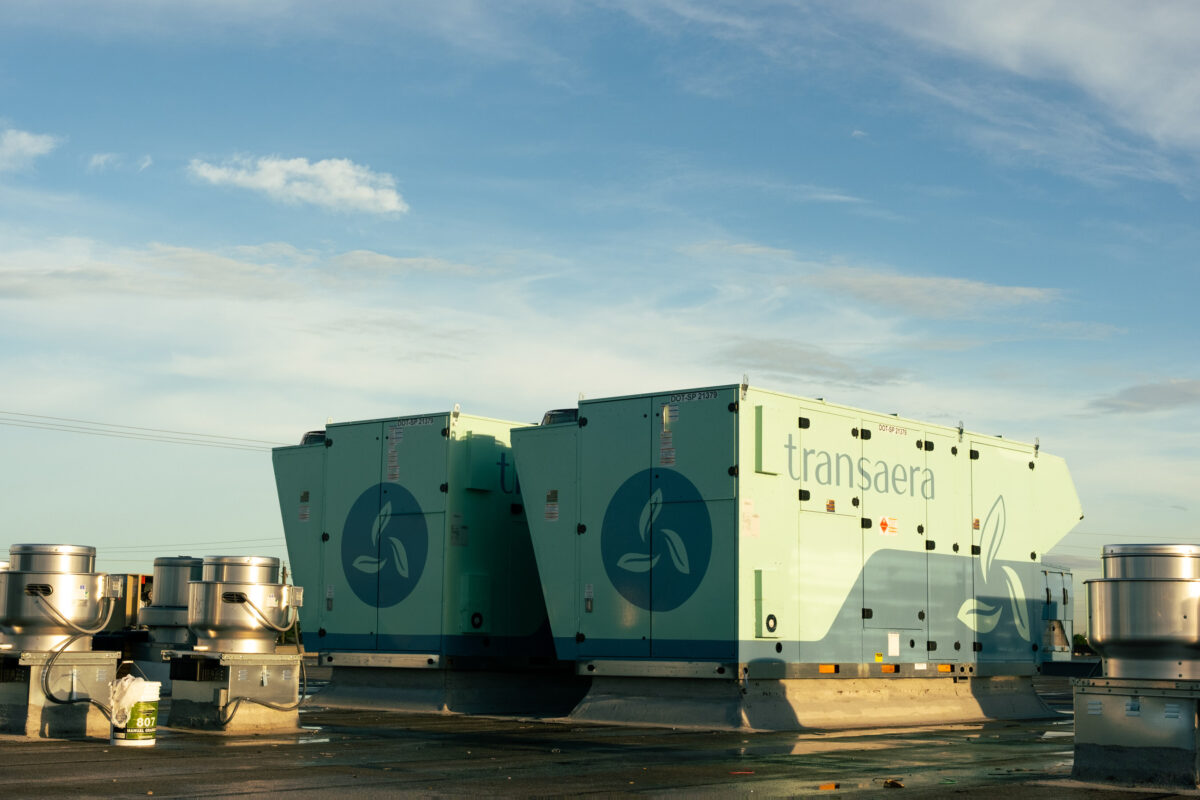





Amazon has conducted a six-month field trial of a new type of rooftop heat pump at one of its logistics facilities in the United States.
The system is described by its provider, US startup Transaera, as a dedicated outdoor air system (DOAS), a type of heating, ventilation and air conditioning (HVAC) technology that treats only outdoor air for ventilation, handling it independently from a building’s main heating and cooling system.
The DOAS is designed to provide cooling, heating and dehumidification in a single integrated platform. It operates as an all-electric heat pump, eliminating the need for gas-fired reheat while addressing both sensible and latent loads in commercial buildings.
A key innovation lies in its dehumidification approach, the manufacturer said. Instead of relying on conventional HVAC methods that overcool air to condense moisture and then reheat it, the DOAS uses solid desiccant materials based on metal–organic frameworks (MOFs). These materials remove moisture from incoming air before the cooling stage, fundamentally changing the air-treatment sequence. As a result, moisture is removed first and cooling is applied afterward, which the company says significantly improves system efficiency compared to conventional approaches.
Transaera claims the system delivers approximately 40% energy savings compared with conventional packaged direct expansion (DX) rooftop units. It can also maintain performance in hot and humid climates, where latent cooling loads are high.
From a design perspective, the system is intended as a drop-in replacement for existing rooftop HVAC units. It fits within standard rooftop footprints without requiring structural redesign, and its weight and dimensions are comparable to those of conventional systems, the company said. It is also designed to be serviceable using standard HVAC maintenance procedures, avoiding the need for specialized technician training.
The technology is primarily targeted at large commercial buildings, including warehouses and logistics facilities, where humidity control and high latent cooling loads present significant challenges.
“At Amazon, we seek technologies that support our Climate Pledge goal to reach net zero carbon emissions by 2040. Our work with Transaera has moved from field trial to readiness for first commercial use, and this new collaboration supports expanding use of this technology within our global network of buildings,” said Asad Jafry, Director of Global Energy, Sustainability and AGV at Amazon.
“HVAC use accounts for over one-third of energy use in commercial buildings,” said Sorin Grama, CEO and Co-founder of Transaera. “This technology has the potential to reduce operational cost while enhancing indoor air quality and occupant comfort across commercial and industrial facilities.”
This content is protected by copyright and may not be reused. If you want to cooperate with us and would like to reuse some of our content, please contact: editors@pv-magazine.com.


By submitting this form you agree to pv magazine using your data for the purposes of publishing your comment.
Your personal data will only be disclosed or otherwise transmitted to third parties for the purposes of spam filtering or if this is necessary for technical maintenance of the website. Any other transfer to third parties will not take place unless this is justified on the basis of applicable data protection regulations or if pv magazine is legally obliged to do so.
You may revoke this consent at any time with effect for the future, in which case your personal data will be deleted immediately. Otherwise, your data will be deleted if pv magazine has processed your request or the purpose of data storage is fulfilled.
Further information on data privacy can be found in our Data Protection Policy.