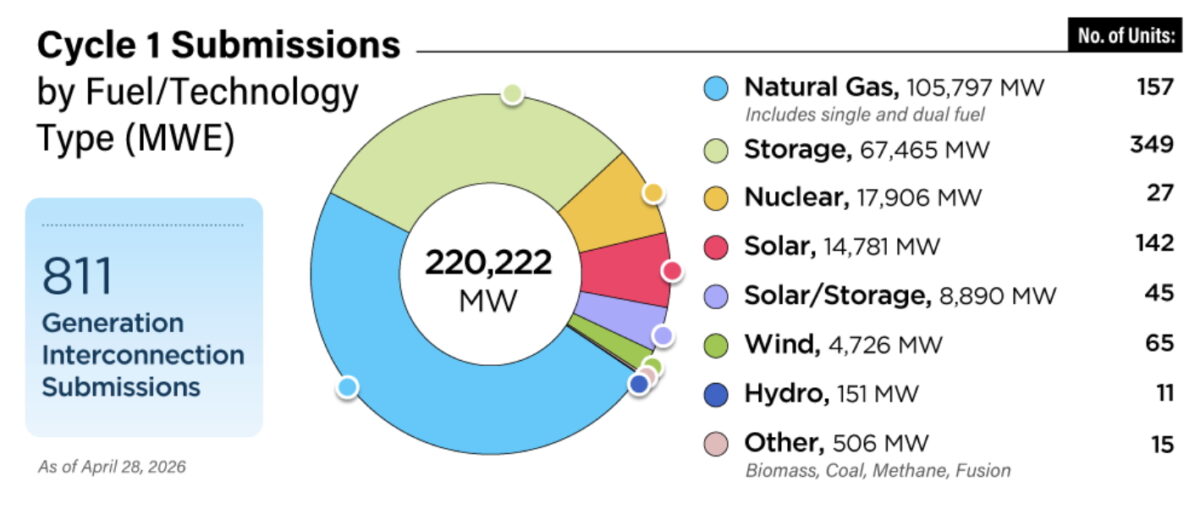





PJM Interconnection, serving the grid region that stretches from Chicago to New Jersey, reports that 811 projects have applied for interconnection studies under its newly reopened standard interconnection process.
To build a generating project, a developer must request an interconnection study and then agree to pay the cost, as determined by the study, to interconnect the project to the grid.
Natural gas projects dominate PJM’s new interconnection queue, at 106 GW of capacity. Storage is next at 67 GW, then nuclear at 17 GW, solar at 15 GW, solar-plus-storage at 9 GW, and wind at 5 GW.
PJM, whose new process uses a first-ready, first-served approach, is now validating which projects have made up-front financial commitments and demonstrated site control, qualifying them to move forward. The previous first-come, first-served approach was seen as contributing to more speculative requests that contributed to PJM’s backlog.
To help review applications, PJM is using an AI-enabled tool developed by Tapestry, a firm spun out by Google.
PJM said in a statement that its current process “is designed to be a one- to two-year process, depending on the impact of an individual project.”
The nonprofit group RMI has recommended that PJM use automation software by providers such as Pearl Street and Nira Energy to complete interconnection studies quickly, potentially in just ten days.
Advanced Energy United this week also called on PJM to increase automation and the use of artificial intelligence tools “to speed up the queue.”
Doubling the pace of adding solar and storage in the PJM region could save $178 billion by 2035, found a study that AEU sponsored earlier this year.
PJM’s reopening of the queue “is a welcome sign of progress,” said Jon Gordon, a senior director at AEU, “and our industry is eager to see whether PJM is able to study and connect new energy projects more quickly going forward.”
Gordon, who said he is looking for PJM to more quickly connect low-cost clean energy and storage to the grid, called for “continuous reforms that speed projects through study, planning, and construction” while enhancing transparency and preventing future backlogs.
Advanced Energy United called on PJM to “explore a more predictable, proactive approach to interconnection, borrowing from the Southwest Power Pool’s innovative Consolidated Planning Process” that was recently approved by the Federal Energy Regulatory Commission (FERC).
AEU’s other recommendations are for PJM to:
- Commit to achieving the FERC-mandated, 150-day study timeline
- Prioritize the most cost-effective solutions for resolving reliability violations
- Reform the energy-only interconnection track
- Ensure that surplus interconnection pathways are workable in practice
- Develop streamlined study processes for new generation exclusively serving new loads
- Ensure interconnection costs are reasonable
- Work collaboratively with states, transmission owners, and developers to address delays that occur after an interconnection agreement.
The consultancy Grid Strategies said in a report last year that PJM’s “very slow” pace of interconnecting new generating capacity in recent years will cost consumers “as much as $7 billion” in 2026, due to higher prices in PJM’s capacity auction. Advanced Energy United sponsored the study.
PJM said in its statement that since 2020 it has processed more than 300 GW of projects, with 103 GW of those reaching a signed interconnection agreement. “Many of these projects” are not being built or are being slowed by state permitting hurdles or supply chain backlogs, PJM said, adding that it is working with stakeholders in industry and government to “help projects get built.”
The Sierra Club claimed in a lawsuit last year that PJM’s recent Resource Reliability Initiative, a process to study projects outside of its standard interconnection queue, would allow large gas-fired power plants to jump the interconnection queue, bypassing renewable energy projects that had been waiting in the queue for years.
This content is protected by copyright and may not be reused. If you want to cooperate with us and would like to reuse some of our content, please contact: editors@pv-magazine.com.






By submitting this form you agree to pv magazine using your data for the purposes of publishing your comment.
Your personal data will only be disclosed or otherwise transmitted to third parties for the purposes of spam filtering or if this is necessary for technical maintenance of the website. Any other transfer to third parties will not take place unless this is justified on the basis of applicable data protection regulations or if pv magazine is legally obliged to do so.
You may revoke this consent at any time with effect for the future, in which case your personal data will be deleted immediately. Otherwise, your data will be deleted if pv magazine has processed your request or the purpose of data storage is fulfilled.
Further information on data privacy can be found in our Data Protection Policy.