





Tandem PV has opened a commercial demonstration factory in Fremont, California, marking a transition for perovskite-silicon technology from laboratory development to repeatable manufacturing at scale.
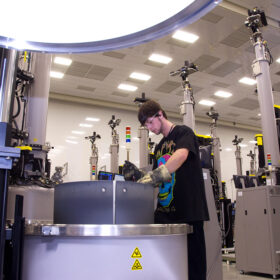
The 65,000-square-foot facility features approximately 40 MW of annual nameplate capacity and is producing tandem solar panels that are roughly 60 times larger than the company’s initial research-scale devices.
By stacking a thin perovskite light-absorbing layer onto a conventional silicon solar cell, the technology captures a broader portion of the solar spectrum to increase power density. The company has reported internal testing results of 29.7% efficiency and aims to provide a higher-output alternative to standard silicon modules as land and balance-of-system costs continue to represent the majority of utility-scale project expenses.
The manufacturing expansion comes at a critical moment for the domestic solar supply chain as rising electricity demand, fueled by AI workloads and data center growth, places renewed pressure on capacity. Project developers are increasingly looking for hardware innovations that can maximize energy production from a fixed footprint.
Tandem PV said its latest-generation panels have shown improvements in durability, with accelerated lifetime testing demonstrating less than 1% average annual power loss, a performance metric intended to meet the 25-year reliability standards required for utility-scale deployment.
The Fremont site is designed to validate large-format production and accelerate market adoption by demonstrating that the advanced materials can be manufactured reliably within the United States. While the industry has navigated long-standing questions regarding the stability of perovskites, the move toward commercial-scale production reflects a pivot toward hardware that can offer lower levelized costs of energy through increased efficiency.
The company said it plans to ship initial modules for customer validation trials later this year, with a goal of reaching high-volume manufacturing by 2028.
Federal and state policy continues to play a role in the reshoring of advanced solar manufacturing, with the company receiving support from the U.S. Department of Energy and the California Energy Commission. As global energy markets remain volatile, the push for domestic leadership in next-generation solar technology remains a strategy for strengthening supply chain resilience. The facility represents a broader effort within the sector to move beyond incremental silicon gains and deliver the kind of breakthrough engineering necessary to meet shifting system reliability needs.
This content is protected by copyright and may not be reused. If you want to cooperate with us and would like to reuse some of our content, please contact: editors@pv-magazine.com.






By submitting this form you agree to pv magazine using your data for the purposes of publishing your comment.
Your personal data will only be disclosed or otherwise transmitted to third parties for the purposes of spam filtering or if this is necessary for technical maintenance of the website. Any other transfer to third parties will not take place unless this is justified on the basis of applicable data protection regulations or if pv magazine is legally obliged to do so.
You may revoke this consent at any time with effect for the future, in which case your personal data will be deleted immediately. Otherwise, your data will be deleted if pv magazine has processed your request or the purpose of data storage is fulfilled.
Further information on data privacy can be found in our Data Protection Policy.