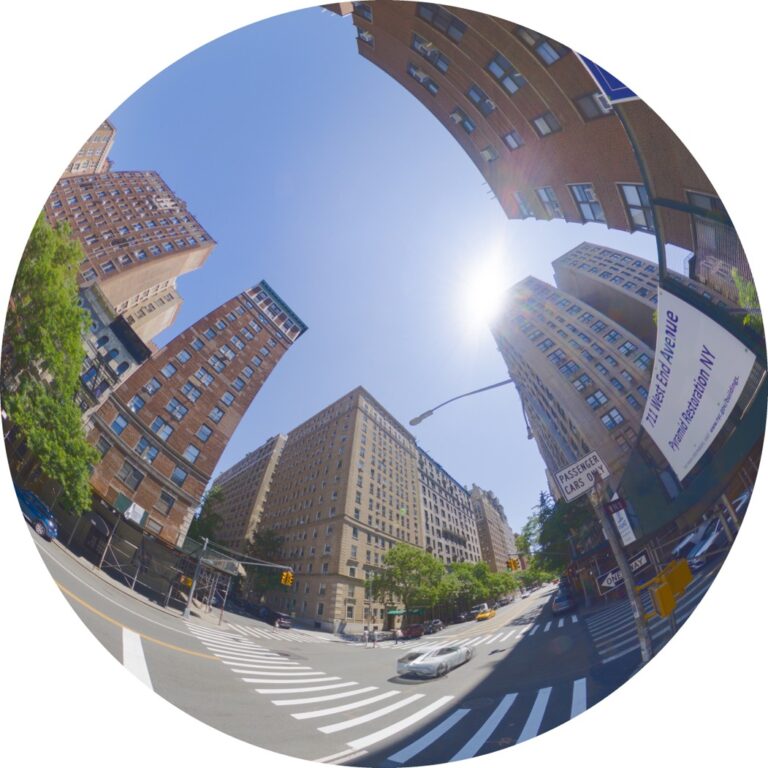





Researchers at Columbia University in the United States have create a new technique to measure solar irradiance at any location by using a single equirectangular image.
The method uses a single hemispherical image taken at the panel location to infer scene geometry, sky visibility, and illumination conditions, which are then used to forecast future solar irradiance over time.
“Our method can be used in two settings,” corresponding author Shree K. Nayar told pv magazine. “First, prior to installing a panel at a specific location on a rooftop or a vertical wall, the method can be used to determine the annual energy the panel would produce. Second, in the case of a panel that is pole-mounted in an urban canyon, we can determine what the best orientation of the panel would be.”
Nayar explained that the only other way to obtain energy forecasts for solar panels is by using 3D city models. In this case, graphics simulations are used to estimate the energy received by a panel.
“Unfortunately, these 3D models are simply not accurate enough to provide precise energy estimates,” he went on to say. “This is because the reflections and shadows cast on a panel are not just affected by large buildings but also small objects such as signs, HVAC vents, parapets, and window sills, which are often missing in 3D scans of cities. A small vent close to a panel could have the same effect as a large building across the street.
The novel approach uses a 360° high resolution, high dynamic range image captured on-site, which reportedly enables to capture details of the surrounding structures, small and big, while also providing useful cues related to the reflectances of the structures around the panel.
Since inertial sensors (IMUs) are unreliable in urban environments due to magnetic disturbances, this method instead relies on visual cues. These are observable features in an image—such as shadows, edges, textures, lighting patterns, and structural lines—that provide information about a scene’s geometry, orientation, and illumination.

The proposed technique relies on a neural network that is trained to predict both sun and gravity directions from the image. Training is performed on large-scale synthetic hemispherical images and fine-tuned on real urban datasets. Once sun and gravity vectors are estimated in camera space, they are matched to their Earth-frame counterparts computed from time, date, and GPS.
The method forecasts solar panel irradiance by modeling both sky and scene illumination over time. This allows prediction of how sky contribution changes with future sun positions and weather conditions. The sun’s contribution is computed geometrically based on whether it falls within the visible sky aperture.
In parallel, irradiance from surrounding buildings is modeled separately, leveraging the insight that scene illumination varies smoothly and is scale-invariant. Finally, the total irradiance is obtained by summing sun, sky, and scene components across time.
“One of the interesting aspects of our algorithm for estimating the irradiance incident on a panel is that it not only computes the contribution of the sky, but also the contribution of the structures around the panel,” Nayar emphasized. “We refer to the latter as the scene irradiance component and have found that, on average, it represents about 12% of the energy received by the panel.”
The method was validated in four urban environments using a single hemispherical image per site and ground-truth measurements from a pyranometer. Across rooftops and deep urban canyons, the model was found to “accurately” track daily irradiance under clear, partly cloudy, and overcast conditions. It “correctly” captured sharp changes caused by the sun entering or leaving the sky aperture, especially when the sky is unobstructed, with errors remaining low overall, though they increase slightly in more complex lighting conditions.
“This technology is inexpensive and portable, making it usable by both homeowners as well as large companies during the planning stage of a solar project to maximize the return on their investment,” Nayar said. “Right now, that process is slow, expensive, and approximate at best.”
“Our approach can also be used to assess panels mounted on vertical walls. Facades of tall buildings represent a major opportunity as they have far larger surface areas than rooftops. The sides of tall buildings often receive more direct sunlight than the roof,” he concluded.
The new methodology was presented in “Forecasting solar energy using a single image,” published in Solar Energy.
This content is protected by copyright and may not be reused. If you want to cooperate with us and would like to reuse some of our content, please contact: editors@pv-magazine.com.


Sounds just like the Solar Pathfinder that has been around for some 20 years. Just a different way of doing the same thing.
I’m demonstrating a Solar Pathfinder this weekend to an architectural student.