Solar and wind take over global power growth in 2025
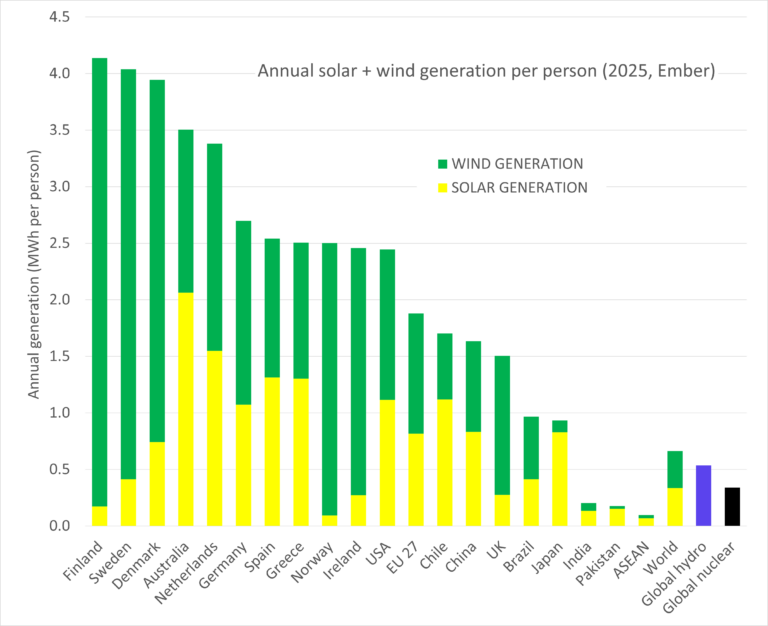
In 2025, solar and wind provided about six times more new generation capacity (Gigawatts) than everything else combined, including coal, gas, nuclear, hydro and all other renewables.
Annual electricity generation from solar and wind are approximately equal, although solar has considerably faster growth rate and is expected to pull ahead.
The leading countries for combined per capita solar and wind generation are Finland, Sweden, Denmark, Australia and the Netherlands, at 3-4 Megawatt-hours (MWh) per capita per year.
Australia and the Netherlands lead for per capita solar generation, while Scandinavia and Ireland lead for per capita wind generation.
Typical electricity demand in advanced economies is 5-12 MWh per capita per year. This will increase to 20-30 MWh per capita per year to accommodate electrification of vehicles, industrial heating, chemical and metal production, and synthetic aviation and shipping fuels. Almost all this additional electricity will come from solar and wind.
Notably rapid per capita deployment of new solar and wind in 2025 occurred in Australia, China, Chile, Finland, Netherlands and Pakistan. The latest war in the Middle East may spark rapid uptake of solar and wind in many countries, coupled with rapid electrification of land transport and heating.
Growth in net nuclear generation and capacity (after accounting for retirements) was approximately zero, as has been the case for the last 30 years. There is no sign of a significant nuclear renaissance. Solar and wind each generate as much electricity as nuclear and are each also rapidly catching hydroelectricity.
In 2025, new solar and wind capacity provided nearly all the additional electricity required to meet global growth in electricity demand arising from rising population, rising affluence, and electrification of transport, heating and industry.
New power plant construction is now heavily focused on solar and wind, together with development of financial arrangements, skilled people and supply chains. Further growth in solar and wind capacity comes from a very large construction industry compared with the fossil and nuclear industries, which allows for much faster growth at lower cost.
The top solar and wind performers are in Europe, apart from Australia. European countries share electricity across national borders, which assists with the balancing of variable solar and wind.
Australia is a global solar pathfinder because it is physically isolated and low-mid-latitude (where 80% of the global population lives). By 2030, Australia is expected to reach 82% renewable electricity (mostly solar and wind). The energy transition in Australia has been straightforward.
Australian solar and wind is supported by about 18 kWh per person of pumped hydro and battery storage, which is very large by global standards. Because this rechargeable storage cycles many times per year, it is equivalent to once-through storage (in the form of hydroelectricity, biomass or hydrogen) that is 30-100 times larger.
Total European premium-class pumped hydro storage potential outside national parks is about 1200 Terawatt-hours, which is vastly larger than required. It will not be necessary to deploy large-scale biomass, hydrogen or CAES storage.
Solar and wind provide the cheapest, lowest emissions, most reliable and most resilient energy in history. At current growth rates, combined solar, wind and hydro generation will catch combined coal and gas generation in 2030.
Authors: Prof. Ricardo Rüther (UFSC), Prof. Andrew Blakers /ANU
ISES, the International Solar Energy Society is a UN-accredited membership NGO founded in 1954 working towards a world with 100% renewable energy for all, used efficiently and wisely.
Please login to comment