




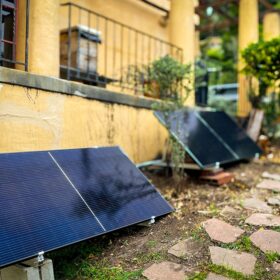
As the U.S. agricultural sector grapples with soaring input costs and a volatile commodities market, a growing number of farmers are turning to solar leasing as a stable “third crop” to ensure their land remains in the family for the next generation.
U.S. family farmers are navigating a period of intense economic volatility. Input costs for essentials like fertilizer and diesel continue to climb while receding international markets and cratering commodity prices have tightened margins to the breaking point.
Today, thousands of farms are choosing to integrate solar energy into their operations to stabilize income and preserve their land for future generations. For many, this is a pragmatic business decision that balances risk with long-term stewardship. However, as solar adoption grows, a wave of local restrictions threatens to strip farmers of their right to decide how to best manage their own property.
Unlike traditional crops that are subject to unpredictable weather and global market shifts, solar leases offer a predictable income stream. Such reliability is a rare commodity in agriculture today. According to data from the Purdue University–CME Group Ag Economy Barometer, over 50% of farmers discussing solar leases in early 2024 were offered annual payments of $1,000 per acre or more.
Guaranteed solar revenue often beats the net return of traditional crops on the same acreage. For many multi-generational farms from Oklahoma to Iowa, this cash flow prevents the land from being sold off for housing. In California’s Central Valley, solar provides a lifeline for parched soil that can no longer be irrigated, making use of land in water-restricted zones.
Critics of rural solar often cite concerns over the loss of prime farmland, yet data from the Solar Energy Industries Association (SEIA) suggests fears are largely misplaced. By the end of 2024, only about 0.05% of American farmland had been affected by solar development, said SEIA.
To put that in perspective, urban expansion and residential sprawl accounted for 95% of farmland loss between 2001 and 2016.
Golf courses alone currently cover three times more prime farmland than utility-scale solar. Even in a long-term scenario where the entire U.S. grid is decarbonized, the Department of Energy estimates that the land required would total roughly 0.5% of the contiguous U.S. land area. A footprint of that size is equivalent to the land currently used for surface coal mining, said SEIA in its analysis of federal land-use targets.
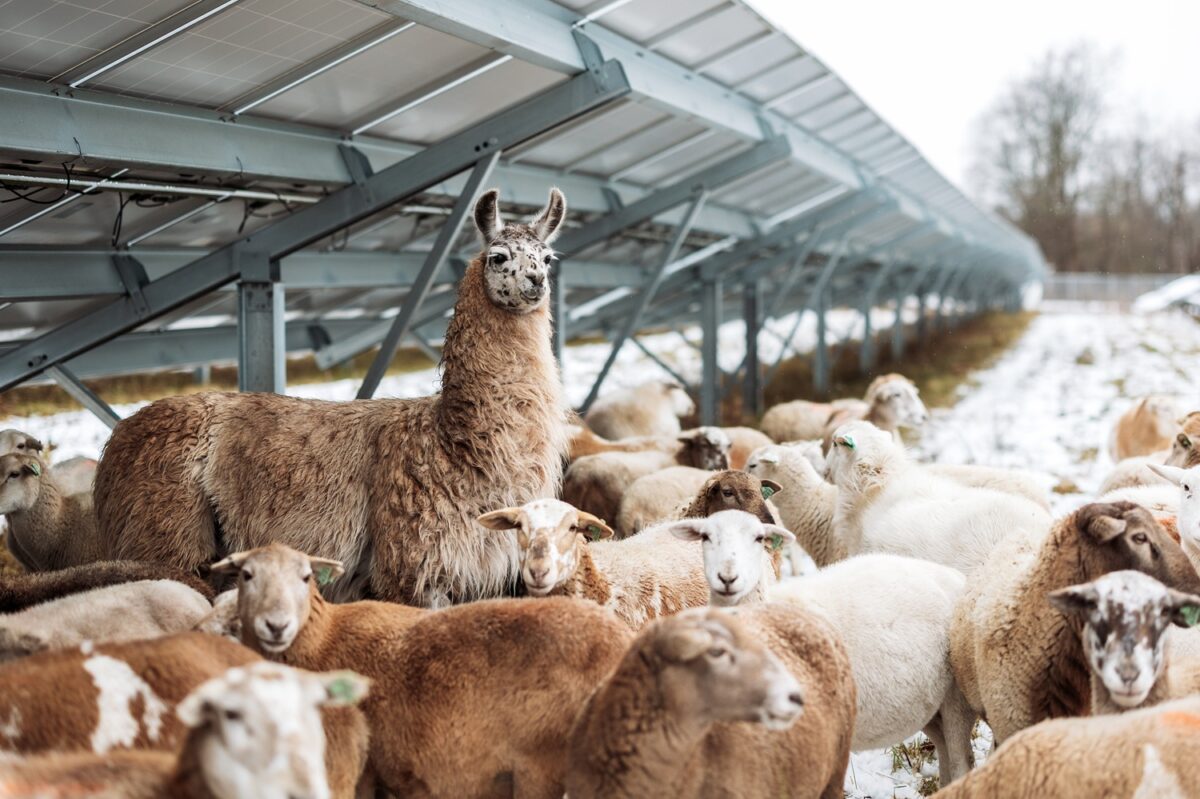
The solar vs. food debate continues to diminish thanks to the rise of agrivoltaics, or the practice of co-locating solar with agriculture. Managed sheep grazing reduces vegetation management costs while maintaining soil health and providing a second revenue stream for livestock owners. And high-value crops like leafy greens, peppers, and berries often thrive in the partial shade provided by panels, said SEIA.
According to a study published in Nature Sustainability, growing crops like cherry tomatoes under solar panels can double yields and improve water efficiency by 65% because the shade reduces evaporation. These farmer-led innovations provide local ecosystems with significant co-benefits, said SEIA.
Despite documented benefits, a growing number of local governments are enacting restrictions or outright bans on solar development on agricultural land. In Ohio, local officials recently used state law to block a project that would have provided farmer Wayne Greier with $540,000 in annual lease payments. He intended to use funds to settle mounting medical debt and keep his farm operational.
Legislative hurdles do more than just block clean energy; they remove decision-making power from the hands of the people who have managed the land for generations. Solar serves as a tool for rural resilience by adding to the local tax base, contributing an estimated $12 billion in Texas alone. Strengthening the tax base supports the infrastructure that keeps rural communities thriving.
This content is protected by copyright and may not be reused. If you want to cooperate with us and would like to reuse some of our content, please contact: editors@pv-magazine.com.



Why are they being blocked?? What is the reasoning?? How is this not relevant to the story. The fact that you intentionally left out half of the story just leads me to assume there must be some legitimate reason that you can’t counter.
Just more fake “journalism”.
Great article! One of the most concise argument for agrivoltaics I have seen. Thanks!