




Part 1 of this report explains that while medium-duration competitors (ESS and EOS) are struggling against plummeting lithium-ion prices, Form Energy is carving out a niche with its 100-hour iron-air technology. By securing massive projects like Google’s 30 GWh installation, the company is proving it can scale its unique long-duration product to fill a critical market gap that standard lithium batteries cannot cost-effectively reach.
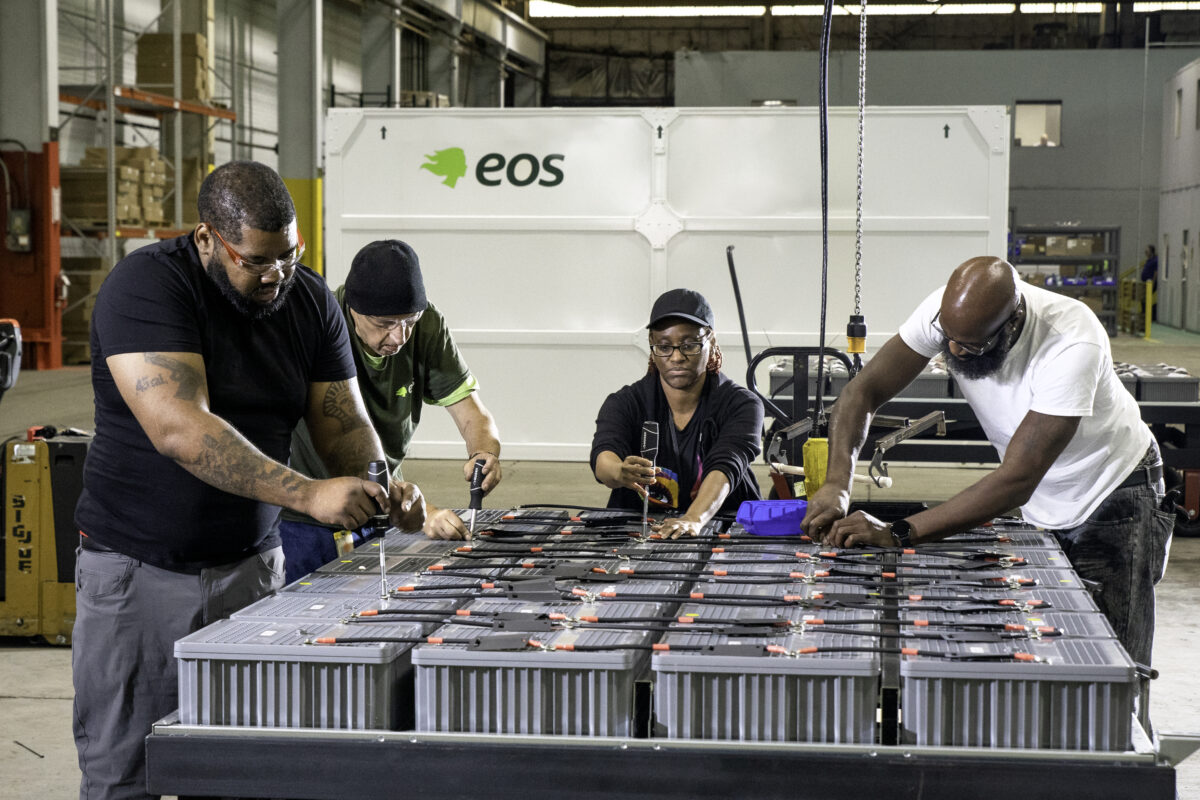
EOS Energy has also gone through a lot of challenges. Various administrations of the company have been pivoting since the early 2010s. Now they’ve gotten some solid footing by signing a healthy volume of deals. As well, they’re building a second facility to cumulatively reach 8 GWh zinc air flow battery manufacturing facility after finally closing on federal government loans.
No small feat in these most recent political days.
The company offers a five to twelve hour flow battery, and suggests minimal degradation.
Additionally, they’ve put out some strong looking data at the end of 2025, including:
- $58.0 million record Q4 revenue, 3-4X revenue projected in 2026
- $240 million recently “secured”, nearly 1.1 GWh of new orders in Q4 from eight customers
- Executed a $600 million senior convertible notes issuance, ended year $624.6 million cash
The company is also about to launch their new platform, the “Indensity”. It aims to deliver 1 GWh per acre – catching up with lithium’s density.
While EOS does not publish any pricing, the company says they aim to deploy products below $100/kWh. Looking at their 2025 backlog of $701.5 million against 2.8 GWh of capacity-a price of $251/kWh is their current blended contracted price.
There are hints of lower pricing with their new high density technology. The company’s big order announcement at the end of 2025 was $240 million for 1.1 GWh – suggesting a price of $218/kWh (though EOS also gets a $45/kWh tax credit).
A respectable 13% price decline from $250/kWh.
However, after recent positive feedback in terms of stock price, and stating in their first quarter financial presentation that they’ve completely shed the “going concern” questions, they still did disappoint the market.
The company missed their fourth quarter earnings by a large margin, spent large amounts of cash in 2025, had manufacturing and deployment challenges, and the projections that analysts were hoping for in 2026 missed the mark.
The Stalking Horse(s)
In parallel to all of this medium and long duration hard work and technology are lithium based products. Products which aren’t in any way slowing down, and might just be getting going. Products that are deploying in massive volumes and advancing rapidly on learning curves.
One energy storage event, two recent technology announcements, procurements, and Chinese five-year plans are widening the Overtone window on lithium potential.
California’s power grid, for possibly the first time, was partially run on sunlight for well beyond 24 hours straight. It was mostly four-hour lithium batteries that allowed the sun to shine overnight.
Long duration, which are classified as 100 hour and longer type energy storage mediums, aren’t being designed for overnight use, but for mitigating a longer term fear. The fear comes from dunkelflaute (“dark doldrums” in German) type events, when winter time low wind, and less sun periods arise. Stringing together batteries that are expected to charge up the next morning isn’t currently modeled as viable.
Two manufacturers have recently put out lithium ion products that are specifically designed for longer durations.
Among the first products to explicitly break through the four-hour lithium wall is the Hithium ∞Cell 1300Ah. The company is deploying them in the ∞Power8 6.9 MW/55.2 MWh system, described as the world’s first “native” eight-hour lithium battery solution.
The manufacturer says the product is specifically designed and aimed at longer duration output, versus taking 2 and 4-hour designed cells and reconfiguring them. For instance, Hithium claims to cut the cost of current-carrying components such as foils by more than 50% compared with two-hour cells, while maintaining safety and durability.
Now the world’s largest car electric manufacturer has released an even larger battery cell and said they believe it represents “a milestone that could reshape the economics of large-scale storage.”
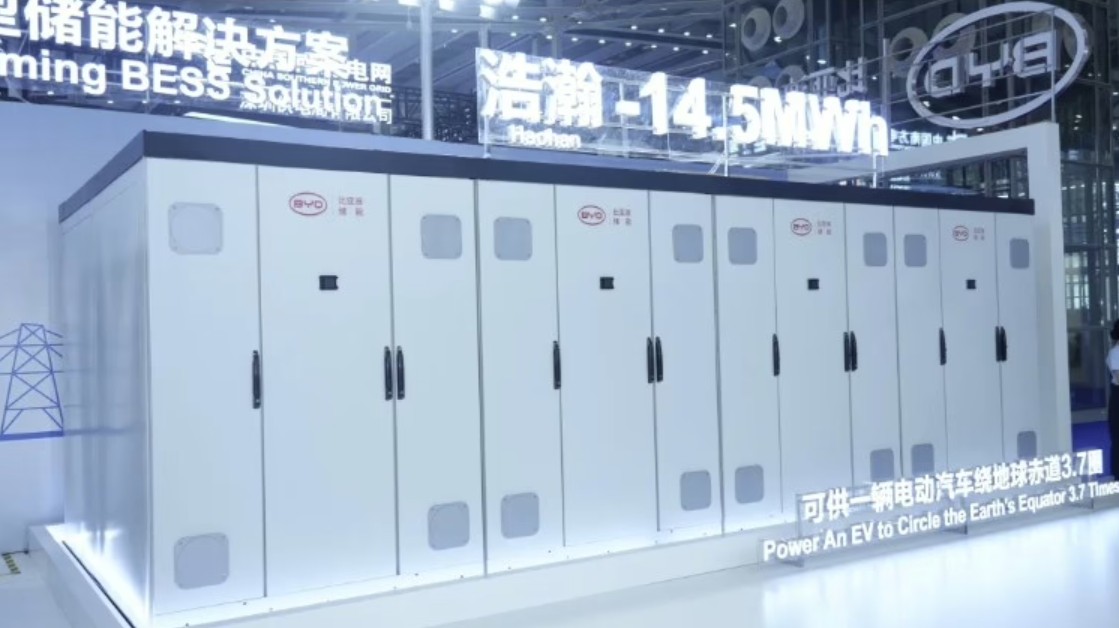
BYD’s 2,710 Ah Blade Battery cell, which the company claims is the largest energy storage cell in the world, is said to have “a total lifecycle cost per kilowatt-hour below CNY 0.1 ($0.014)”.
If the basic cost of a battery prior to incentives and profits is a penny and a half, and the daytime solar electricity is “free” or at least heavily discounted due to overproduction, then wholesale electricity delivered from these units is going to be highly competitive with other sources.
Vincent Shaw of pv magazine and ESS News, based in China, commented that we should be paying close attention to what’s going on in China with an open mind.
First off, their most recent five-year plans has made energy storage as a key industry to be supported – much like solar was. This will mean massive growth and significant experimentation.
Long-duration storage will be a focus of the market. In addition to electrochemical energy storage, there will be a variety of technical approaches, like compressed air energy storage (CAES), flywheel, flow battery, and supercapacitor energy storage. Even for electrochemical energy storage, sodium-ion battery technology is expected to develop and capture a portion of the market of lithium-ion batteries. We will see many interesting things about energy storage in the next five years.
Shaw projects that energy storage installation capacity will reach a high figure by the end of the coming five years. He suggested watching how China massively expanded their solar capacity over the last five years, and will outpace the rest of the world combined within their own borders.
Shaw finishes by saying, “Don’t be surprised if we see 1 TWh of energy storage installation (in a single year) achieved in the near future.”
This content is protected by copyright and may not be reused. If you want to cooperate with us and would like to reuse some of our content, please contact: editors@pv-magazine.com.


Great set of articles!
Please consider completing the article set with an LCOE analysis for soar and storage.
And, if you wanted to be heroic, I’d love to see a reliable analysis of the additional electrical energy needs for all of California to be decarbonized — meaning the additional electrical needs to support decarbonization of transportation, industry, processing, buildings, ag, etc..
Thanks!
Eos is not a flow battery.