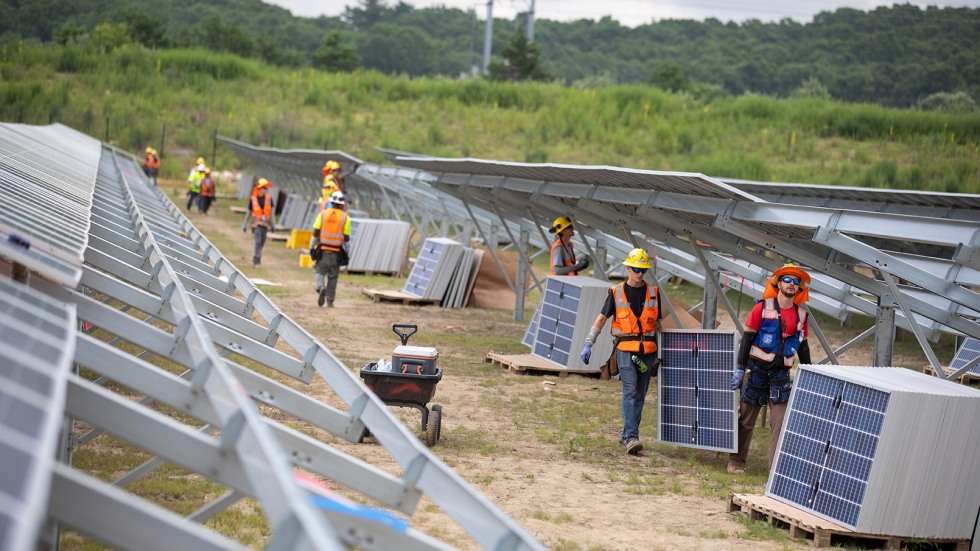





The U.S. solar industry faces a critical shortage of skilled labor as developers rush to meet the July 4, 2026, construction deadline mandated by the One Big Beautiful Bill Act (OBBBA).
Analysis from the 2025 U.S. Energy & Employment Report (USEER) and the IREC National Solar Jobs Census reveals that while the industry now supports over 280,000 workers, the supply of qualified personnel is failing to keep pace with accelerated project timelines.
Projections suggest the industry requires approximately 355,000 workers by late 2026 to support installation targets of 60 GW to 70 GW, leaving a projected near-term gap of 53,000 positions.
Hiring difficulty remains a systemic challenge, with 86% of solar employers reporting some level of difficulty filling open positions according to the 2025 USEER. This issue is most acute in the utility-scale sector, where 27% of firms describe hiring for installation and project development roles as very difficult.
The talent gap is particularly pronounced for mid-level technical roles and management positions, with 47% of firms reporting significant hurdles in hiring directors and supervisors. The shortages are primarily driven by a lack of candidates with specialized industry experience, technical training, or specific certifications required for increasingly complex high-voltage and AI-integrated systems, said USEER.
The 2026 apprenticeship mandate adds a layer of regulatory pressure to existing labor shortages. Under current federal guidelines, projects must ensure that 15% of total labor hours are performed by qualified apprentices to secure the full value of the Section 45Y and 48E tax credits.
However, the Interstate Renewable Energy Council Census indicates that only 43% of the U.S. workforce currently has access to the skills training necessary for these roles. This disparity is forcing a shift in how the industry approaches workforce development, as Tier-1 developers move away from third-party labor providers to build internal training pipelines.
To bridge the gap, the sector is increasingly focused on attracting veteran candidates and workers from transitioning fossil fuel industries. Efforts are complemented by the deployment of digital documentation tools and automated site-tracking software, which allow smaller teams of expert journey-level workers to oversee larger groups of semi-skilled laborers.
In 2026, the ability to secure a compliant, documented workforce has become a determining factor in project bankability, along with interconnection and supply chain stability as leading development risks.
This content is protected by copyright and may not be reused. If you want to cooperate with us and would like to reuse some of our content, please contact: editors@pv-magazine.com.






They should do away with these labor section 45Y and 48E tax credits on these projects. It is becoming harder and harder (and will only get worst as time passes) to meet these requirements as the two year apprentice time line happens pretty quickly and to fill those spots behind the new JM is difficult. We should go back to how it use to before the IRA and let companies train their own people with all this hassle.
The International Brotherhood of Electrical Workers (IBEW) already has a fully developed apprenticeship program covering the United States and Canada. Apprentices, journeymen, Forman and project supervisors are all available to go to work right now. The fact most of these projects want only cheap labor rather than skilled labor to keep cost down and profits up, the added cost per set panel by skilled union labor only adds 5% to 7% to the bided price but adds quality of workmanship to cause less call-backs when the project is done. The IBEW and the National Electrical Contractors Association (NECA) have the management and labor skills to do work anywhere in North America. Permanent installations deserve permanent industrial equivalents and for over one hundred years, the IBEW and NECA have built America’s and Canada’s infrastructure strong.
This is exactly what we’re seeing across the market right now. The gap isn’t just about volume, it’s about access to qualified, compliant, and project-ready talent at the pace these timelines demand.
At The Imagine Group, we’ve been supporting solar manufacturers, EPCs, and developers through similar challenges, whether that’s rapid workforce ramp-ups, hard-to-fill technical roles, or building out project teams under tight deadlines.
The apprenticeship and compliance component is also a big shift. It’s not just hiring anymore, it’s about structured workforce strategies, documentation, and alignment with evolving federal requirements.
There’s a real opportunity here for organizations to rethink how they approach talent, leveraging supplemental partners, expanding sourcing strategies, and building scalable pipelines that can flex with demand.
The next 12–18 months will be critical, and the teams that can align workforce strategy with project timelines are going to be the ones that stay ahead.
If anyone is navigating similar challenges and wants to connect, always happy to be a resource: aperez@imaginestaffing.net.