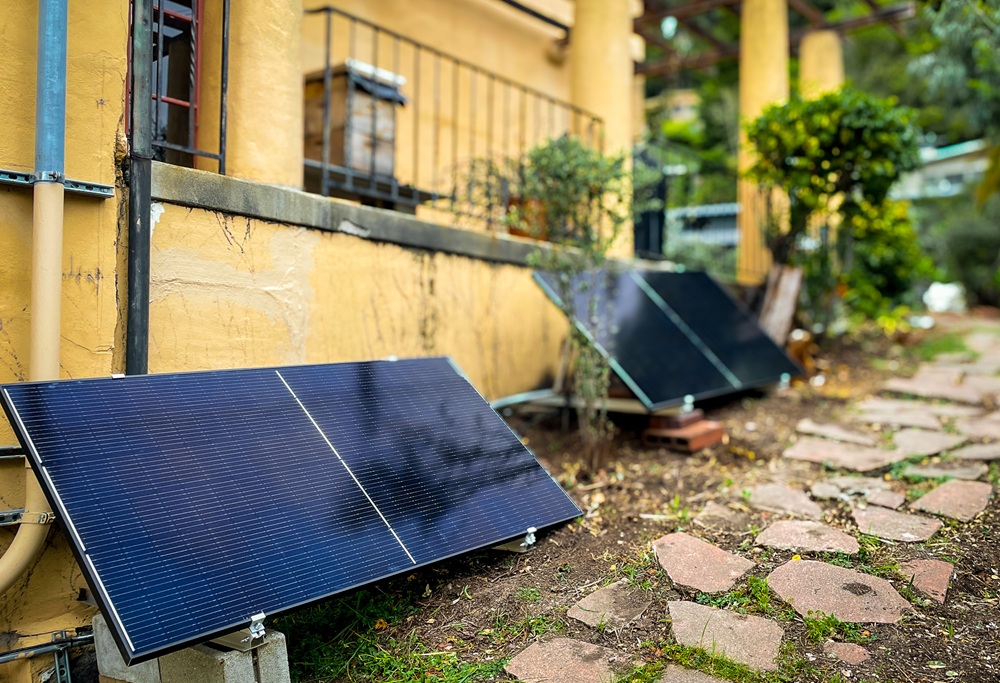





In a span of less than 24 hours across April 13 and 14, 2026, Maryland and Colorado became the fourth and fifth states to advance plug-in solar legislation to their respective governors’ desks.
The two states join Utah and Maine, where such legislation has been signed into law, and Virginia, in which plug-in solar rules were passed by both chambers and sent to the governor, who returned it to request minor tweaks to the bill’s language.
The bills’ passage is the latest in what has been described as a movement to enact solar laws around the United States.
In total, 33 states plus the District of Columbia have seen bills introduced into legislative bodies. However, measures in at least 10 of those places have either failed or been held over until the next legislative session, and legislators in several other states have taken no action on the bills in recent weeks.
Maryland’s plug-in solar rules
In Maryland, portable solar language was included in HB 1532, known as the “Utility RELIEF (Reducing Energy Load Inflation for Everyday Families) Act.” The bill is a sweeping legislative package that includes provisions that allocate funding for energy bill relief, grid modernization, and renewable energy investment.
The bill allows residential electricity customers to use portable solar energy generating systems with a maximum output of 1,200 watts that is designed to feed power into a standard outlet and is certified by UL or an equivalent national testing lab, per utility meter. Devices with power output of 391 watts or less are exempt from the UL certification requirements.
The bill exempts these systems from utility fees and interconnection requirements, but requires customers who use the devices to notify the utility, provide information about their system, and, if required by the utility, to pay for the installation of an automatic locking disconnect switch.
Governor Wes Moore is expected to sign the bill, which was a major part of his legislative agenda for the session. If he does, the plug-in solar rules will take effect on October 1.
Colorado’s plug-in solar rules
Colorado’s HB 26-1007 contains provisions related to both plug-in solar and meter-collar adapters. The bill allows “portable-scale solar generation devices” with up to 1,920 watts of power output that connect directly into standard wall outlets, as long as they are labeled and listed by a national testing laboratory (eg. UL).
The 1,920-watt limit is the highest such limit among plug-in solar laws passed in the United States. Devices with power output of 391 watts or less are exempt from the listing requirements.
The bill also prohibits landlords from preventing the installation of a portable solar generation device, but requires tenants to notify the landlords, and allows landlords to set rules for preventing fire and electrical overload of the apartment’s circuits. HOAs are also prohibited from preventing the installation of portable solar devices, as long as the devices are properly attached and secured.
Colorado governor Jared Polis is expected to sign the bill. If he does, the rules will take effect on January 1, 2027.
This content is protected by copyright and may not be reused. If you want to cooperate with us and would like to reuse some of our content, please contact: editors@pv-magazine.com.




…I am very concerned about the 1920-watt rating on 15-amp 1800-watt circuits. Most electrical outlets are on #14 AWG wire and only Kitchen and laundry circuits be required to have 20-amp #12 AWG wire with 2400-watt circuits that would qualify the 80% of rated load rule 1,920 watts using #12 wire and 20-amp circuit breakers or fuses. The 80% rule on #14 wire with a rating of 1,800 watts is 1440 watts. “Plug and Play” plug in solar going through the legislative process in California SB-868 Portable solar generating devices is setting the limit at 1200 watts so even the lowest sized wire and breakers could carry the output. Since the average homeowner does not know electrical systems and electrical codes, they cannot be trusted to find the correct size circuits to plug in the 1920-watt panel system.
… The idea of user installed solar need to fit the electrical system of any available electrical outlet without overloading it without the need for additional wiring needed that requires local permitting, approval, utility approval and fees. Over the period of one year, most grid tied solar panel systems will produce 1.2 to 1.4 kilowatts per watt installed and if the average house usage per hour over the course of a day is like mine of 800- watts per hour would be covered by a 1200-watt system during most daylight hours. Utilities will not be required to give any credit for excess electricity and will just keep it with no banking at all. Oversizing the system, in most cases, will only fatten the utilities profits while costing the homeowner more at time of installation if batteries are not incorporated into the system, as a buffer, and that adds a lot of cost that may not be needed.
… A system that puts out 1920 watts should be on NEM so there can be pay back by the utility. Most utilities have a minimum size of 2,000 watts to be on NEM so adding another 80 watts and getting paid by the utility, for excess power could be worth it, to go NEM instead.
Yes a 15-amp, 120-volt circuit has a maximum rating of 1,800 watts (15A
120V). However, solar panels will not produce continuous loads (running 3+ hours) non stop 1920-wat. While a system may have 2000W microinverter, the actual power output varies based on sun exposure, shading, and panel angle, often averaging lower than the peak capacity. Realistic Output is 820W–860W of total solar panel capacity.
I agree with the comment on wire size. In addition, rapid shut down tech should also be required at the solar panel should emergency power cut or other be necessary. Leaving a generating array remain ON can pose problems.
What is to stop people from plugging in multiple 391 was watt systems?
Agree with your assessment, however a 1200 watt max system could be plugged into any standard 15 or 20 amp receptacle. A 1920 watt max system would more than likely have a 5-20P NEMA plug that could only connect into a 20 amp receptacle. That being said, most household receptacles are not a 5-20R.