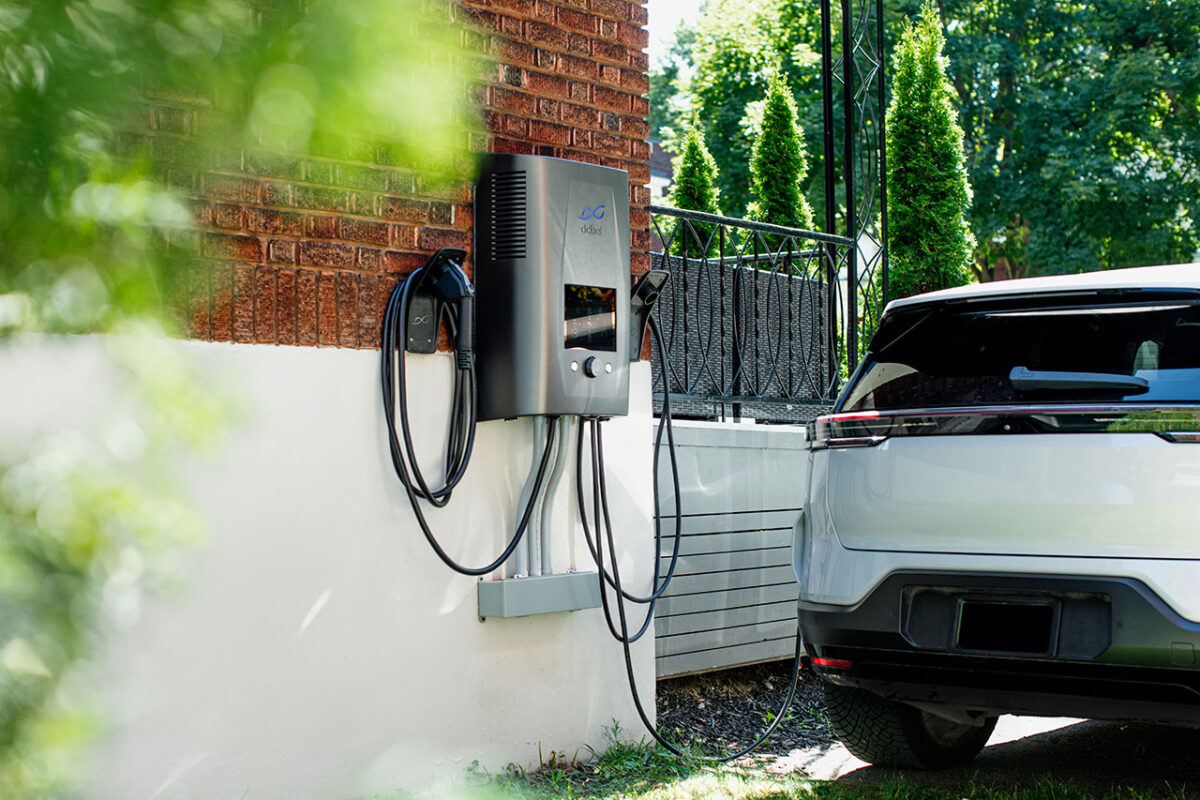





Montreal-based smart energy technology company dcbel (pronounced like “decibel”) is in the process of implementing a California program it calls Ready Deployment with Dynamic Rates, largely funded by the California Energy Commission (CEC) through an initiative called Responsive, Easy Charging Products with Dynamic Signals (REDWDS).
The REDWDS program is designed to accelerate the development and deployment of easy-to-use EV charging products that respond to remote signals to support grid reliability and decarbonization goals.
Dcbel’s key technology is the Ara Home Energy Station, a hardware hub that combines a bidirectional electric vehicle charger, a solar inverter, and a stationary battery management system into a single enclosure.
Powered by the company’s Orchestrate software, the Ara system is designed to learn household energy patterns to optimize power consumption, helping homeowners save money on a dynamic rate schedule. In addition, the system enables vehicle-to-home backup power during grid outages and can export stored energy back to the grid when electricity prices are high.
Under phase 1 of the Ready Deployment with Dynamic Rates program, which runs through December 31, 2026, the company plans to install 200 Ara stations at single-family homes to demonstrate that its products are capable of participation in energy transactions as part of dynamic rate pilot programs.
The dynamic rates programs are experimental utility rate structures that are currently being tested by the state’s investor-owned utilities. The programs use hourly rates that change daily based on expected grid conditions, allowing customers who can shift their usage to lower cost periods to save money.
Solutions like the dcbel Ara system automate this shifting, allowing a customer’s solar and EV battery to power the home or even export power when prices are highest.
Program details for California homeowners
According to the dcbel website, homeowners who participate in the California program can receive up to $13,800 in rebates, including over $10,000 for the Ara unit and installation costs, as well as rebates for interconnection, switching to a dynamic rate plan and owning a bidirectional EV.
While the company is nearing the limit of 200 participants, spots in the program remain available to homeowners who qualify.
“Our interest is in a broad collection of participants,” said Diana Gilmore, U.S. programs lead at dcbel, in an interview with pv magazine USA. Gilmore said the company is looking for homeowners with “diverse use cases” in various places throughout the state, so it can prove its technology works for many different kinds of homeowners.
Participating homeowners can use the Ara equipment to charge (and discharge) their bidirectional-capable electric car to perform peak shaving (using stored energy to avoid drawing from the grid during peak times), and get access to backup power for their homes.
Gilmore says the Ara technology works with any car that uses the ISO 15118 bidirectional standard. The company’s CEC grant award letter specifically lists the Nissan Leaf and Volvo EX90 as compatible cars for phase 1. Cars from Mitsubishi, GM, Hyundai and others are listed as compatible cars for planned phase 2 deployments.
Additionally, Gilmore says dcbel has tested Ara for compatibility with cars from manufacturers that prefer not to publicly disclose that their cars are capable of the technology.
Future CEC funding
The CEC awarded dcbel with more than $52 million in potential funding under the REDWDS initiative in early 2024, but only $2,466,148 in funding for phase 1 of the project was guaranteed. Additional funding of $49,923,904 is available for phase 2 only if dcbel meets certain performance metrics during phase 1.
To qualify for the phase 2 funding, the company must complete the initial deployment to homeowners with electric vehicles, with at least 50% of those customers residing in ZIP codes that represent disadvantaged or low-income communities. The company must also demonstrate that its technology works to perform energy transactions and track and report data to the CEC.
If everything goes well, dcbel plans to expand its offering to thousands of single family homes as part of phase 2. But first, the company must successfully complete phase 1 and obtain permission from the executive director the CEC to proceed to phase 2.
Additionally, stipulations in the initial award make it clear that funding for the REDWDS program beyond phase 1 is not guaranteed.
The Clean Transportation Program, under which the CEC administers REDWDS funding, is currently expected to deliver $95.2 million per year through 2028-29, but the state leaders have recently been grappling with a projected $24 billion budget shortfall over the next two years. A revised budget recently released by Governor Gavin Newsom eliminates the shortfall and makes no changes to CEC funding.
For the time being, dcbel is focusing on executing its phase 1 California plan, as well as serving homeowners in Quebec, where it announced it would enter the market in April.
“We’re at the point where the rubber is hitting the road, so to speak,” said Gilmore. “The technology is being installed at these homes. For anyone who’s been looking forward to this: now is the time. It’s coming to fruition, and that’s very exciting for us.”
This content is protected by copyright and may not be reused. If you want to cooperate with us and would like to reuse some of our content, please contact: editors@pv-magazine.com.


By submitting this form you agree to pv magazine using your data for the purposes of publishing your comment.
Your personal data will only be disclosed or otherwise transmitted to third parties for the purposes of spam filtering or if this is necessary for technical maintenance of the website. Any other transfer to third parties will not take place unless this is justified on the basis of applicable data protection regulations or if pv magazine is legally obliged to do so.
You may revoke this consent at any time with effect for the future, in which case your personal data will be deleted immediately. Otherwise, your data will be deleted if pv magazine has processed your request or the purpose of data storage is fulfilled.
Further information on data privacy can be found in our Data Protection Policy.