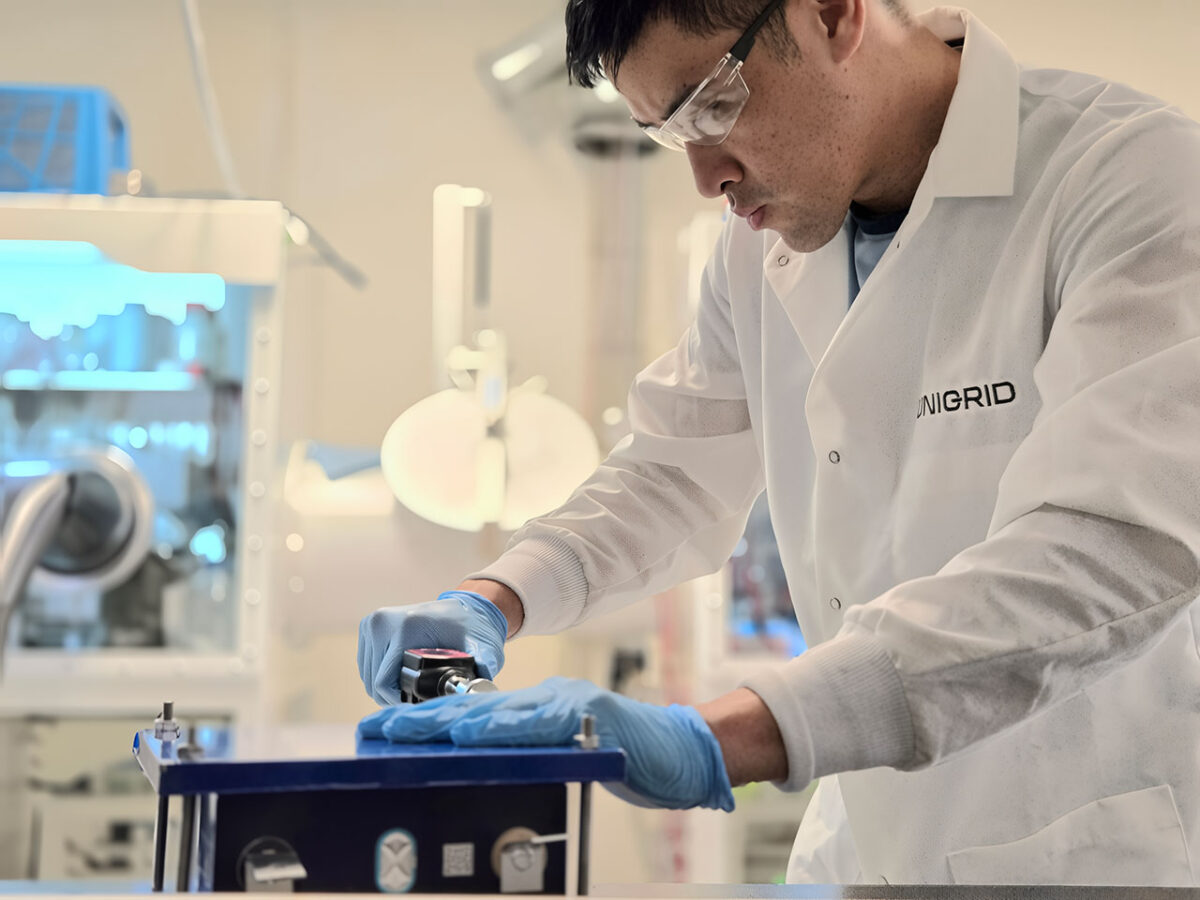





Darren Tan, CEO of San Diego-based battery technology company Unigrid, thinks the energy storage industry can learn a thing or two from Dropbox and Google Drive.
His company has developed a unique sodium chromium oxide battery chemistry that testing has shown retains as much as 95% of its energy storage capacity after completing 5,000 charge-discharge cycles. That kind of longevity puts the batteries in the range of 20- to 25-year service lives, a fact Tan said makes the batteries perfect for a long-term leasing arrangement.
“We want to build something that you can pass on to your children.” said Tan in an interview with pv magazine USA. “It’s going to be a long-term asset, and by offering it at zero money down, we can reap monthly benefits together with the user rather than forcing them to fork out a large amount of cash on day one hoping that this thing will last 25 years. We take the risk away from them.”
Going back to the data storage metaphor, Tan said when batteries don’t lose capacity over time, they become something like a USB stick — once a customer has bought one, they may not buy another. But online-storage models like Dropbox provide data storage as a service, and Tan envisions distributed batteries doing something similar.
“Can we learn from the data storage world, where people can lease a certain amount of capacity to use however they like?” Tan wondered. “They can buy and sell electricity. They can store it ahead of a storm… and it doesn’t matter where the batteries are, physically. It could be in the home, it could be in your community.”
Tan joins other distributed battery advocates in describing the technology as a “win-win” approach. “The user gets a reliable source of storage and power, and the (battery) supplier gets consistent, recurring revenue rather than struggling to sell more units.”
Tan sees a parallel to this approach in the way home solar has largely moved from a purchase that costs a homeowner $25,000 to $50,000 to the current third-party ownership model, where zero-down leases and PPAs can provide immediate and ongoing savings.
“If batteries are inching towards a similar quarter-century operating life, rather than 7 to 10 years, this is something we need to consider, too,” he said.
Unigrid, a company founded out of a University of California San Diego technology spin-off during the Covid-19 pandemic, now operates out of offices in the Sorrento Valley neighborhood of San Diego.
The company contracts with international battery foundries to produce its cells, and said existing lithium cell manufacturing infrastructure is compatible with its unique chemistry. This arrangement allowed Unigrid to ramp production to 100 MWh per year as of the start of Q4 2025, and Tan said the company plans another 10x ramp to 1 GWh per year in 2026.
Unigrid is preparing to prove the viability of this leasing model by offering a behind-the-meter, zero-export commercial energy storage product in California this summer, installing its batteries at business locations for free and delivering immediate savings by reducing their demand charges and peak energy charges.
This content is protected by copyright and may not be reused. If you want to cooperate with us and would like to reuse some of our content, please contact: editors@pv-magazine.com.







By submitting this form you agree to pv magazine using your data for the purposes of publishing your comment.
Your personal data will only be disclosed or otherwise transmitted to third parties for the purposes of spam filtering or if this is necessary for technical maintenance of the website. Any other transfer to third parties will not take place unless this is justified on the basis of applicable data protection regulations or if pv magazine is legally obliged to do so.
You may revoke this consent at any time with effect for the future, in which case your personal data will be deleted immediately. Otherwise, your data will be deleted if pv magazine has processed your request or the purpose of data storage is fulfilled.
Further information on data privacy can be found in our Data Protection Policy.