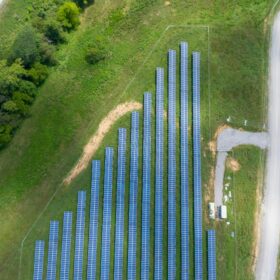
New York reaches deal on 70% by 2030 bill, Utilities want EVs, talking money in NYC: pvMB, 6/18/19
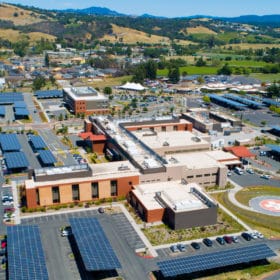
Spring showers as Bloomberg shows some love to LONGi, Ameresco builds a nice hospital carport, NREL trains executives, and more!
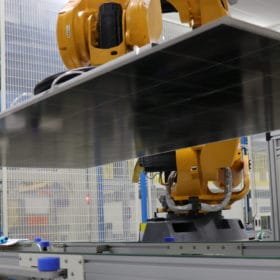
Ten American-Made Solar Prize ideas get $100,000, go to next round
NREL has announced finalists in its first round of seeking new solar technologies that have significant market potential.

MIT works to refine the flow of promising perovskites
Scientists at the Massachusetts Institute of Technology have developed an accelerated process for screening new perovskite compounds as they search for those with the potential to be used in high efficiency solar cells. According to MIT, the process speeds up the synthesis and analysis of new compounds by a factor of ten and has already highlighted two sets of materials worthy of further study.
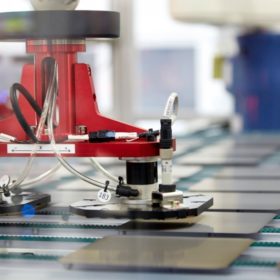
Jinko and REC petition for review of Hanwha patent
The manufacturers are pushing back on the basis for the suit that their Korean/German rival has launched, arguing that there is evidence the innovations they refer to were either not new or were obvious steps forward.
Hannon Armstrong jumps into community solar, SRP gives emissions the boot: pvMB 6/6/19
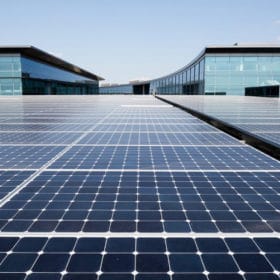
Good morning and welcome to today’s edition of the pvMB. This morning, we’ll be looking at the Sunpower system at a “destination” Porsche dealership, PacificCorp installing a solar + storage sytem in lieu of wires for Rocky Mountain Power, Laura Olton’s appointment to head the Rhode Island Public Utilities Commission and more!

Solar coming to Baltimore County govt., North Carolina utility Commission’s new chair: pvMB 6/5/19
Hello and welcome to your Hump Day MB, where we’ll be looking at the potential solving of LID, LevelTEn Energy raising $20.5 million in funding, the verification of CAISO as a reliability coordinator and much more!
“Unlimited” capacity hydrogen storage facility developing in Utah
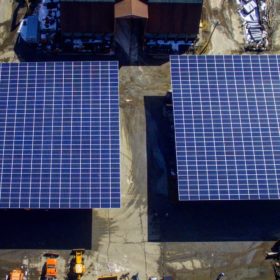
An MOU was signed by Mitsubishi and Magnum Developers in Utah to develop a 1,000 MW power facility at underground salt caverns in Utah that can be used to store renewable hydrogen and compressed air, while also deploying flow batteries and solid oxide fuel cells at the site.
Scientists see global PV rocketing to 10 terawatts by 2030, for starters
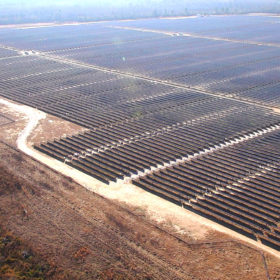
A Science journal article describes how to reach “a future with ~10 terawatts of PV by 2030 and 30 to 70 terawatts by 2050, providing a majority of global energy.”
New York’s winter time solar duck curve cometh
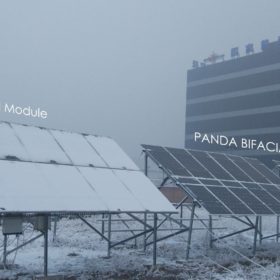
A site origination exercise and load analysis by Cornell University suggests that 9 GW of solar will reduce peak demand in New York by nearly 10%. However it also finds that solar needs better capacity valuations to make for a stronger market, and will drive a wintertime duck curve during the season of lower electricity demand.

Wyoming’s first solar trade association, EV chargers encroaching on gas stations: pvMB 5/21/19
We’ve got a jam-packed MB for you this morning. Today we’ll be looking at the formation of the American Solar Grazing Association, a community solar bill in Maine, the winners of the 17th Solar Cup and much much more!