
Swift Solar acquires Meyer Burger assets to scale U.S. HJT and perovskite production
Solar manufacturer Swift Solar has acquired the heterojunction technology (HJT) intellectual property and manufacturing assets of Meyer Burger to establish domestic cell production.
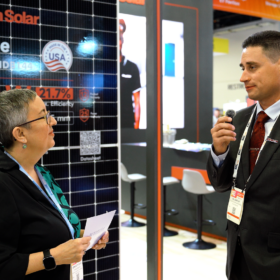
Hounen Solar showcases solar modules for the US market
Hounen’s 1 GW facility in South Carolina has been in continuous operation for three years, according to Bill Bentley, Sales Manager at Hounen. The company will also introduce advanced solar technologies including HJT and tandem.

Solar industry icon: ‘This group of people is not going to be thwarted’
Dick Swanson has left his fingerprints all over the modern solar industry. He is widely known for spreading the word on solar’s impressive learning curve with what has become known as Swanson’s Law, for developing the interdigitated back contact (IBC) cell, and for founding SunPower. In June, Swanson was named 2025 IEEE Photonics Society Aron Kressel Award Recipient and spoke with pv magazine to reflect on his work.

Meyer Burger lays off 283 solar production workers in Arizona
The Swiss company began manufacturing heterojunction modules in the United States nearly one year ago, but ran into trouble less than six months later after a large purchase agreement was terminated.
International PV module pricing may rise to $0.11/W by year end
International PV module prices, driven by Chinese averages, will likely rise from $0.08/W to $0.10/W today to $0.11/W by the end of 2025 and potentially $0.13/W by 2027, says Clean Energy Associates (CEA), noting that heterojunction and back-contact technologies now make up 12% of global module capacity.

Update: New market entrant to manufacture solar cells and modules in U.S.
Newly formed NuVision Solar is a U.S.-owned and operated manufacturer with plans to produce HJT solar cells and modules.

Fraunhofer ISE warns of risk from higher than expected UV-induced degradation in TOPCon, PERC, HJT cells
The researchers of the German institute explained that UV-induced degradation may cause larger than expected efficiency and voltage losses in all dominant cell technologies, including TOPCon devices. The scientists expect that silicon nitride layers could be used to enhance TOPCon UV stability compared to PECVD layers typically utilized in PERC and heterojunction cells.
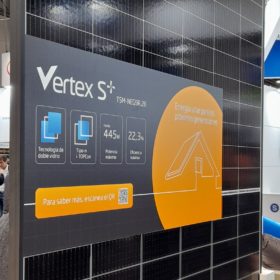
Trina Solar files with U.S. Trade Commission to protect TOPCon solar patents
The solar panel manufacturer filed patent complaints against Runergy and Adani Green Energy.

Back contact solar beats mono PERC at lifetime energy generation
A new analysis finds that back contact solar shows an average lifetime energy generation increase of 16.0% over mono PERC. The paper also says back contact had an average 9.7% shorter payback time and 10.7% lower LCOE across all modelled locations.

REC introduces 640 W commercial solar panel
The new product contains heterojunction cell technology (HJT) with up to 22.5% efficiency.