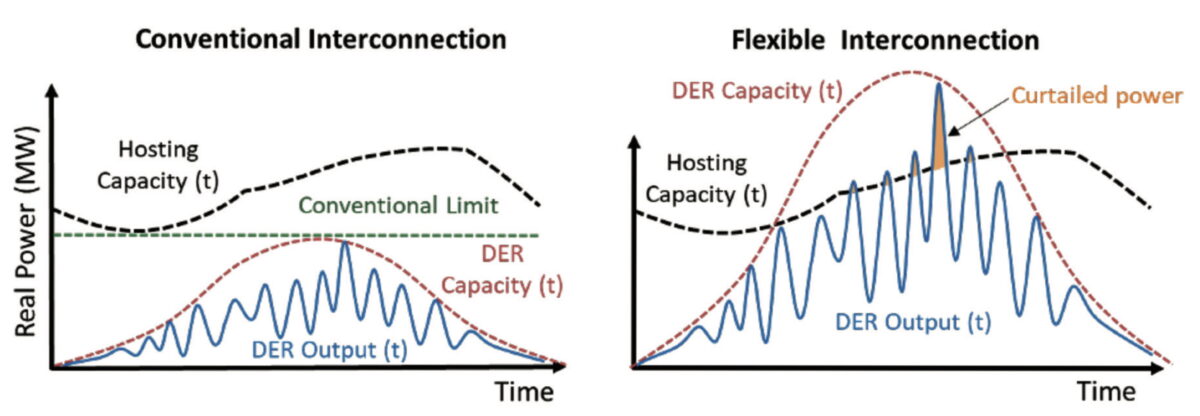





The New York Solar Energy Industries Association projects that solar developers could profitably add 3.3 GW of community solar in upstate and western New York if utilities enabled more community solar to interconnect, by offering a flexible interconnection option with 5% curtailment.
A typical community solar project in New York has 5 MW of capacity and is connected to a distribution circuit, NY SEIA says.
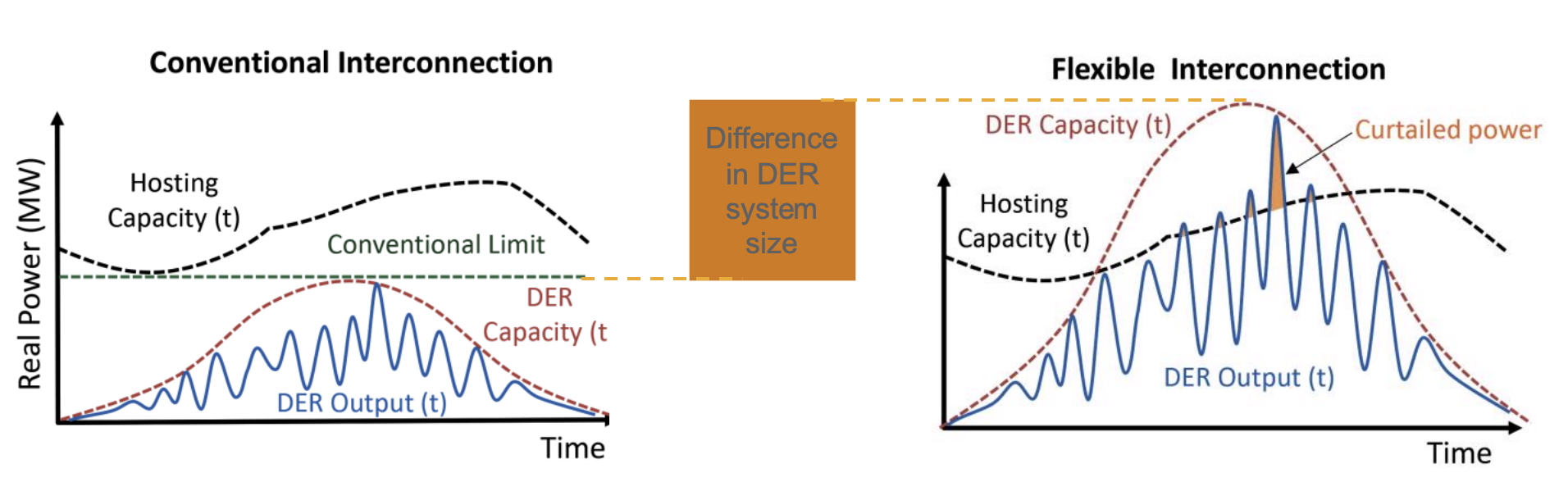
With flexible interconnection, solar output would be curtailed as needed to avoid breaching the thermal limit of substation transformers.
The potential increase in community solar capacity on a distribution circuit when flexible interconnection is an option is illustrated by the orange box in the image below, prepared by the Pacific Northwest National Laboratory and based on the EPRI image above.
NY SEIA’s projection that 3.3 GW in “cost-effective” community solar could be added is based on an analysis that EPRI presented on a webinar.
EPRI estimated that with conventional interconnection, the potential for community solar deployment in New York without substation upgrades is only 17% above the current deployment level. But with flexible interconnection as an option, the potential would increase to 71% above current deployment with 5% curtailment, and 97% above current deployment with 10% curtailment. EPRI found that the net benefit would be higher at 5% curtailment than at 10% curtailment, even though more capacity would be possible at 10% curtailment.
NY SEIA Executive Director Noah Ginsburg described to pv magazine how NY SEIA used the EPRI values to “approximate the amount of PV that can realistically be developed with flexible interconnection after siting and economic constraints are considered.”
NY SEIA considered only the two New York utility service areas in which EPRI found flexible interconnection to be economically viable without the use of investment tax credits. For each of those utility territories, NY SEIA took EPRI’s percentage increase in technical potential for community solar assuming flexible interconnection with 5% curtailment, and multiplied it by the amount of PV capacity greater than 1 MW in size that is either already installed in the territory or in advanced stages of development.
NY SEIA’s calculation yielded values of 3.2 GW of additional community solar in the National Grid territory and 100 MW of added community solar in the territory of Orange and Rockland Utilities, if flexible interconnection with 5% curtailment were an option.
EPRI’s presentation said that one limitation of its study is that “smart inverter functions were not considered.” EPRI assumed that curtailment of community solar would be managed by a distributed energy resource management system (DERMS), and counted DERMS costs in its analysis.
Ginsburg said on the webinar that “a number of questions have been asked in the Q and A about what would protect the owner of an asset from excessive curtailment beyond the expected level.”
Solar developers surveyed as part of the study also expressed concern about how to define the revenue generating opportunity for projects subject to curtailment, “to ensure that the projects were financeable,” Ginsburg said.
“One of the key challenges to actually realizing some of this potential is developing an equitable and transparent framework for quantifying, allocating and managing curtailment risk,” he added.
EPRI presented options on financial risk management in a report titled “Principles of access for flexible interconnection.”
On the webinar, EPRI also analyzed the potential for increased deployment of battery energy storage systems (BESS) in New York with flexible interconnection.
NY SEIA summarized EPRI’s battery storage findings, saying that in downstate New York, flexible interconnection can address constraints on both charging and discharging, potentially enabling an estimated 174% to 274% increase in retail BESS hosting capacity in ConEdison territory.
The webinar is titled “Flexible interconnection in New York State.”
A report on EPRI’s analysis is expected to be published when the New York State Energy Research and Development Authority (NYSERDA), which funded the study, completes its review.
New York has more community solar capacity than any other state, NY SEIA says.
This content is protected by copyright and may not be reused. If you want to cooperate with us and would like to reuse some of our content, please contact: editors@pv-magazine.com.

By submitting this form you agree to pv magazine using your data for the purposes of publishing your comment.
Your personal data will only be disclosed or otherwise transmitted to third parties for the purposes of spam filtering or if this is necessary for technical maintenance of the website. Any other transfer to third parties will not take place unless this is justified on the basis of applicable data protection regulations or if pv magazine is legally obliged to do so.
You may revoke this consent at any time with effect for the future, in which case your personal data will be deleted immediately. Otherwise, your data will be deleted if pv magazine has processed your request or the purpose of data storage is fulfilled.
Further information on data privacy can be found in our Data Protection Policy.