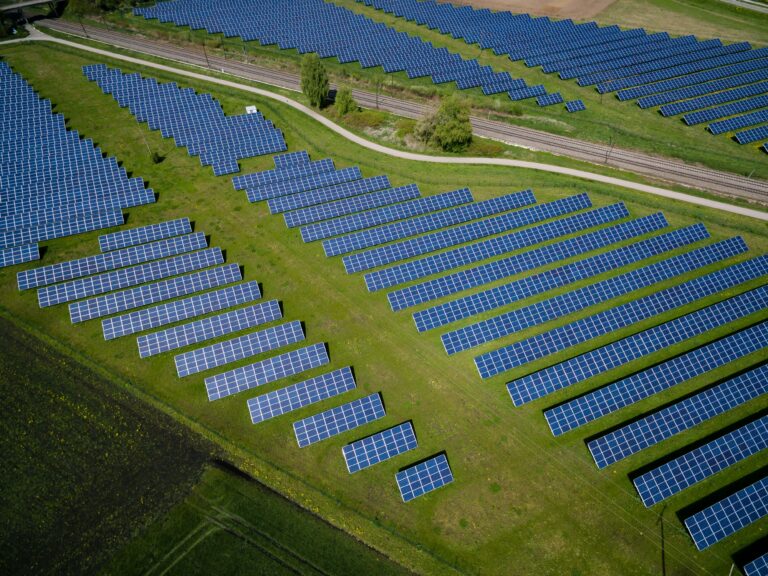





California’s energy transition is currently held back by transmission constraints, but a growing body of data suggests the solution lies in the distribution grid level.
While over 98% of active projects in the state’s interconnection queue face significant delays, the “middle mile” of community-scale solar and storage offers a faster path to decarbonization. A report by Pathfinder Communications, Community Choice Aggregation (CCA) and the Middle Mile, highlights how these localized projects bypass the five-to-ten-year timelines typical of transmission-scale infrastructure.
According to the study, 5.4 GW of community solar and storage to the distribution grid requires a $3.2 billion investment, but it yields $4.2 billion in electricity price reductions. By leveraging existing local networks, community-scale projects eliminate the need for $2 billion in transmission and distribution upgrades.
The most significant fiscal impact for Community Choice Aggregators (CCA) is the projected $4.6 billion reduction in Resource Adequacy requirements, which are the costs paid to ensure backup power is available during times of peak electricity demand.
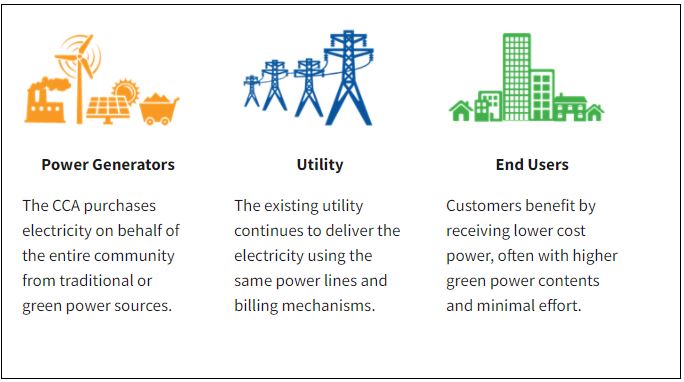
At present, 25 CCAs, an alternative to investor-owned utilities, serve one-third of California’s electricity consumers, providing the necessary scale to stabilize these “middle mile” markets. Beyond direct savings, the deployment of 5.4 GW of local capacity is expected to cut out-of-state electricity imports by 13% and reduce reliance on the state’s vulnerable transmission system by 2%. It also curbs greenhouse gas emissions by 1.8% by reducing the need for natural gas generation to firm up the system during peak hours.
Operational success in this sector depends on vertical integration to remove the 20% to 30% cost premium associated with intermediary handoffs in project development. Firms like Renewable America are now augmenting these front-of-the-meter projects with behind-the-meter battery programs for commercial and industrial customers. Such programs offer 20% bill savings to hosts with no upfront capital while functioning as load-modifying resources for the local CCA.
As community solar added 464 MW of capacity nationally in the final quarter of 2025, the data indicates that localized, distribution-level assets are emerging as a viable hedge against a gridlocked wholesale market.
For CCAs in California, community solar offers an alternative to waiting for a massive grid overhaul that may take a decade. By investing in localized, community-scale solar and storage now to save billions, cut emissions, and bypass the interconnection queue.
This content is protected by copyright and may not be reused. If you want to cooperate with us and would like to reuse some of our content, please contact: editors@pv-magazine.com.



The easiest energy consuming system to pro-actively transition from fossil fuels to electrification is transportation. That’s why China, France & South Korea have already leapfrogged past the US by rapidly deploying widely distributed, readily accessible EV charging networks. Here in the US, that has been intentionally throttled by MAGA BigOil&Gas and utility monopolies. EV chargers being installed here are a limited number of fast chargers, primarily along interstate highways. This is a proverbial “Drop-in-the Bucket”. France & South Korea have already mandated construction of solar parking lot canopies, with on-site battery storage +Vehicle-2-Grid chargers at ALL existing parking lots over 80 spaces, nationwide, within 3 to 5 years, largest lots first. That’s how you electrify transportation,….FAST. And if China is exporting the best & lowest cost solar panels, inverters, cabling, energy management modules and EVs,….so be it. We just need US politicians, city planners & CCAs who think like insurance risk-management analysts, equipped with the best AI tools.