




Since the late 1800s, American cities and towns have enjoyed electric streetlight service to provide illumination and chase away the dark of night.
The earliest of these systems were tied directly to coal-fired steam turbines, and the arc lamps they used pulled several hundred watts of power through carbon rods that needed replacement after every eight hours of use.
Nearly 150 years later, streetlight efficiency and material stability have improved by several orders of magnitude, but most streetlight systems still consist of pole-mounted fixtures connected by underground wires to the local grid, built and maintained by local utility companies at relatively high cost.
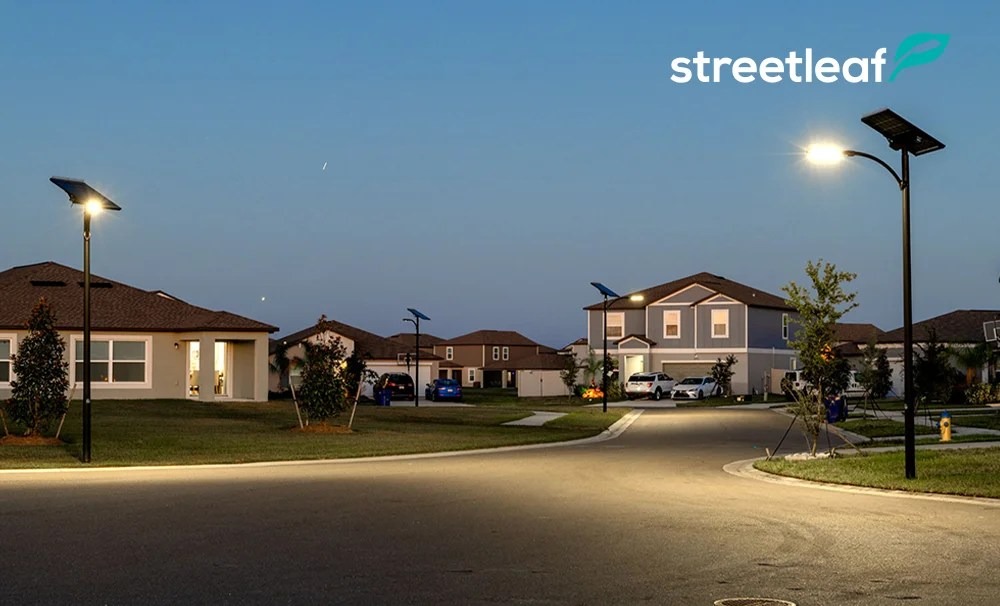
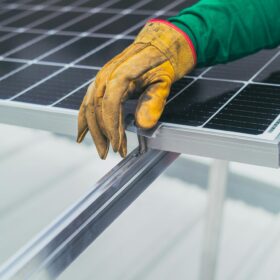
Streetleaf, a solar streetlight company that combines modern LED assemblies, monocrystalline solar panels and lithium iron phosphate (LFP) batteries, says it can deliver its solutions to new housing developments for less money than the local utility and provide better service by keeping the lights on during local power outages.
The Florida-based company has just announced the completion of its latest project, a 40-pole installation completed for the “Novel” master-planned community in the Dittmar-Slaughter neighborhood of Austin, Texas.
The project is Streetleaf’s first in Austin, but the company has also completed installations in other Texas cities such as Dallas and Houston, and several other states.
Streetleaf’s origin story
Streetleaf CEO Liam Ryan says the idea for the company was born out of necessity. While working on a new housing development, he was looking to source 2,000 streetlights. The local utility couldn’t deliver an economical solution, so his team began looking elsewhere.
They asked two questions to prospective suppliers: Could the suppliers deliver that large of an order, and could they maintain the lights over 10 plus years?
“Nobody in the market could do that,” he told pv magazine USA, “So we’re like ‘Hey, I guess we’ve got to do it ourselves.’ And then we saw the opportunity.”
The “easy button” for housing developers
While the ability for the lights to stay on during an outage is a nice benefit for residents, neighborhood developers care much more about project economics and logistics.
Ryan described the company’s offering as an “easy button” for developers who might otherwise face long timelines and high costs to trench and connect traditional streetlights to the local utility grid.
“Our equation at the end of the day is we’re putting extra hardware, a solar panel, a lithium iron phosphate battery… on top of a metal pole,” Ryan said. “That extra hardware has to be more cost effective than digging a hole, running wire, running conduit, and tying a traditional streetlight into the grid.”
While Streetleaf does sell its products directly to customers, the company also operates on a service agreement model. Ryan says this allows developers to avoid the upfront costs of installing the equipment and instead pay a monthly fee.
He described these arrangements as “a win-win for everyone,” adding, “Our fee is less than what the local grid-tied utility fee would have been… they pay less and get a superior product.”
In addition to the most recent installation for Risewell Homes, Streetleaf has also provided solutions for Brightland Homes, D.R. Horton, and Lennar.
The tech and its limitations
Streetleaf currently offers three product lines:
- Streetleaf AVE, which outputs 5,400 lumens and includes a 150 W solar module and 820 Wh battery
- Streetleaf BLVD, with 7,200 lumen output, a 220 W solar module and 1.23 kWh battery
- Streetleaf PATH, with 588 lumen output, 27 W of embedded solar cells, and 102 Wh battery
The two larger offerings are both covered with five-year warranties, while the smaller PATH lights are covered for a single year. All of the products use a 3000K “turtle safe” color temperature, bespeaking Streetleaf’s Florida roots.
Another common feature is what the company calls “5 day battery autonomy.” Ryan told us the devices feature a “storm watch mode” that automatically dims the lights when the forecast calls for prolonged periods of overcast weather, but maintain motion-sensor capabilities to brighten the lights when cars and pedestrians pass by.
However, the tech can only work year-round in geographical areas that get enough sun. Ryan said the company designed the BLVD light to work “in the Sun Belt down.” He added that in more northerly locations, they offer the AVE system, but equip it with the larger solar panel and battery of the BLVD to meet the same needs.
Scaling up to 100,000 installations
From that first project in Florida, the company’s installation base has now grown to 11,000 systems in its home state, with an additional 2,000 spread across projects in 10 other states.
Ryan told us his goal is to grow the company rapidly, “from 13,000 streetlights in the world to 100,000 and beyond… really what we’re pushing for is to become a utility scale street lighting company that just happens to be solar.”
This content is protected by copyright and may not be reused. If you want to cooperate with us and would like to reuse some of our content, please contact: editors@pv-magazine.com.


Great idea to save on install time and money. The challenge is that the time of year when you want the most light is when you are getting the least solar. These systems must dump a lot of excess solar generation in June to be able to function in December.