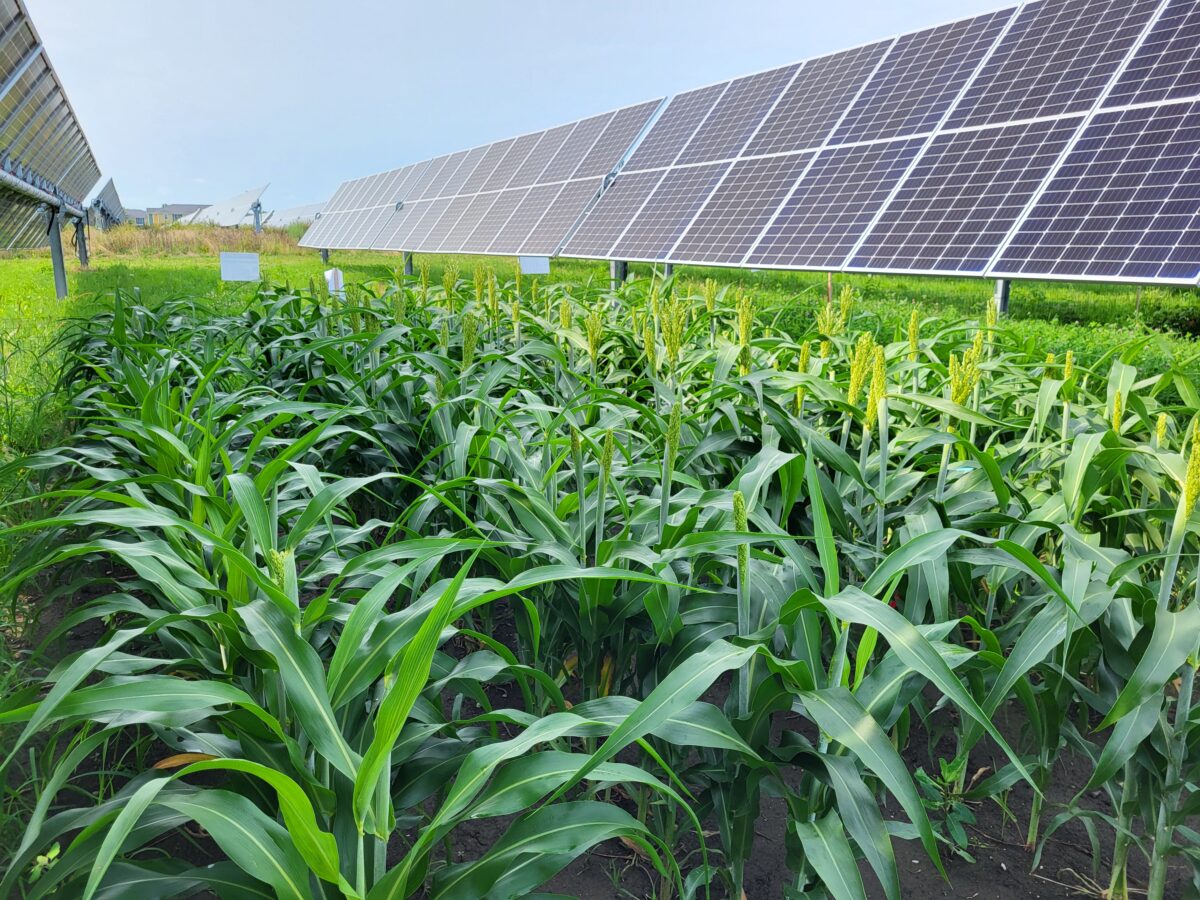





A research team from the University of Illinois Urbana-Champaign has experimentally examined how shading in agrivoltaic systems influences sorghum and soybean grain yields, focusing on source-sink dynamics, which are the processes by which plants produce and allocate assimilates like sugars during growth.
“To our knowledge, no previous studies have conducted source–sink manipulations within solar arrays to investigate the physiological mechanisms governing grain weight during grain filling,” corresponding author DoKyoung Lee told pv magazine. “If shading from PV panels results in a yield penalty, it is essential to understand not only the overall yield reduction but also which specific yield components are affected. In this study, we examined both yield and yield components, such as grain number and grain weight, in sorghum. Further, we elucidated the distinct physiological mechanisms underlying grain weight by assessing alterations in source and sink strength.”
The research took place during the growing seasons of 2023 and 2024 at Solar Farm 2.0 in Champaign, Illinois, USA, a project that generates approximately 20,000 MWh/year for the university. Individual PV panels were 1 m wide by 2 m long, mounted on 1.5 m brackets, with a 5.5 m spacing between rows. Panels are installed on a north-south axis with single-axis tracking, allowing them to rotate east-to-west. Eight plots – four sorghum and four soybean – were planted inside the PV plant, while the other eight served as controls under full-sun conditions. Each plot had dimensions of 4 m wide by 6 m long, with five rows spaced 0.75 m apart – two rows on the east side, two rows on the west side, and one in the middle.
Source manipulation was conducted on both sorghum and soybean 7 days before anthesis, while sink manipulation was performed on both 14 days after anthesis. In the case of sorghum, the source was manipulated by removing alternate leaves below the flag leaf, and the sink was manipulated by removing vertically half of the panicle. As for the soybean, the source was manipulated by removing two lateral leaflets of each trifoliate leaf, while the sink was manipulated by removing all pods from all branches, leaving pods only on the main stem.

“Soybean showed a yield penalty regardless of shading intensity (across different rows) between PV panels. In contrast, sorghum showed a smaller yield penalty than soybean, and this penalty diminished as shading decreased in the middle row, resulting in no yield penalty,” Lee said about the test results. “Grain formation in sorghum was also sensitive to resource availability, but sorghum was able to compensate as it increased grain size when resources were sufficient.”
According to Lee, the contrasting physiological mechanisms between sorghum and soybean represent “one of the most compelling findings of this study.” Soybean uses C3 photosynthesis, the basic photosynthesis pathway, while sorghum uses C4 photosynthesis, an enhanced photosynthesis system that concentrates CO₂. According to the researchers, the team expected C4 plants to take the bigger hit from PV shade, but found the opposite.
Per the results, both crops integrated with PV electricity generation increased the land equivalent ratio (LER), with 1.54 for sorghum and 1.23 for soybean. Lee further explained that the primary factor contributing to yield penalties in both sorghum and soybean was reduced grain number under shading conditions. “While grain weight in sorghum responded strongly to changes in resource availability, soybean showed sensitivity only under resource limitation, not under surplus conditions,” he said.
“These findings guide optimizing cultivar selection and management practices in agri-PV systems,” the researcher stated.
The team also found that, to reduce yield penalties, management should first target the critical period before anthesis, when grain number is set. Increasing sink size in both sorghum and soybean, along with crop-specific practices during this stage, will be key. After anthesis, however, the two crops require different approaches. For sorghum, boosting resource availability during grain filling may offset yield losses by increasing grain weight. For soybeans, the focus should be on avoiding resource limitations, as additional resources have only a limited effect on grain weight.
The research work was presented in “Shading impacts on sorghum and soybean grain yields in agrivoltaics systems: Source-sink strength in response to shading,” published in Smart Agricultural Technology.
This content is protected by copyright and may not be reused. If you want to cooperate with us and would like to reuse some of our content, please contact: editors@pv-magazine.com.





By submitting this form you agree to pv magazine using your data for the purposes of publishing your comment.
Your personal data will only be disclosed or otherwise transmitted to third parties for the purposes of spam filtering or if this is necessary for technical maintenance of the website. Any other transfer to third parties will not take place unless this is justified on the basis of applicable data protection regulations or if pv magazine is legally obliged to do so.
You may revoke this consent at any time with effect for the future, in which case your personal data will be deleted immediately. Otherwise, your data will be deleted if pv magazine has processed your request or the purpose of data storage is fulfilled.
Further information on data privacy can be found in our Data Protection Policy.