





Swedish startup POL has announced the POL Lux, a solar electric catamaran camper boat that will start at $135,000. The 25-foot craft is designed for up to 13 passengers.
The catamaran design creates a canopy space for integrated PV. The boat can operate purely on solar power at a reduced speed of about 4 knots (4.6 miles per hour).
On a full charge of the 18 kWh battery, the craft can travel about 70 miles. The dual electric motors can propel the craft at a max speed of about 13 miles per hour, and cruising speed tops out at about 8 miles per hour. The company said the dual motors are much quieter than their gas-powered counterparts, making for a more serene nature exploration experience.
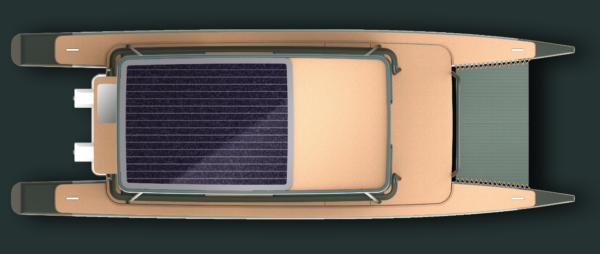
The eight foot wide POL Lux has a modular, adaptable design that can readily convert from a day-cruiser with ample seating to a tented, private area with multiple beds and a raised hammock. The boat also contains a large net that can be released out of the bow for passengers who want to lounge in the water.
The lightweight craft features a twin-hull design and large front and rear bumpers for safety. It is designed with a large overlapping deck with cork flooring and chamfered intersecting edges to frame out the living area.
“We created a flexible space, with modular components to allow for multiple configurations, encouraging you to use the space how you wish. Bring on board what you need, leave behind what you don’t,” said POL.
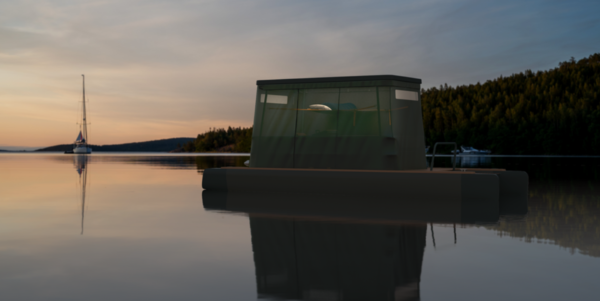
The boat is undergoing prototype testing this year, and the company is currently accepting waitlist applications to be first in line for the new technology when it is released.
Electric shipping
Electric boats are unconventional, but may serve a larger role than recreational vehicles like the POL Lux. Battery-powered electric boats are now being seriously considered for large-scale shipping.
Researchers from the University of California, Berkeley, and Lawrence Berkeley National Laboratory have released a study which examines “the technical outlook, economic feasibility, and environmental impact of battery-electric containerships.”
Breaking from previous studies, the researchers have classified the volume of space housing the batteries as an opportunity cost, rather than a fixed technical constraint. After modeling a wide variety of containership sizes, as well as 13 major world trade routes, the research suggests that more than 40% of the world’s fleet of containerships could be electrified “cost-effectively and with current technology,” by the end of this decade.
This content is protected by copyright and may not be reused. If you want to cooperate with us and would like to reuse some of our content, please contact: editors@pv-magazine.com.






I believe that it could be a good idea to install solar panels on government buildings such as schools and colleges because there is so much space that is both safe and secure and it has the potential to create tons of MW of electricity every single day.
Nice
Great post!
I think it could be an excellent idea to put solar panels on government buildings, such schools and universities, as there is a lot of safe and secure space there and it might provide tons of MW of electricity every day.
As a reader, the POL Lux feels like the future of quiet exploration—solar-powered, modular, and designed for real relaxation.
Nice post!