





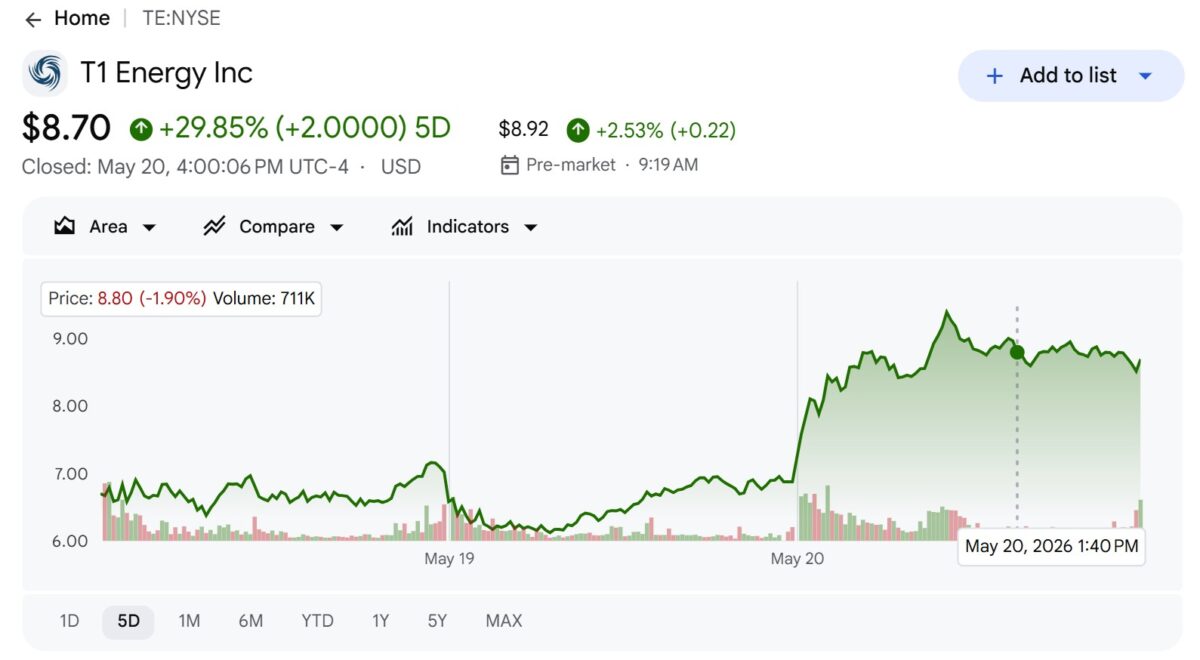
A report by Fuzzy Panda Research questioning T1 Energy’s ability to deliver solar modules that qualify for the 45X advanced manufacturing tax credit or the 10% domestic content Inflation Reduction Act adder triggered a sell-off of as much as 13% on Tuesday, May 19.
That same day, Roth Capital Partners analyst Philip Shen published a note titled “Another Misleading Short Report; Buy the Dip,” pushing back on the thesis. The following day, the stock climbed 26% on heavy trading volume, approaching its 52-week high before pulling back.
Shen’s disdain for the report came through early:
It is difficult to write a report with “10 Parts” and have every part be misleading and/or false, but today’s short report on TE managed to do exactly that.
-Philip Shen, Roth Capital Partners
T1 Energy is a solar module assembly company with a manufacturing facility based in Texas. It was formerly known as Freyr Battery, until a rebrand and move to Austin. Until recently, it had been developing a Georgia battery factory, and prior to that the Norwegian-founded company attempted battery work in Europe. It is also constructing a 2.1 GW solar cell factory in Milam County, Texas, with plans to source polysilicon and wafers from Corning.
The “10 Parts” in the Fuzzy Panda report are individual items the research group says build toward T1 Energy’s business not being a safe investment — at least, not one built on the manufacturer being able to deliver high-value, domestic-content-eligible solar modules to the US market.
Much of the report focuses on the factory’s former owner, Trina Solar, and on intellectual property sold to a Singaporean company named Evervolt. Fuzzy Panda questions how genuine the sale was, and whether control of the IP could cause the Internal Revenue Service to reject T1 Energy’s Foreign Entity of Concern compliance.
Roth Capital’s response was that Evervolt is an “industrial conglomerate based in Singapore that completed a bonafide purchase of Trina’s US IP through an auction process that we believe had multiple bidders.” Roth also said that, as is required of all deals of this nature, T1 Energy performed extensive due diligence, and that the agreement specifically excludes any IP from restricted entities.

Source: T1 Energy on x.com
Fuzzy Panda also offered drone footage as evidence that T1 Energy is 12 months to 18 months behind pace on constructing its solar cell facility. The company says it still expects the facility to come online at the end of 2026.
pv magazine USA spoke with an industry expert who said that given median timelines for US factory construction, including equipment delivery, it is more likely the facility deploys at the end of 2027. The expert noted that almost every solar supply chain manufacturing facility is taking longer to come online than projected.
Additionally, Fuzzy Panda sees significant risk in the $41.4 million of 45X advanced manufacturing tax credits T1 Energy booked in the first quarter of 2026. T1 Energy recently sold $160 million in 2025 tax credits.
Roth Capital said booking those tax credits as a non-cash offset to cost of goods sold is standard accounting practice once the eligible products are produced and sold and the conditions for receipt are reasonably assured.
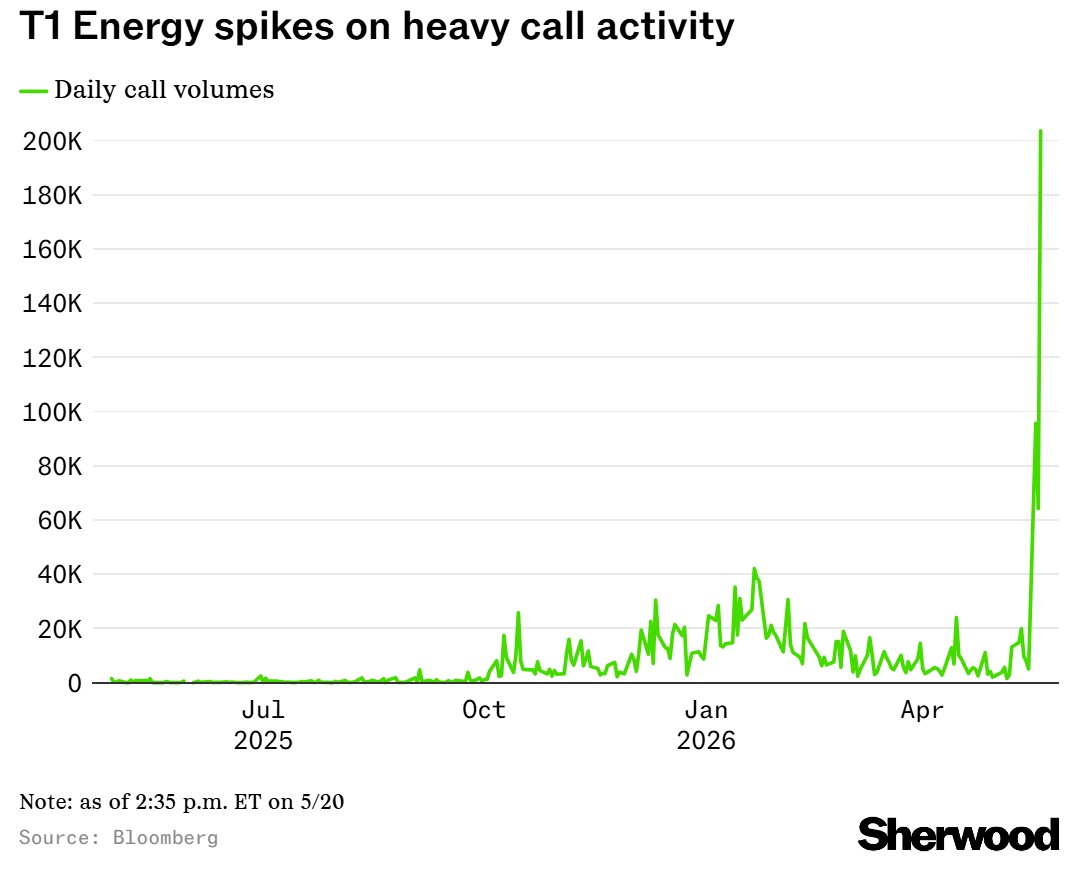
Sherwood News noted that call option activity on T1 Energy spiked sharply the day of the report and after Roth’s response.
Source: Sherwood News
The solar tax credit market was already tightening. New restrictions under the One Big Beautiful Bill Act are reshaping project bankability, with developers facing a steep learning curve on effective control and material assistance limits.
This content is protected by copyright and may not be reused. If you want to cooperate with us and would like to reuse some of our content, please contact: editors@pv-magazine.com.




By submitting this form you agree to pv magazine using your data for the purposes of publishing your comment.
Your personal data will only be disclosed or otherwise transmitted to third parties for the purposes of spam filtering or if this is necessary for technical maintenance of the website. Any other transfer to third parties will not take place unless this is justified on the basis of applicable data protection regulations or if pv magazine is legally obliged to do so.
You may revoke this consent at any time with effect for the future, in which case your personal data will be deleted immediately. Otherwise, your data will be deleted if pv magazine has processed your request or the purpose of data storage is fulfilled.
Further information on data privacy can be found in our Data Protection Policy.