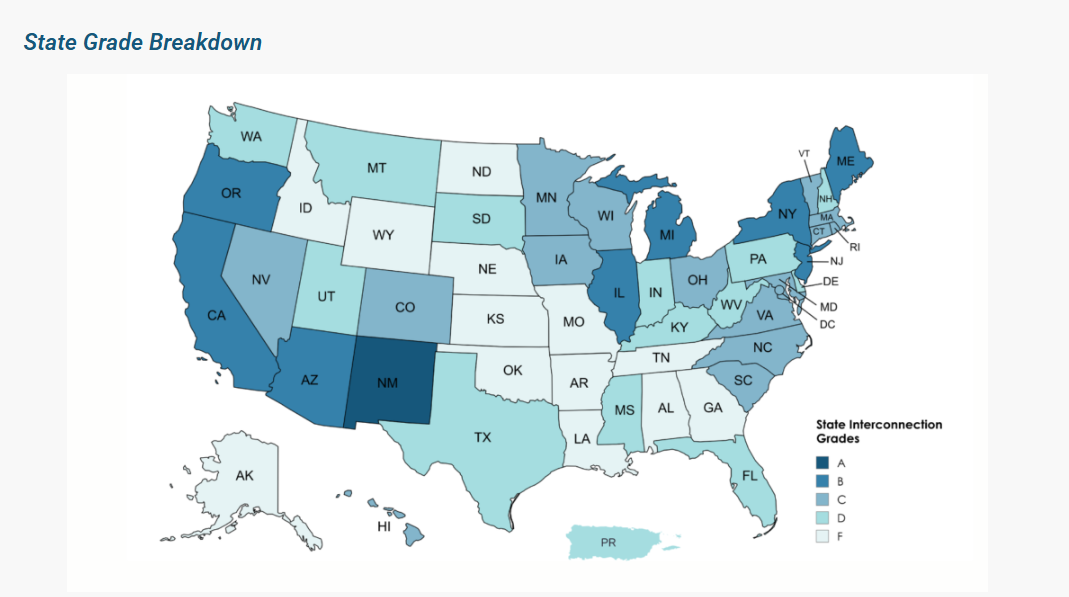





Distributed solar and energy storage adoption across the United States faces a bottleneck from state regulatory interconnection frameworks. According to a national scorecard released by the Interstate Renewable Energy Council (IREC) and Vote Solar under their joint “Freeing the Grid” initiative, a majority of U.S. states fail to operate modern interconnection procedures.
The initiative evaluates state-level distributed energy resource (DER) interconnection rules across 10 operational categories based on 56 criteria worth 63 points. The scorecard tracks codified, statewide rules rather than informal utility practices or uncodified public utility commission orders.
For the solar and storage industry, these criteria dictate queue velocity, equipment specifications, and project bankability. The scorecard directly tracks whether states define export capacity to protect storage from over-studying, maintain clear screening thresholds to bypass full system impact studies, enforce strict timelines for permission to operate (PTO), and cap application or upgrade fees to ensure cost predictability. It also rewards states that adopt IEEE 1547-2018 standards for inverter performance and establish independent dispute resolution pathways to bypass public utility commission backlogs.
The findings reveal a division in how state regulations manage a high-penetration DER grid, demonstrating a lack of standardization across state lines and utility territories. New Mexico is the only state to achieve an “A” grade, recognized for incorporating project eligibility rules, explicit incorporation of energy storage, and data-sharing protocols.
Beyond New Mexico, eight states earned a “B” grade: Arizona, California, Illinois, Maine, Michigan, New Jersey, New York, and Oregon. While these states established frameworks, they retain friction points within their supplemental review timelines or dispute resolution processes.
The remaining balance of the country falls behind. Sixteen states received a “C” grade and 14 states received a “D” grade due to screening thresholds, application fees, and grid upgrade cost-allocation models. Thirteen states, including Alabama, Alaska, Arkansas, Georgia, Idaho, Kansas, Louisiana, Missouri, Nebraska, North Dakota, Oklahoma, Tennessee, and Wyoming, earned an “F” grade. These states lack standardized, statewide interconnection procedures, leaving rules and approval processes to individual utility discretion.
The “Freeing the Grid” scorecard focuses on written rules. It does not track utility execution, meaning states with high grades on paper can see operational backlogs if enforcement mechanisms are absent. To help states update rules, the initiative tracks badges for states that codify energy storage integration, adopt IEEE 1547-2018 standards, and mandate transparency.
A blueprint for state reform
To clear queues and transition from legacy, one-way volumetric grid standards, state regulators must look to blueprints that alter the interconnection lifecycle, said Freeing the Grid.
The Building a Technically Reliable Interconnection Evolution for Storage (BATRIES) project, led by IREC in collaboration with the Storage Interconnection Committee (STORIC), provides a toolkit to resolve these barriers.
Defining export capacity over nameplate totals
The most critical operational bottleneck for paired solar-plus-storage projects is the utility practice of evaluating grid impacts using gross nameplate capacity. Summing the maximum potential output of an inverter and a battery forces developers to pay for unnecessary distribution upgrades. The BATRIES framework replaces this model with a strict focus on “Export Capacity,” or the maximum power a facility can physically inject into the grid.
By formally recognizing software-based Power Control Systems (PCS) certified under standards like the UL 1741 Certification Requirement Decision (CRD), state rules can force utilities to model projects based on programmed export limits rather than nameplate arithmetic.
Updating fast-track technical screens
While 34 states require utilities to review initial application paperwork for completeness within 10 business days, Freeing the Grid data reveals a massive drop-off in actual engineering velocity. Only 16 states mandate that utilities complete the initial engineering review and clear a small, inverter-based project for the fast track within that same 10-day window. For developers, this lack of strict deadlines turns what should be a simple sign-off into an indefinite engineering backlog.
The BATRIES toolkit addresses this by embedding export capacity directly into fast-track thresholds. The framework recommends allowing small inverter-based systems to qualify for simplified tracking if the nameplate rating stays below 50 kW and the controlled export capacity remains under 25 kW. For larger commercial assets, applying export limits rather than nameplate capacity across standard 15% peak line load penetration screens prevents low-impact projects from triggering multi-month system impact studies.
The framework recommends allowing small inverter-based systems to qualify for simplified tracking if the nameplate rating stays below 50 kW and the controlled export capacity remains under 25 kW. For larger commercial assets, applying export limits rather than nameplate capacity across standard 15% peak line load penetration screens prevents low-impact projects from triggering multi-month system impact studies.
Capping upgrade risk and application fees
Unpredictable upgrade costs and open-ended utility study fees are a major driver of late-stage project cancellations. National best practices outline standard cost boundaries: capping application fees at $300 for systems up to 25 kW and $2,000 for systems up to 5 MW, while limiting supplemental review fees to $2,500 This measure is currently codified in only five states.
To provide commercial certainty before procurement, the toolkit advocates for cost-sharing mechanisms on shared distribution infrastructure and requires utilities to provide binding cost estimates, capping a developer’s final upgrade liability to within 10% to 30% of the initial utility estimate.
Engineering flexibility over queue eviction
Under standard utility procedures, if a project fails an initial technical screen, it is typically evicted from the queue or forced into a costly study phase. The BATRIES model introduces a mechanism for “itemized design modifications.”
Rather than restarting the application process, rules should allow developers to actively modify system configurations during the review phase. This includes adjusting software operating profiles, shifting discharge hours, or adding non-export controls to mitigate local grid impacts on the fly. Paired with independent technical ombudspersons to arbitrate utility disputes, these procedural pathways keep projects moving forward without the years-long delays of a formal public utility commission complaint.
Freeing the Grid emphasizes that adopting these standardized, transparent interconnection policies is what transforms a state from a restrictive market bottleneck into an optimized, high-penetration clean energy economy.
This content is protected by copyright and may not be reused. If you want to cooperate with us and would like to reuse some of our content, please contact: editors@pv-magazine.com.



By submitting this form you agree to pv magazine using your data for the purposes of publishing your comment.
Your personal data will only be disclosed or otherwise transmitted to third parties for the purposes of spam filtering or if this is necessary for technical maintenance of the website. Any other transfer to third parties will not take place unless this is justified on the basis of applicable data protection regulations or if pv magazine is legally obliged to do so.
You may revoke this consent at any time with effect for the future, in which case your personal data will be deleted immediately. Otherwise, your data will be deleted if pv magazine has processed your request or the purpose of data storage is fulfilled.
Further information on data privacy can be found in our Data Protection Policy.