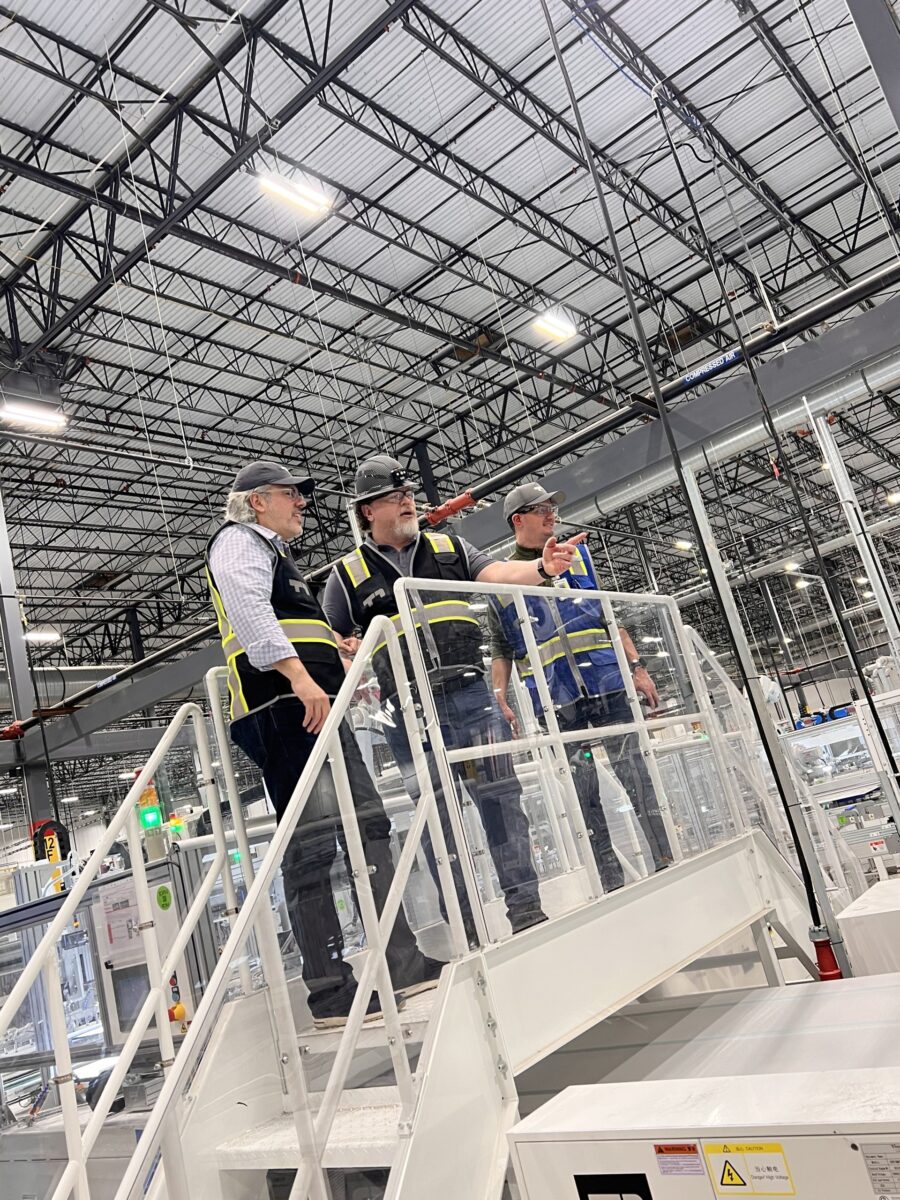





As the United States pushes to secure its energy supply chain, domestic solar manufacturing is undergoing its most significant expansion to date. Front and center in this buildout is T1 Energy, an emerging cornerstone of the domestic solar ecosystem.
The company is rapidly scaling its manufacturing footprint—anchored by its fully operational 5.0 GW module facility in Wilmer, Texas, and an upcoming 2.1 GW TOPCon cell factory in Rockdale—to deliver high-domestic-content solar technology.
Leading up to the eagerly anticipated Solar Manufacturing USA 2026 event in Austin, Texas on 22-23 September 2026, event partner and Conference Chair, Finlay Colville will be speaking to the leading companies that will form a key role in U.S. PV manufacturing over the next 5-10 years.
Finlay caught up with T1 Energy’s CEO Daniel Barcelo to understand some of the recent developments and plans for T1 Energy, as one of the most important companies in the PV manufacturing ecosystem in the United States today.
[Finlay]To start with, could you give an update on the latest progress at the module facility in Wilmer?
[Daniel]G1 is fully operational. We saw maximum daily run rates above our 5.0GW nameplate capacity at the end of last year. We produced 2.79 GW of modules in 2025. We expect to manufacture between 3.1 and 4.2GW of modules this year, depending on demand and access to the right solar cells. All of this reflects the talent and dedication of our people and gives us strong confidence in our ability to build on this momentum in 2026 and beyond.
[Finlay]It was fascinating to see how quickly the facility ramped up. Often with new factories in locations where PV manufacturing generally has not been well established, it can take companies up to a year or longer to reach high utilization rates. It seems the Wilmer module facility was operating above 90% utilization by the end of 2025. Can you comment on what made this possible?
[Daniel]It’s the winning combination of our people and our product. In roughly one year, the T1 operations team took G1 from initial production to maximum daily run rates above nameplate capacity. And we saw record sales and delivery of merchant volumes to major new customers who are very interested in high-efficiency, low-cost modules built in the U.S.
[Finlay]The move upstream to cell manufacturing appears to be progressing well. What have been the biggest challenges to date in building a cell factory in the United States and how has the process differed from the existing module factory in Wilmer?
[Daniel]We believe the manufacturing of TOPCon cells is the key to our integrated supply chain strategy. And things have been going very well. We are taking a two-phased approach to the buildout where Phase 1 will be a 2.1-gigawatt fab. The biggest challenge we have faced was that it was a very rainy spring. Rockdale received more than three times the average rainfall in April. But the construction and operations team adjusted and we remain on track to begin cell production in the fourth quarter of 2026.
[Finlay]In addition to securing in-house supply of solar cells for T1 Energy’s module production needs, the other key issue for domestic U.S. module assembly relates to the materials needed, such as glass, frames and films. It seems this is something the U.S. sector as a whole needs to pull together to fully onshore. How do you see this evolving from T1 Energy’s perspective?
[Daniel]Building our own G2 solar cell fab is critical to delivering high domestic content modules. We also have a deal to use domestically sourced steel frames. There are other components that remain challenging, such as glass, PVA, and j-boxes. For these components, we are in discussions with potential suppliers and are working on contracts that could support the construction of new factories. Hopefully, other domestic manufacturers step up to join us.
[Finlay]To have a fully domestic solar manufacturing ecosystem, the United States will need to add significant capacity at the wafer stage, not to mention greater production of polysilicon compared to today. Do you think it is necessary for a company like T1 Energy to be fully integrated back to ingots and wafers for example, or would the emergence of some high-volume upstream specialists at the polysilicon and wafer stages allow for a partial integration strategy to be implemented in the coming years?
[Daniel]We’ve got great partnerships with American suppliers like Corning and Hemlock Semiconductor for our polysilicon and wafers. Our focus is to deliver high domestic content to our customers, from polysilicon through modules. With these long-term strategic partnerships, full integration under one roof is not necessary. Again, the most important thing is to keep the supply chain on American soil. Our guiding focus is manufacturing our electrons here at home, investing in American advanced manufacturing to power our nation’s energy independence and ignite our AI leadership.
[Finlay]And finally on a personal note. How are you enjoying playing such a prominent role in the solar industry in the United States? What have been the biggest surprises and how does the solar industry differ to other sectors you’ve been involved with in the past?
[Daniel]I was in the oil & gas space for nearly 20 years, so stepping into solar didn’t feel unfamiliar. I don’t think about solar energy or renewable energy. Energy is energy. Solar is an exceptional technology that is the lowest cost, easiest to scale, and fastest to deploy energy source out there and will boost energy independence and AI leadership. Solar isn’t at odds with other energy forms. The more domestic solar we manufacture here at home, the more oil and gas we have for export to our allies abroad. Solar isn’t winning because it’s clean; it’s winning because it’s essentially zero-marginal cost electricity generation and keeps the U.S. a major global exporter. Once you see that clearly, it’s hard to look away.
The Solar Manufacturing USA 2026 event in Austin, Texas on 22-23 September 2026 is the first ever U.S. conference focused exclusively on domestic PV manufacturing in the United States, including producers across the value-chain from polysilicon to modules, domestic materials supply-chains, and the production equipment and technology used in the factories.
The pv magazine USA team and event partner Finlay Colville intend to make Solar Manufacturing USA 2026 the most important meeting for the U.S. solar industry in 2026, with a powerhouse speaker lineup. To get involved in the event, please reach out to us at the contact links on the event website here.
This content is protected by copyright and may not be reused. If you want to cooperate with us and would like to reuse some of our content, please contact: editors@pv-magazine.com.






By submitting this form you agree to pv magazine using your data for the purposes of publishing your comment.
Your personal data will only be disclosed or otherwise transmitted to third parties for the purposes of spam filtering or if this is necessary for technical maintenance of the website. Any other transfer to third parties will not take place unless this is justified on the basis of applicable data protection regulations or if pv magazine is legally obliged to do so.
You may revoke this consent at any time with effect for the future, in which case your personal data will be deleted immediately. Otherwise, your data will be deleted if pv magazine has processed your request or the purpose of data storage is fulfilled.
Further information on data privacy can be found in our Data Protection Policy.