




As the U.S. renewable fleet enters a period of unprecedented demand, the industry is hitting a critical inflection point where operational nuance is as vital as hardware procurement. Data center electricity use is on track to quintuple by 2040, and global cooling demand is projected to triple by 2060, placing a massive burden on a grid that now counts on solar, wind, and storage. Meeting the demand ahead requires collaboration between asset owners, operators, financiers, insurers, brokers, and manufacturers to ensure infrastructure remains durable and reliable.
The 2026 Solar Risk Assessment consists of 19 articles written by global industry partners to provide an objective analysis of resilience and reliability. Data from the report reveals that while extreme weather remains a major driver of financial loss, the next frontier of risk is domestic, originating from within the plant itself.
Equipment-driven brushfires
Historically, the industry has focused on wildfire defensibility, but data from kWh Analytics shows that only 4% of photovoltaic fire loss events occur in high wildfire risk areas. In contrast, 84% of fire events are equipment-driven brushfires, meaning the source of ignition is the solar equipment.
Nextpower highlights a critical detection gap in current maintenance practices where 79% of identified high-risk photovoltaic connector and fuse issues exhibit no detectable thermal signature at the time of inspection.
While thermal drones are a standard tool for identifying module-level defects, they often fail to catch balance of system issues where no measurable heat is present before a failure. Because most high-risk connector failures begin without measurable heat, Nextpower argues that high-resolution visual inspection must complement thermography to reduce fire frequency.
Hardware risk also extends to manufacturing quality. Testing data from Kiwa PVEL and Kiwa PI Berlin shows that 30% of manufacturers exhibit junction box failures in reliability testing. These failures raise fire risk across entire portfolios and suggest that stakeholders should prioritize production oversight and pre-shipment inspections to verify manufacturing quality.
Tropical storms
As solar power plants are increasingly installed in hurricane-prone locations, the structural integrity of single-axis trackers is under scrutiny. GameChange Solar reports that current IEC 62782 standards for tracker design underrepresent the cyclical loading experienced during a real-world hurricane by 8x.
Fatigue failure occurs when cracks form in a material due to repeated wind forces that are applied and then removed. Modeling by CPP Wind Engineering Consultants for GameChange Solar found that a site during Hurricane Ian likely experienced over 8,000 cycles with pressures up to 1,400 Pa. The standard only requires 1,000 cycles at 1,000 Pa. Testing conducted by GameChange Solar showed that while common rail designs passed the standard test, they developed visible cracks when subjected to more realistic cyclical loading.
Beyond wind, lightning is becoming a more frequent threat to onshore renewables. Vaisala Xweather reports that 32% more U.S. wind turbines were hit by four or more lightning strokes in 2025 compared to the previous year. This increase in lightning frequency necessitates more robust grounding and protection protocols for renewable assets.
Hail mitigation
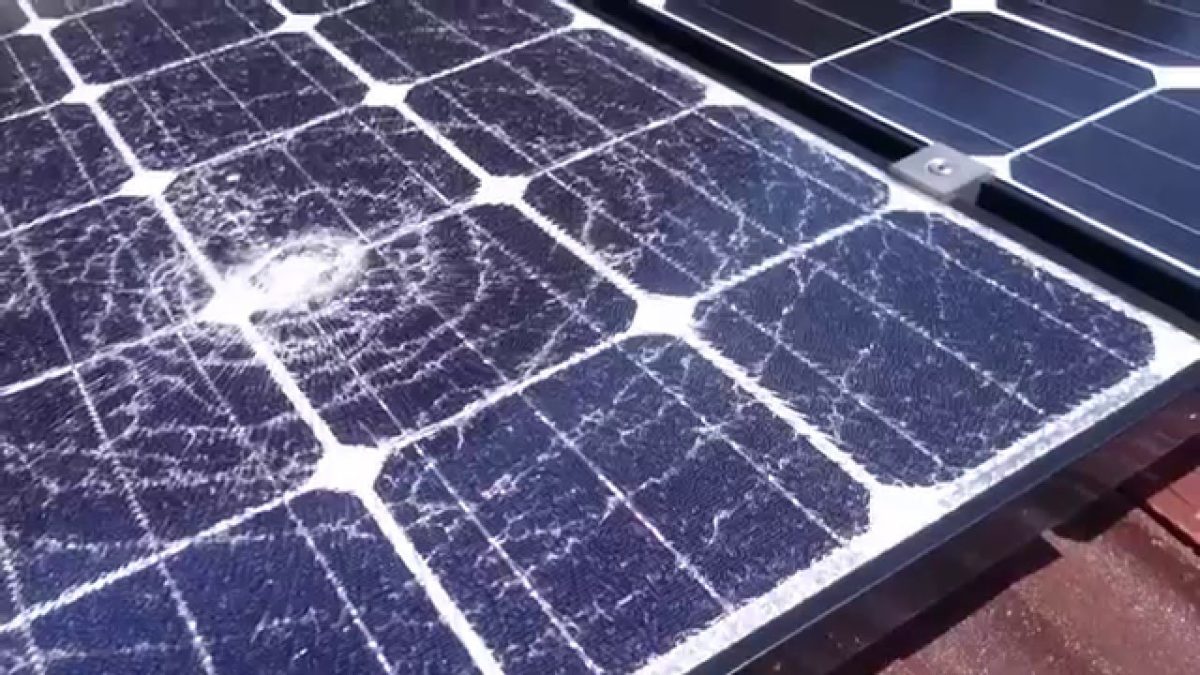
Hail remains the most expensive type of insured loss for the solar industry. Research from kWh Analytics and GroundWork Renewables indicates that standard 2mm glass modules are no longer sufficient for 52% of the contiguous U.S. to keep risk below an acceptable loss threshold.
In the highest-risk regions, which cover 13% of the U.S., both hail-hardened modules and robust stow protocols are required. Robust stow is defined as the execution of a 70-degree or greater tilt position during a storm. However, software-based stow can fail if operational policies are inadequate.
GroundWork Renewables testing data confirms that hail-hardened constructions, typically using 2.5mm or 3.2mm glass, offer significantly lower failure probabilities and provide a stronger baseline of protection for utility-scale developments.
Reliability
Operational intelligence provider Above Surveying analyzed data from over 3,000 assets and found that thermal anomalies do not follow a linear degradation path.
Instead, the data shows that defect rates, which include cell cracks and busbar peeling, accelerate significantly after year 7. This trend introduces meaningful long-term financial risk for projects that assume a constant rate of degradation over a 30-year life.
Additional reliability challenges include:
- The propeller effect: Azimuth Advisory Services documents that operational twist in tracker rows can reduce total yield by over 2% and increase the risk of module glass and cell cracking.
- Wind stow modeling: Array Technologies notes that using hourly wind data for energy modeling underpredicts losses by up to 4% because it fails to capture the 3-second gusts that trigger tracker safety stow positions.
- Fungal bio-soiling: Solar Unsoiled has identified black fungi as a driver of persistent losses, costing an estimated $330 million annually in the humid subtropical U.S. alone.
- Inverter shutdowns: SmartHelio reports that inverter shutdowns account for 28% of recoverable solar performance risk, with persistent overheating causing losses of approximately $15,000 per inverter annually.
Battery storage
As lithium iron phosphate (LFP) batteries dominate new storage deployments, the industry is struggling with state-of-charge inaccuracies.
ACCURE Battery Intelligence finds that these estimation errors can cost battery energy storage systems operators more than $1 million per GWh annually in dynamic markets like ERCOT. Because LFP batteries have a flat voltage curve, it is difficult for standard management systems to provide a reliable view of available energy, leading operators to maintain conservative buffers that leave tradable energy unused.
Furthermore, PowerUp reports that 75% of utility-scale battery sites show early signals of HVAC-related thermal anomalies. These cooling failures can lead to thermal runaway if unmanaged, making early anomaly detection essential for both safety and asset availability.
Regulation and the $1 million daily penalty
The regulatory landscape is shifting rapidly, introducing new classes of risk. Crux reports that new prohibited foreign entity rules take effect in 2026, yet only 38% of developers feel fully prepared to meet these requirements.
The financial consequences for falling behind on compliance are severe. Vaisala notes that non-compliance with heightened FERC cybersecurity and regulatory standards can trigger penalties of $1 million per day for renewable energy developers. Additionally, CAC highlights that tax insurance underwriters are tightening terms, with 75% of underwriters refusing to cover valuation step-ups above 25%, creating a constraint for project financing.
As the industry grows, the risks are becoming more localized, more technical, and more expensive. Success in the next phase of the energy transition will require moving beyond broad assumptions and toward a strategy rooted in granular, field-verified data.
This content is protected by copyright and may not be reused. If you want to cooperate with us and would like to reuse some of our content, please contact: editors@pv-magazine.com.



By submitting this form you agree to pv magazine using your data for the purposes of publishing your comment.
Your personal data will only be disclosed or otherwise transmitted to third parties for the purposes of spam filtering or if this is necessary for technical maintenance of the website. Any other transfer to third parties will not take place unless this is justified on the basis of applicable data protection regulations or if pv magazine is legally obliged to do so.
You may revoke this consent at any time with effect for the future, in which case your personal data will be deleted immediately. Otherwise, your data will be deleted if pv magazine has processed your request or the purpose of data storage is fulfilled.
Further information on data privacy can be found in our Data Protection Policy.