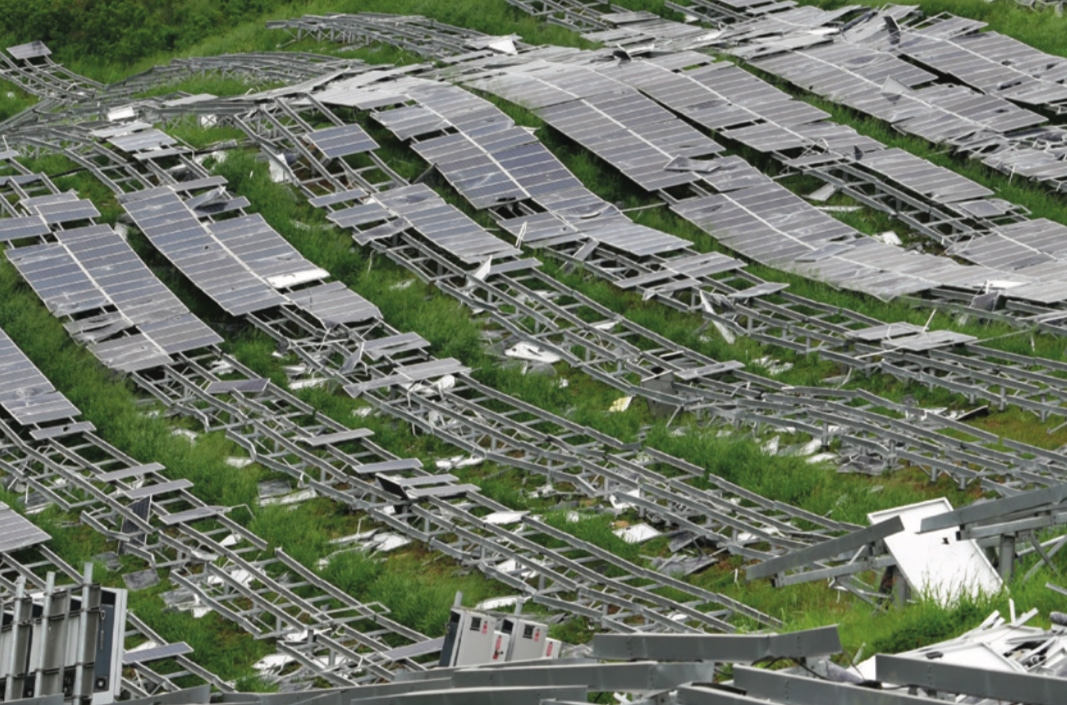





Renew Risk released its U.S. severe connective storm (SCS) Model to address a gap in how the insurance industry calculates potential losses from hail, tornadoes, and wind.
The company reported that while hail represents only 6% of loss incidents, it drives 73% of total financial losses for solar projects. The software arrives as the United States is expected to add 86 GW of utility-scale solar capacity in 2026, much of it located in storm-prone regions.
Severe convective storms became a major financial burden for the energy sector in 2025, accounting for 51% of natural catastrophe losses and totaling $46 billion. The Renew Risk model uses machine learning and physics-based AI to simulate how these storms interact with specific engineering features of a solar farm. This includes analyzing glass thickness, tracker stow angles, and the mechanical reliability of mitigation systems.
The importance of site-specific engineering was demonstrated during a 2024 storm in Texas. The 350 MW Fighting Jays Solar Farm suffered significant damage to thousands of panels during a hail event. However, two nearby solar farms using automated weather tracking and vertical stow positions reported no direct hail damage. A third site in the same area sustained only minor damage caused by a motor failure in its defensive system.
The new modeling tool integrates an industry exposure database that Renew Risk updates monthly. This database provides calculations for total insured value and potential business interruption costs. The company developed the engine in partnership with Vāyuh, an AI firm specializing in atmospheric physics.
Renew Risk was founded in 2021 and recently raised $5.9 million in seed funding at a $20.2 million valuation. The company claims its modeling approach allows it to develop new catastrophe risk tools in nine months, compared to the three-year timeline typical of traditional providers. The launch follows the release of offshore wind risk models for markets in Europe and Asia.
This content is protected by copyright and may not be reused. If you want to cooperate with us and would like to reuse some of our content, please contact: editors@pv-magazine.com.



By submitting this form you agree to pv magazine using your data for the purposes of publishing your comment.
Your personal data will only be disclosed or otherwise transmitted to third parties for the purposes of spam filtering or if this is necessary for technical maintenance of the website. Any other transfer to third parties will not take place unless this is justified on the basis of applicable data protection regulations or if pv magazine is legally obliged to do so.
You may revoke this consent at any time with effect for the future, in which case your personal data will be deleted immediately. Otherwise, your data will be deleted if pv magazine has processed your request or the purpose of data storage is fulfilled.
Further information on data privacy can be found in our Data Protection Policy.