




The Pew Charitable Trusts released a policy playbook on how to use distributed energy resources (DERs) to help solve the nation’s energy affordability and reliability challenges.
While the number of adopted DER policies jumped nearly 80% last year, DER policy in the United States falls far behind other nations, leaving what Pew calls “vast untapped potential to scale DERs to the benefit of American consumers and the nation’s electric grid.”
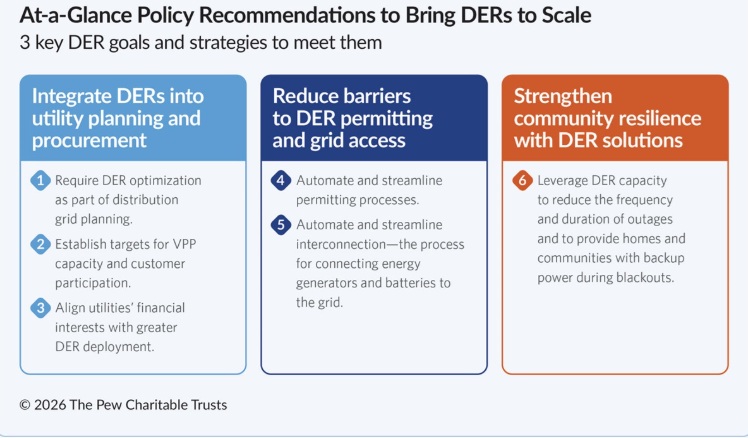
The policies focus on three goals: Integrating DERs into utility planning and procurement, reducing barriers to DER permitting and grid access, and strengthening community resilience.
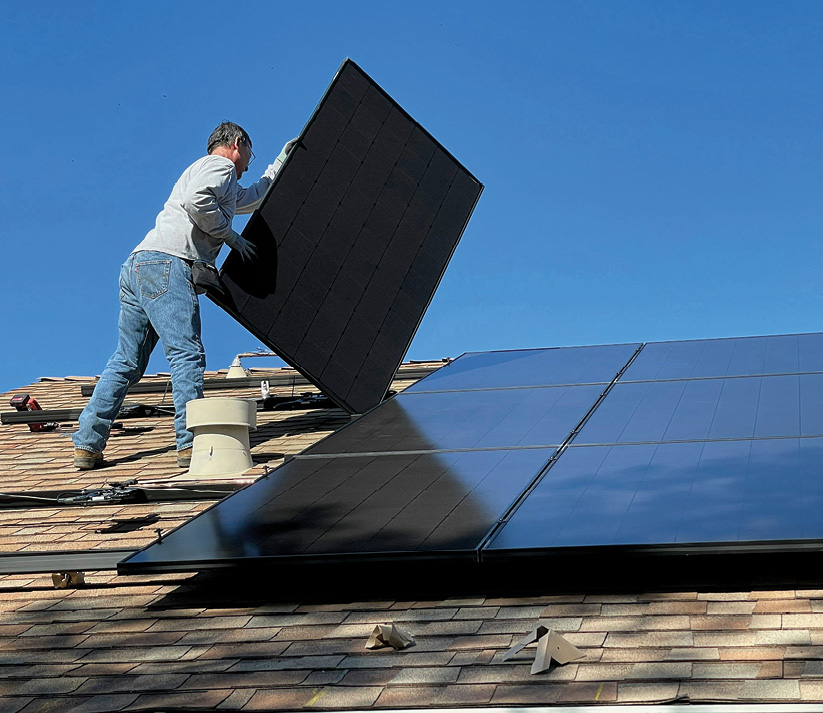
Distributed energy resources are rooftop and community solar projects generally under 5 MW and on relatively small tracts of land. The key is that the power is used very close to where it’s generated.
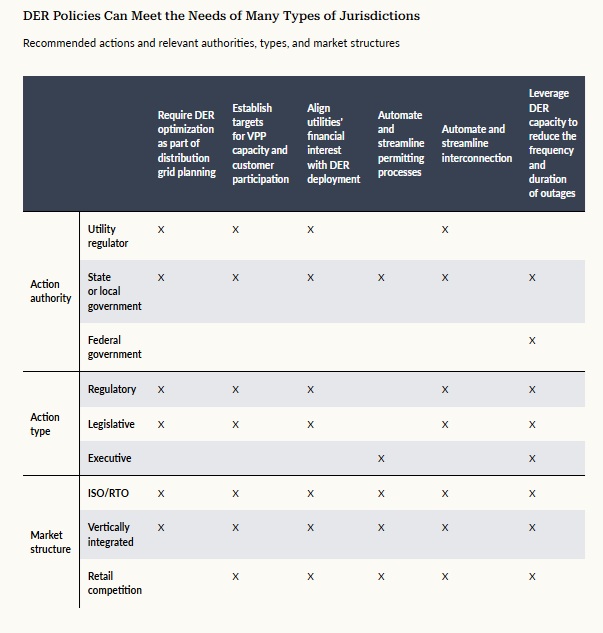
The Pew policy playbook offers six recommendations for boosting adoption:
- Require DER optimization as part of distribution grid planning
- Establish targets for VPP capacity and customer participation
- Align utilities’ financial interest with DER deployment
- Automate and streamline permitting processes
- Automate and streamline interconnection
- Leverage DER backup capacity to reduce the frequency and duration of outages.
Policies
The playbook authors point out that distribution planning has typically been done by local utilities on their own, while the recommendation is that it should be part of integrated resource plan (IRP) processes that most utilities conduct every few years. To achieve this, the report says that states must coordinate with regional transmission operators, where relevant, and require that utilities be more transparent around modeling and assessment of resource needs and options.
In states where utilities are not responsible for IRP, Pew researchers suggest that state commissions can use the Australian Energy Market Operator (AEMO) as a model and require utilities to develop robust distribution plans. The Pew report includes a cast study on Australia’s plan for DER optimization.
The playbook recommends an action step for the legislature that suggests providing guidance to the state commission to evaluate the planning processes of utilities to ensure that DERs are “Fully leveraged to maintain or improve affordability of electric rates while also meeting projected increases in demand.”
State commissions are offered nine action steps on how to update distribution plan methodologies, developing consensus on increasing DER deployment scenarios and conducting distribution system needs and analyses and plan reviews. The report authors again point to Australia’s AEMO as an example.
Success stories
The playbook offers example of policy successes in New York, Texas, Virginia, Puerto Rico the UK and the AEMO in Australia.
In New York, a landmark regulatory framework called reforming the Energy Vision (REV) was approved by the Public Service Commission (PSC) in 2016. This vision was designed to move utilities from the traditional model of rewarding investment in utility poles and wires toward a market- and performance-based revenue model.
The New York PSC also issued its Track Two order that offered a “share of net benefits” incentive to encourage utilities to pursue DERs and other non-wires alternatives (NWA). The New York case study in the report notes that by implementing the share-of-net-benefits approach in a 2020 rate case, utilities were given “a clear pathway to profit from DER investments in the same way they do from traditional assets”.
In Australia, coal use began dropping in the 2010s and the country turned to renewable generation, with rooftop solar contributing nearly 13% of Australia’s total energy generation in 2025. In 2020, the AEMO projected that by 2040, 63% of the country’s coal-fired generation would be retired and DER capacity would have doubled or tripled.
As costs and transmission line complexity rose, the Australian Energy Market Commission made a rule change in 2024, requiring AEMO to consider DERs as an optimized input to ISPs and requires that is assess all investment options for managing and enhancing the national electric system. The report states that these rules position distribution resources as “central to Australia’s efforts to not only expand its electric system but also transition it away form its historical reliance eon coal facilities.”
Also included in the playbook is a look at policy on virtual power plants (VPPs), using Virginia as a model. In 2025 Virginia enacted a landmark law that required Dominion Energy to start pilot program to manage demand through use of VPPs and mandates that the pilot include DER aggregations of up to 450 MW. The pilot will run through the summer of 2028, after which time the Virginia State Corporation Commission will assess its success in delivering grid services during peak demand periods.
Opportunity
The Pew policy playbook emphasizes the great opportunity to bring an affordable, reliable, clean, and flexible energy future offered by bringing DERs and VPPs to scale.
This content is protected by copyright and may not be reused. If you want to cooperate with us and would like to reuse some of our content, please contact: editors@pv-magazine.com.





By submitting this form you agree to pv magazine using your data for the purposes of publishing your comment.
Your personal data will only be disclosed or otherwise transmitted to third parties for the purposes of spam filtering or if this is necessary for technical maintenance of the website. Any other transfer to third parties will not take place unless this is justified on the basis of applicable data protection regulations or if pv magazine is legally obliged to do so.
You may revoke this consent at any time with effect for the future, in which case your personal data will be deleted immediately. Otherwise, your data will be deleted if pv magazine has processed your request or the purpose of data storage is fulfilled.
Further information on data privacy can be found in our Data Protection Policy.