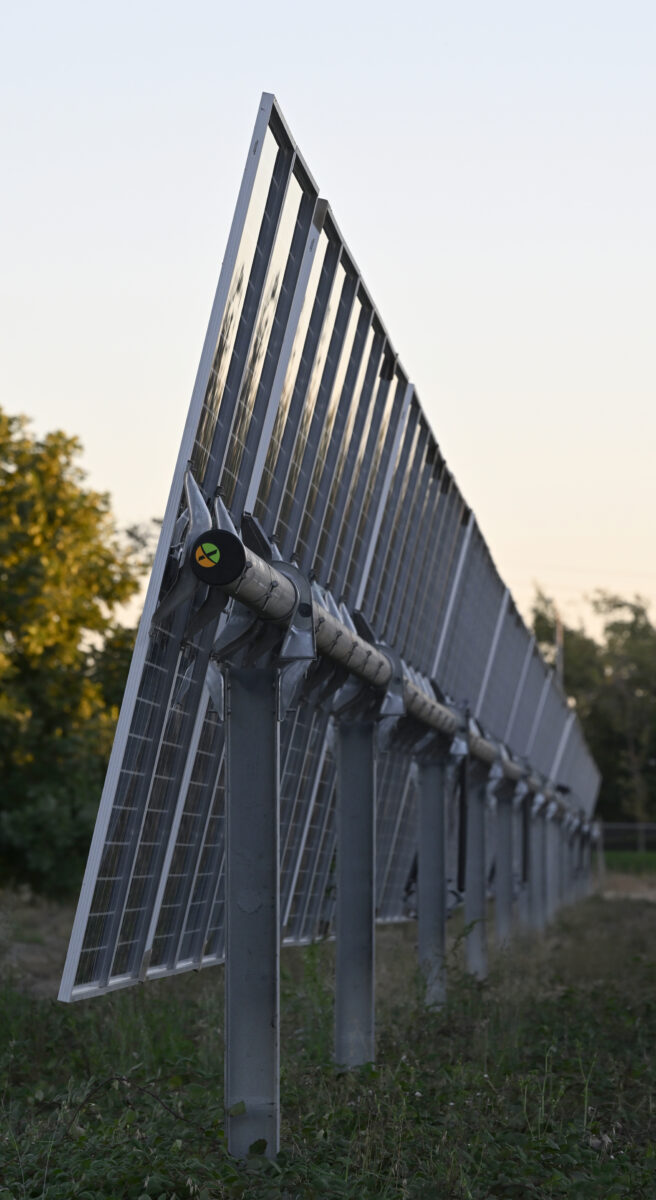





Last month, Oregon-based renewable energy insurance firm kWh Analytics announced an agreement with California-based tracker manufacturer Nextpower to share data in order to improve how information on solar operations is relayed to insurance carriers. The pilot program will collect data from Nextpower trackers to be used in creating better models that reflect a more dynamic and evidence-based view of project risk.
Jason Kaminsky, chief executive officer of kWh Analytics, explained to pv magazine USA that losses from hail and other extreme weather events can potentially price production shortfall insurance out of the reach of many developers and owners. Part of the reason for this, he says, is because carriers are not looking closely enough at day-to-day operations and thus are not correctly modeling risk or rewarding risk mitigation efforts.
Kaminsky aims to develop additional partnerships with industry and operators to evaluate operational experience and evolving technology to better understand all of the factors that contribute to production shortfalls over time. Ultimately, the argument goes, this will lead to better project financing and products. The interview has been edited and condensed.
pv magazine USA: Why are insurance carriers suitable institutions for collecting and analyzing solar projects to put a price on risk?

Image: kWh Analytics
Jason Kaminsky: Banks, where I used to work, are not great at accepting volatility when structuring a loan. They try to basically structure out all volatility from their underwriting. And insurance companies are really good at accepting volatility. That’s what they do all day long.
As a result, we have developed the Solar Revenue Put and the Wind Proxy Hedge, both fancy names for what are essentially production shortfall insurance for solar farms and wind farms, respectively. We reduce cash flow volatility to by insuring downside production scenarios. A developer buys them at the time of financing a project in order to get a larger loan from the bank. Insurance becomes a source of project finance optimization.
From our point of view as insurers taking on the volatility we focus on reliability. The issue mostly comes down to production-linked risk. Is the asset going to produce what you think it’s going to produce? And that’s led to years of research and solar risk assessment about all the various things that could go wrong with an asset as it gets older.
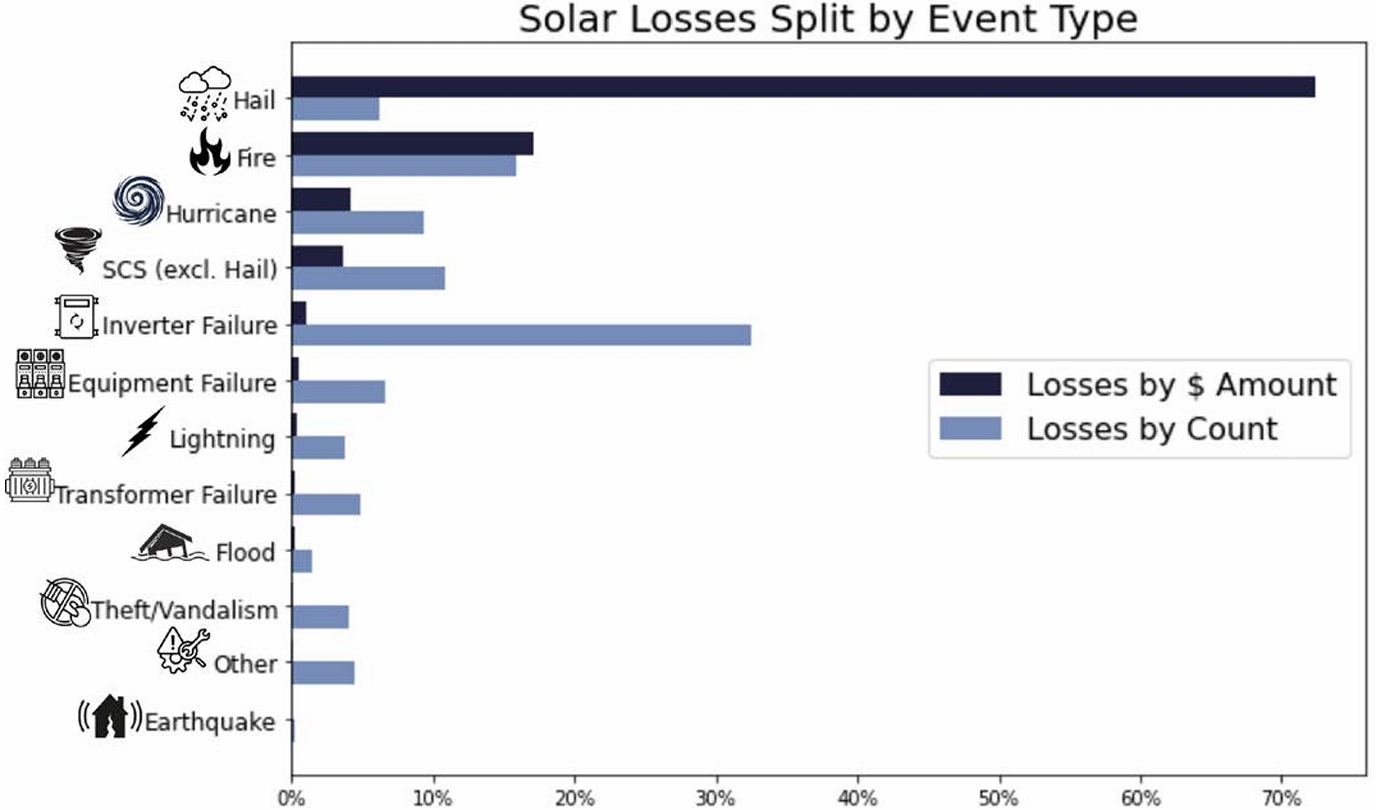
pv magazine USA: According to your 2025 Solar Risk Assessment report, hail accounts for 73% of total financial losses for solar projects despite representing only 6% of loss incidents, and this percentage has grown over previous years. How has the industry’s appreciation of hail risk evolved?
Jason Kaminsky: I think we’re still in the kind of early days of figuring out how, as an industry, we’re addressing some of these perils. No one talked about hail prior to 2019. Then we saw the $80 million Midway solar project claim. And then all of a sudden everyone woke up to the fact that, hey, we’re putting glass out in a field in Texas. Maybe we should think about how to do that with a risk management lens.
And, credit to the industry, I’d say we’ve all come together to try and figure out what sorts of behaviors, such as tracker stow modes for hail, flood and wind, and what sorts of equipment can be more resilient in the environments in which they’re installed. But we’re still somewhere in the first or second inning, using a baseball analogy, as we try to understand the costs and economic trade-offs associated with using more resilient equipment and practices, and then underwriting to that.
pv magazine USA: Would you say lack of information is a real problem in the solar insurance industry? Where is the industry now with regard to rates that reflect realistic risk models?
Jason Kaminsky: Risk-adjusted rates have dropped dramatically over the past 12 months across the entire property insurance industry, renewable energy included. But on the whole, the risk profiles themselves have not changed. The CEO of Chubb said on a recent earnings call that this severe rate reduction is “dumb” because it is not based on fundamentals. With these lower-than normal rates, it can seem like insurers are signing off on non-robust configurations, such as fixed-tilt racking in Texas. But the insurers are really just trying to compete right now: There’s an oversupply of capital in the market.
There’s a funny temporal element where the project owner is making a 40-year investment and taking a seven- to 12-year loan, maybe longer than that, to build a productive site. At the same time, insurance reprices every single year. The hard thing with these mismatched cycles is that you get one where insurers are sort of chasing premiums and not asking the questions that they should be asking. And then a year later, they take some losses, capital leaves the market, the carrier drops the client, and all of a sudden everyone cares again.
pv magazine USA: So, the developer can get the policy in the risk-acceptant part of the cycle and then lose it after an event causes everybody to pay attention.
Jason Kaminsky: That means, unfortunately, the owners are not getting the signals that they should be from the insurance market, and those carriers are not taking a long-term relationship view. I’ll call it a market problem.
One of our company’s missions, aside from growing a profitable business, is to help our clients build better infrastructure and avoid getting stuck. They’re holding a material amount of risk. It’s not from an accounting perspective on their balance sheet, but it’s contingent liability. Whether or not it’s booked, they’re holding it.
pv magazine USA: I guess the owner’s risk is that it has to produce a contracted amount of power, and there is some possibility that the project could lose insurance and so not be able to operate at all.
Jason Kaminsky: Developers are really, really good at a lot of things. They’re really good at finding and developing land, at sourcing equipment, at managing tax structures, and at raising capital. Most of them are not experts in natural catastrophes because that is not a muscle that they’ve had to develop over the last 20 years. We are very good at that. We have knowledge that I think is unique, and we could be helpful to people. We can give them feedback, but we can’t do that unless we actually know what they’re building.
pv magazine USA: What’s interesting now is that a lot of the big utility-scale projects are now just reaching middle age, right? The information that we didn’t know then, we are now learning from projects that have been operating for half their lifespans.
Jason Kaminsky: Hopefully, maybe a third of their lifespans.
pv magazine USA: Even better. What do you know about the elements that impose risk on a project that you didn’t know in the beginning? As you’ve come along, how has the amount of information that you’ve been able to look at changed? As you say, you want to make money. In your 2005 risk assessment report, you point out that solar production is, on average, 8.6% lower than projected. You can’t be making money if you’re insuring something that’s going to be constantly underproducing or breaking down due to weather events.
Jason Kaminsky: We know production estimates are not always accurate, right? There’s no single reason why. I’m still surprised by some of the technical reasons why. Some of it is market incentives in the financing process. Some of it is inverter availability. A lot of it is shading and tracking issues. Whatever they are, there are lots of them that, on the aggregate, just erode the ability to meet performance targets.
The good news is that there’s a willingness to talk and share information across the industry. There’s not a lot of avenues for it, really. I mean, there’s the federal labs, which are sort of cyclical based on the administration’s priorities. So, it is up to us in the insurance sector to consolidate and curate research from those communities and bring it together in a very digestible manner.
An example is our annual Solar Risk Assessment report that you cited earlier. There’s very rich content in there. And if you go back seven or eight years ago to the very first one, a lot of those things that we were looking at as sort of emerging research are now very much accepted.
pv magazine USA: You’ve got to be really accurate about that. So how has that changed in terms of your ability to process information from the field and then turn that into something useful in terms of assessing risk?
Jason Kaminsky: I have my foot in many different communities; in the finance community, in the asset management community, in the insurance community, and I’ve been very heartened that on the asset management and O&M [operations and maintenance] side, people are pretty open and willing to share information. Because I think there’s an acceptance that it’s not a competitive advantage for my neighbor’s system to have a giant loss, right? That’s bad for everyone.
There’s a lot of data out there that we can source, much of it from manufacturers. So, Nextpower has a lot of trackers in the field. It has a lot of sensors. It knows whether or not its equipment is going into stow mode. It knows the specs on everything. We’ve developed a relationship with Nextpower so we can use that data for our underwriting.
I think that our partnership with Nextpower is an early indicator of some of those collaborations that will occur between industry and the financial community as ways to share data more fluidly and enable our clients to get credit for risk management and best practices. We’re also going through an exercise of how to build those partnerships and then be able to say, “Okay, if you use technology ‘X,’ there might be a definable risk reduction that we can price.”
We as a carrier should really like that, and give clients a more competitive rate based on real data, right? And we do really like that.
This content is protected by copyright and may not be reused. If you want to cooperate with us and would like to reuse some of our content, please contact: editors@pv-magazine.com.





By submitting this form you agree to pv magazine using your data for the purposes of publishing your comment.
Your personal data will only be disclosed or otherwise transmitted to third parties for the purposes of spam filtering or if this is necessary for technical maintenance of the website. Any other transfer to third parties will not take place unless this is justified on the basis of applicable data protection regulations or if pv magazine is legally obliged to do so.
You may revoke this consent at any time with effect for the future, in which case your personal data will be deleted immediately. Otherwise, your data will be deleted if pv magazine has processed your request or the purpose of data storage is fulfilled.
Further information on data privacy can be found in our Data Protection Policy.