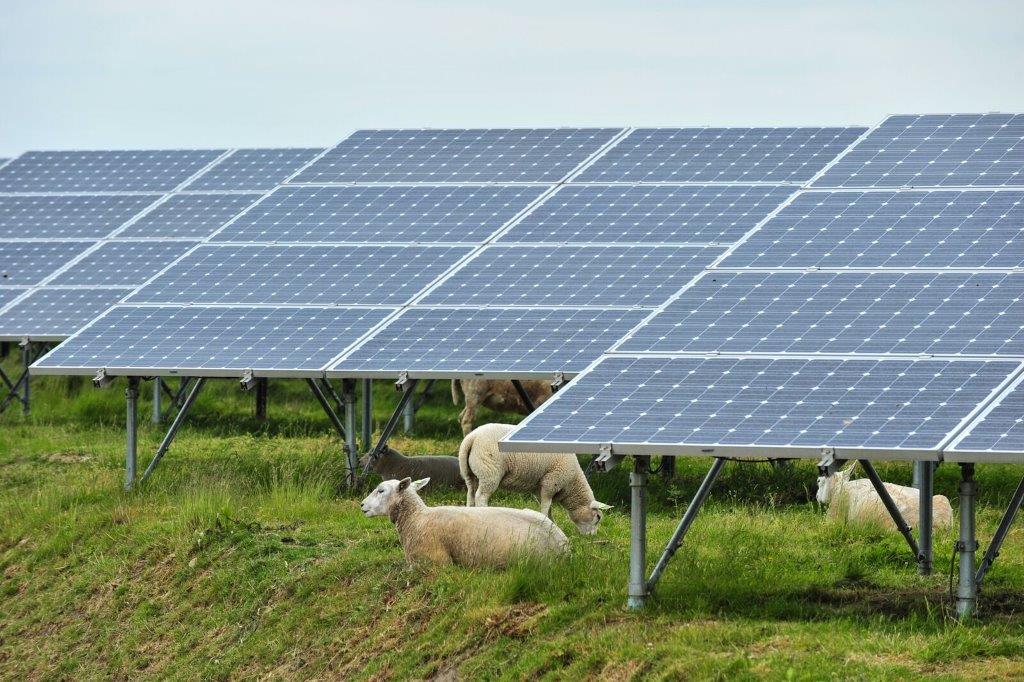





A research team from the University of Minnesota in the United States has investigated the impact of agrivoltaics arrays on the yield and the nutritional quality of grasses and legumes for grazing dairy cattle.
“This study is among the first to evaluate forage biomass and forage quality of multiple grass and legume species grown under different agrivoltaic solar array designs in a grazing dairy system,” corresponding author Bradley J. Heins told pv magazine. “We wanted to determine how solar intensity and solar panel configuration influence both yield and feed quality for forages. We need more research on what to grow under solar panels, and this is some of the early research that gives guidance to farmers and solar developers on what to plant.”
He added that his team is planning to expand the research in the coming summer and to explore vertical bifacial solar panels. “We will compare these to a regular ground mount solar installation for cattle grazing. We are going to really look at the economics of different solar array configurations,” he said. “We are also going to evaluate long-term animal performance and grazing behavior in agrivoltaic systems.”
The crops were planted beneath a 30 kW PV site, a 50 kW PV site, and one control site in the university’s vicinity.
The 30 kW solar site had fixed solar arrays mounted at 35 degrees south, while the 50 kW site was square-shaped, with a flat-top array using reflectors. In both sites, the panels were mounted 2.5 to 3.0 m off the ground. No cattle were allowed to graze any of the experimental plots during the study, which was conducted from May 2022 to September 2022 and from May 2023 to September 2023.
Forage crops included alfalfa, field peas, meadow fescue, orchardgrass, red clover, brown midrib sorghum-sudan grass, and white clover. Furthermore, the crop ranged included three grass-and-legume mixes with either alfalfa, red clover, or white clover. Forage samples were clipped three times per year, when forages reached approximately 25-35 cm in height, which corresponded to the recommended height for lactating dairy cows.
Samples were dried at 60 C for 99 hours to determine dry matter concentration, and two 2 samples from each plot were randomly selected for botanical composition. They were then sent to a lab, where they were analyzed for crude protein, neutral detergent fiber, acid detergent fiber, mineral concentrations, and total-tract neutral detergent fiber digestibility (TTNDFD).
The analysis showed that forage biomass was lower at the 50 kW solar site (3,223 kg/ha) than at the 30 kW solar site (8,968 kg/ha) and the control pasture (9,987 kg/ha). The 50 kW forages had greater crude protein on a dry matter basis, at 23.8%, compared with 20.1% at the 30 kW site and 18.2% at the control pasture. The 50 kW forages also had greater TTNDFD, at 54.4%, compared with 52.3% at the 30 kW site and 49.1% at the control pasture.
“The results showed that forage quality may be maintained or even enhanced in agrivoltaic systems,” concluded Heins. “We didn’t really know what to expect. But we found grasses – namely, orchardgrass and meadow fescue – to have great biomass production under solar panels compared to growing in a regular pasture.”
The results have appeared in “Agrivoltaic arrays and effects of forage biomass and nutritive value of grasses and legumes for grazing dairy cattle,” published in JDS Communications. Scientists from the University of Minnesota and the University of New Hampshire have participated in the research.
This content is protected by copyright and may not be reused. If you want to cooperate with us and would like to reuse some of our content, please contact: editors@pv-magazine.com.



By submitting this form you agree to pv magazine using your data for the purposes of publishing your comment.
Your personal data will only be disclosed or otherwise transmitted to third parties for the purposes of spam filtering or if this is necessary for technical maintenance of the website. Any other transfer to third parties will not take place unless this is justified on the basis of applicable data protection regulations or if pv magazine is legally obliged to do so.
You may revoke this consent at any time with effect for the future, in which case your personal data will be deleted immediately. Otherwise, your data will be deleted if pv magazine has processed your request or the purpose of data storage is fulfilled.
Further information on data privacy can be found in our Data Protection Policy.