




Lawmakers in Minnesota honored former House Speaker Melissa Hortman by naming the state’s community solar garden (CSG) program after her. Hortman, her husband Mark, and their dog Gilbert were fatally shot inside their Brooklyn Park home in June 2025.
After passing through the House and Senate with bipartisan votes, Governor Walz signed the bill into law to honor her leadership in shaping the state’s community solar program.
“Naming this program in her honor ensures her legacy lives on as her work continues to shape our future,” Governor Walz said.
The legislation driven by Hortman, in addition to establishing community solar in the state, implemented a solar energy standard that required public utilities to adopt renewable energy and accelerated growth of Minnesota’s solar industry. Mandates requiring investor-owned utilities such as Xcel Energy to source at least 1.5% of its electricity from solar power by 2020 and 10% by 2030 helped accelerate Minnesota’s transition to renewable energy.
Minnesota’s original community solar garden program, passed in 2013, was the first in the country and later became a national model adopted by more than a dozen other states. Community solar programs are designed to enable people to receive solar electricity without installing or purchasing the panels themselves. Subscribers are typically renters, those whose rooftops are not oriented for solar or those who can’t afford the upfront costs. The programs allow these ratepayers to participate in a shared solar project, and they typically lock in electricity rates over a set period of time.
Supporters of naming the program after Hortman said her work helped Minnesota-based companies expand in the solar industry, creating thousands of jobs and strengthening the state’s clean energy economy.
Kevin Cray, vice president of government and regulatory affairs at the Coalition for Community Solar Access (CCSA) called Speaker Hortman “a staunch champion for making sure the community solar program was thoughtful and adopted the right things.” He recalled that she continued that through the final process. “We wouldn’t have the program we have today without her,” he said.
Ten years after Minnesota’s community solar legislation was enacted, bill HF 2310 was passed and is what Cray referred to as an entire program rewrite, the most significant change perhaps being expanded access to solar energy for low- and moderate-income (LMI) households.
A recent report from the Minnesota Department of Commerce confirms that the community solar garden program driving equitable access to clean energy for LMI ratepayers, while maintaining the state’s leadership in community solar deployment. According to Pete Wyckoff, deputy commissioner of the Minnesota Department of Commerce.
Read more about the Department of Commerce report here.
A Minnesota solar developer focused on LMI communities, Cooperative Energy Futures, has installed about 13 MW of community solar between the two iterations of the program, according to Pouya Najmaie, policy and regulatory director. Najmaie, told pv magazine USA that, overall, they’ve been very happy with the community solar program, “especially the new LMI CSG program. We have always focused our efforts on subscribing low-to moderate-income communities so the new program’s carve out and better incentive structure for LMI populations significantly helped us achieve our goals and, more importantly, create a more equitable renewable transition in Minnesota,” he said.
In the previous iteration of the program administration was handled by the utility Xcel, whereas that has transitioned to the Department of Commerce. “Commerce has been a very fair and responsive administrator,” Najmaie said. “They seem to really understand the value of the CSG program.”
The new program has a cap that graduates downward, eventually settling at 60 MW in a few years. Najmaie noted that the cap is the only downside and “the unfortunate result of a compromise necessary to pass the new LMI program.”
According to the Minnesota Solar Energy Industries Association (MNSEIA), Minnesota ranked number one in the nation for the largest CSG program. The trade association estimated that as of 2022, there was over 860 MW of community solar in the state.
While the first iteration of Minnesota’s bill was a pacesetter for other state’s programs, ten years after it was enacted it had become fairly stale, Cray said, and other states had picked up and expanded upon the Minnesota model. In 2022, MNSEIA noted that the Minnesota program was unseated in 2022 by New York “due to outdated rules and gridlocked negotiations.” Cray noted that in addition to New York, Illinois, Maryland, Massachusetts also enacted and expanded Minnesota-like legislation.
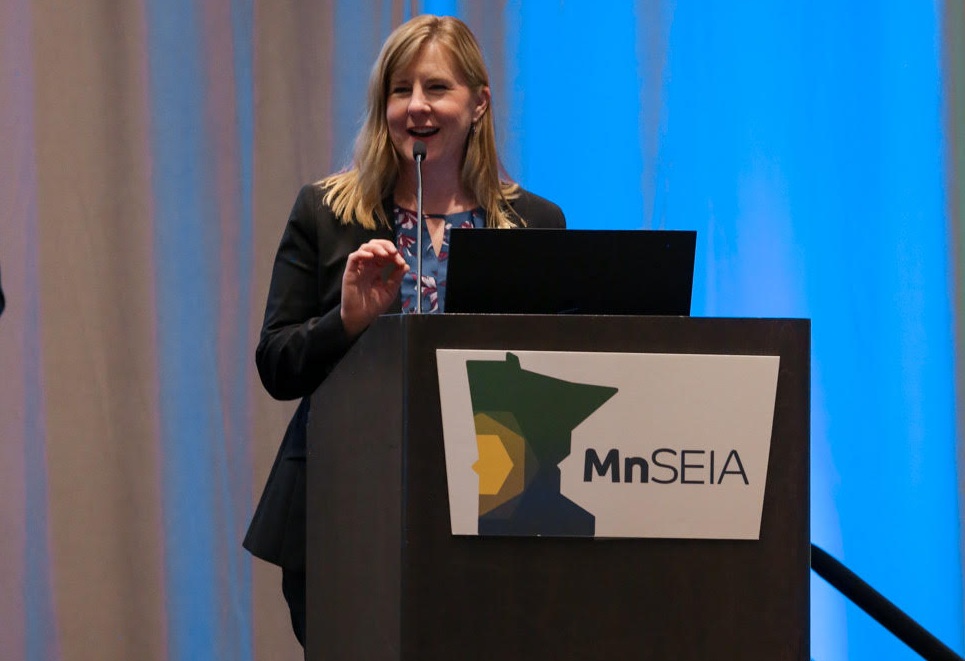
Naming the Minnesota program the Melissa Hortman Community Solar Garden Program is almost as significant as she was to the program itself. “Speaker Hortman’s leadership is woven into the very foundation of Minnesota’s community solar program, “Logan O’Grady, executive director of MnSEIA told pv magazine USA. “Naming the program in her honor is not just appropriate—it reflects the reality that without her vision and persistence, Minnesota would not be the national leader in community solar that it is today. Her influence extends beyond our state, helping shape how policymakers across the country think about equitable access to clean energy.”
This content is protected by copyright and may not be reused. If you want to cooperate with us and would like to reuse some of our content, please contact: editors@pv-magazine.com.



By submitting this form you agree to pv magazine using your data for the purposes of publishing your comment.
Your personal data will only be disclosed or otherwise transmitted to third parties for the purposes of spam filtering or if this is necessary for technical maintenance of the website. Any other transfer to third parties will not take place unless this is justified on the basis of applicable data protection regulations or if pv magazine is legally obliged to do so.
You may revoke this consent at any time with effect for the future, in which case your personal data will be deleted immediately. Otherwise, your data will be deleted if pv magazine has processed your request or the purpose of data storage is fulfilled.
Further information on data privacy can be found in our Data Protection Policy.