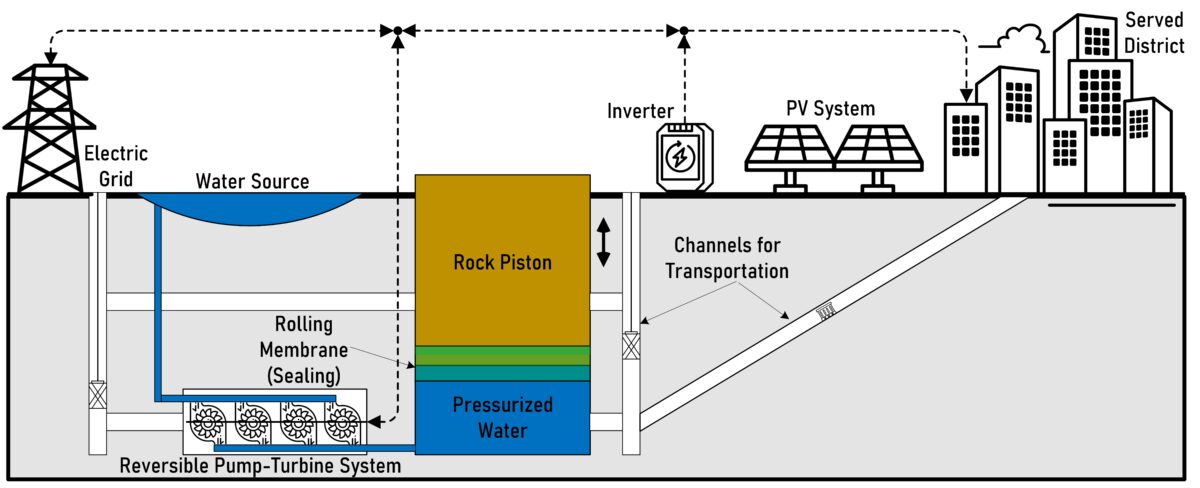





An international research team has found that combining utility-scale solar PV with gravity-based hydraulic hydro storage (HHS) could deliver a levelized cost of energy (LCOE) as low as $0.022/kWh in select U.S. locations.
The study analyzed 936 sites across the country using multi-objective capacity optimization to assess the techno-economic viability of integrating PV and HHS at gigawatt-hour scale.
“This represents the first comprehensive geospatial benchmark for giga-scale HHS paired with utility-scale solar PV,” co-author Mohamad T. Araji told pv magazine. “Previous research focused mainly on sub-100 MWh systems or single-site conceptual models.”
Muhammed A. Hassan, another co-author, noted that the study systematically models PV-HHS operation while accounting for nighttime power demand, spatial load variability, solar resources, and regional costs. “Multi-objective optimization allows us to define the precise conditions under which this technology can move from theory to grid-scale reality,” he said.
The system consists of three elements: a PV array as the primary generation source, an HHS unit serving as the energy buffer, and an aggregated commercial district load representing 2,000 buildings. When PV output exceeds demand, surplus electricity powers a reversible pump-turbine, lifting a rock piston and storing energy as gravitational potential. During discharge, the piston’s weight drives pressurized water through the same turbine to generate electricity.
Construction leverages standard mining techniques, including cutting the piston from solid bedrock and installing a rolling membrane seal. Storage capacity scales with the fourth power of the piston’s radius, enabling GWh-scale storage sufficient to power a city for a day. Unlike conventional pumped hydro, HHS does not rely on elevation differences, widening its potential deployment, the scientists stressed.
PV panels were modeled with a 20.3% efficiency, facing south at a tilt equal to local latitude. The HHS system was assumed to have 80% round-trip efficiency and eight hours of storage. Load profiles were derived from TMY3 weather data, and MATLAB optimization balanced low LCOE against high reliability, measured by loss of load probability (LOLP).
Araji highlighted that in high-potential regions such as New Mexico, Nebraska, and Maine, the LCOE can reach $0.022/kWh because revenue from surplus solar exports offsets capital and operational costs. “The system can achieve extremely high self-sufficiency at district scale, with a levelized cost of storage (LCOS) below $0.166/kWh, competitive with utility-scale batteries for long-duration applications,” he said.
Across climates, storage requirements ranged from 1.012 GWh to 4.232 GWh, with PV capacity typically lower in southern latitudes (0.626–2.305 GW). Around 75% of locations achieved an asset-level LCOE below $0.093/kWh, and most maintained an LOLP under 3.2%, demonstrating robust performance despite varying weather conditions.
“The feasibility of these giga-scale projects is highly influenced by local policy,” the academics emphasized. “The state-specific power purchase agremeent (PPA) structures and regional PV capital costs are the primary determinants of the system’s relative performance. For gravity storage to reach its full potential, site selection must prioritize a convergence of favorable geological conditions and supportive electricity market designs.”
The research findings were presented in “Techno-economic analysis of utility-scale photovoltaic plants with hydraulic hydro gravity storage for self-sufficient cities,” published in Energy Conversion and Management. Researchers from Canada’s University of Waterloo and Egypt’s Cairo University have participated in this work.
This content is protected by copyright and may not be reused. If you want to cooperate with us and would like to reuse some of our content, please contact: editors@pv-magazine.com.





By submitting this form you agree to pv magazine using your data for the purposes of publishing your comment.
Your personal data will only be disclosed or otherwise transmitted to third parties for the purposes of spam filtering or if this is necessary for technical maintenance of the website. Any other transfer to third parties will not take place unless this is justified on the basis of applicable data protection regulations or if pv magazine is legally obliged to do so.
You may revoke this consent at any time with effect for the future, in which case your personal data will be deleted immediately. Otherwise, your data will be deleted if pv magazine has processed your request or the purpose of data storage is fulfilled.
Further information on data privacy can be found in our Data Protection Policy.