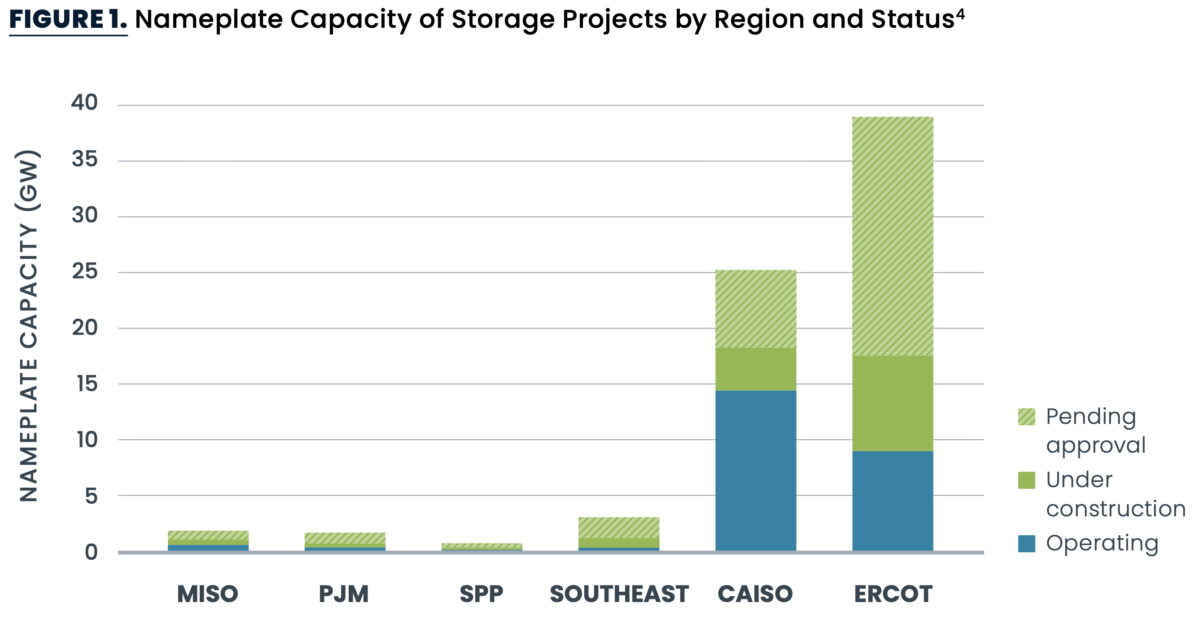





Battery energy storage system (BESS) deployment in the U.S. is highly concentrated in two states: Texas, which offers “connect and manage” interconnection, and California, which has provided BESS with “15 years of policy and market support,” says an analysis published by the nonprofit consultancy GridLab.
But BESS deployment in four Eastern U.S. grid regions pales in comparison, with Texas having deployed nearly ten times more storage than the eastern regions combined, as shown in the featured image above, from the study.
“Texas and California, two very different states, have proved that grid-scale battery storage can effectively tackle rising peak demand, yet nearly half of the United States grid is not maximizing the benefits of storage,” said GridLab Executive Director Ric O’Connell.
The BESS report evaluates “why eastern markets, facing unprecedented load growth and rising consumer costs, are so far behind in storage deployment when they urgently need flexible sources of power,” he said.
Of the four eastern markets considered, three are served by the transmission grid operators SPP, MISO and PJM, and the fourth consists of Southeastern states that are not served by a grid operator.
Problems
Holding the eastern grid regions back are problems with market design, interconnection processes, and procurement design, as well as planning and modeling limitations, says the study.
Modest BESS deployment in the Eastern U.S. is not due to “a lack of developer interest or technological viability,” the study adds. The graph below, from the study, shows “latent interest” by BESS developers in the Eastern U.S., with 140 GW of BESS projects active in interconnection queues, as shown in dark blue.
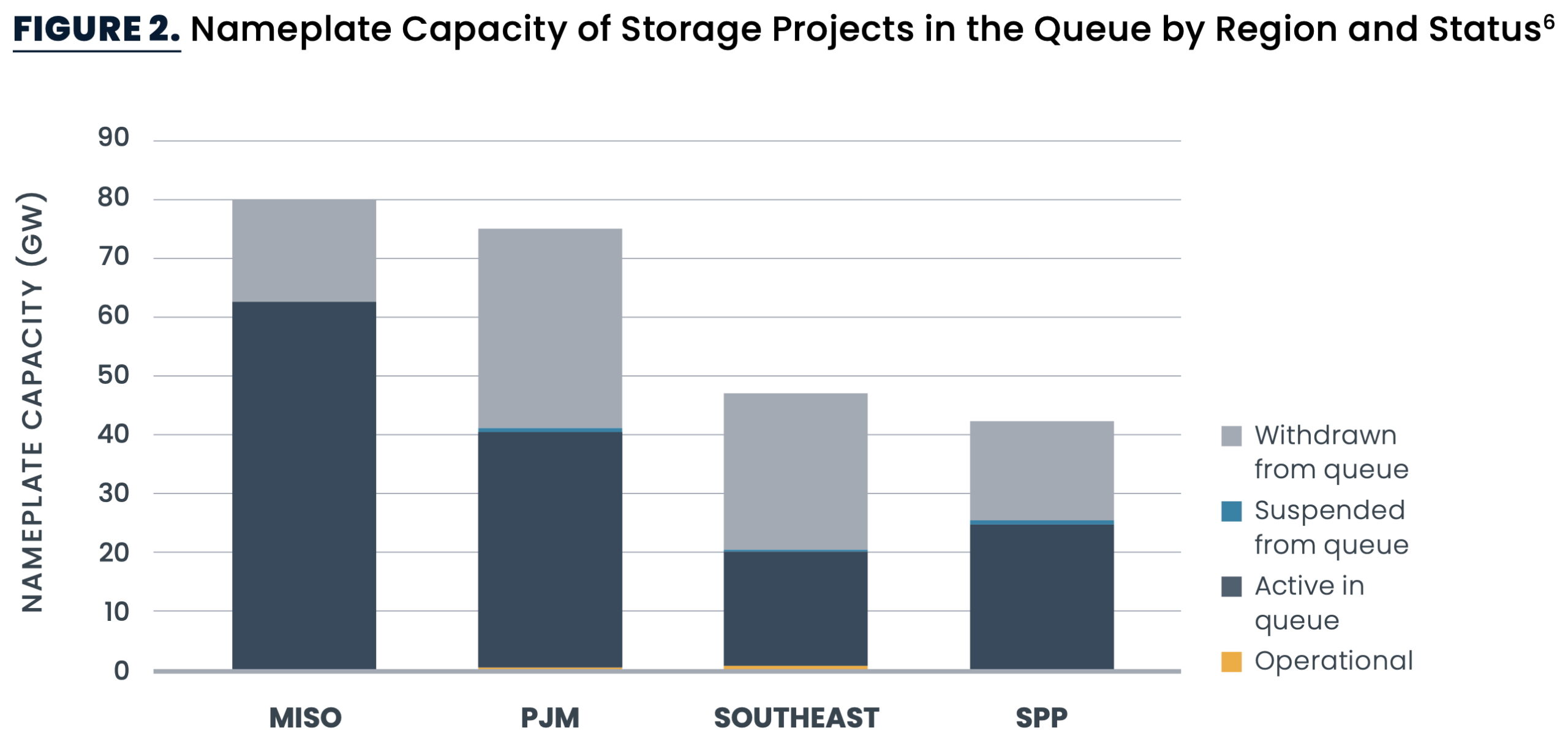
The graph also “highlights the gap between proposed and realized projects,” as thin orange segments representing operating BESS projects are barely visible at the bottom of the bars.
Solutions
Alongside discussions of the types of value that BESS can offer to the grid, and the policy factors that are slowing the ability of BESS to deliver that value, the study describes 15 “key paths forward”:
- Market design:
- Pay storage for flexibility
- Improve pricing for ramping and locational value
- Transition toward dynamic state of charge treatment
- Use performance-based accreditation in capacity markets
- Move toward long-term capacity agreements.
- Interconnection:
- Reduce speculative queue volume
- Shift toward proactive, deliverability-focused planning
- Expand fast track and surplus interconnection pathways suited to BESS
- Rapidly pair BESS with large-load demand.
- Procurement:
- Modernize procurement to value the multi-service capabilities of BESS
- Increase transparency into bid evaluation criteria and valuation models
- Allow flexible contract structures]
- Use state procurement mandates where needed.
- Planning and modeling:
- Use realistic modeling assumptions regarding BESS
- Incorporate sub-hourly dynamics.
The GridLab report is titled “The Storage Gap: Deployment Challenges in the East.”
The study’s lead authors are Miles Farmer and Kim Smaczniak, partners with the energy law firm Roselle LLP.
This content is protected by copyright and may not be reused. If you want to cooperate with us and would like to reuse some of our content, please contact: editors@pv-magazine.com.



How about cities mapping the locations of all their large parking lots, over 100 spaces, and adopting expedited permitting, allowing microgrid contractors to rapidly construct multiple projects with pre-approved modular system designs & engineering. Start building a widely distributed matrix of (sub)urban solar farms +on-site BESS +EV chargers right where most residential & small business utility rate payers live, work& commute, from large apartments & condos to business districts, shopping centers & various municipal facilities like schools & hospitals. Parking lots constitute a massive inventory of valuable but ridiculously under-utilized urban land.