




The National Laboratory of the Rockies has published a geothermal market report projecting that enhanced geothermal systems, whose levelized cost of energy is now about $140/MWh, could reach an LCOE of $100/MWh by 2035.
Unlike conventional geothermal, which taps an underground reservoir of hot water in permeable rock, enhanced geothermal accesses heat from underground rock by fracturing the rock and using fluid to transfer the heat and generate electricity. Either technology can provide continuous power as needed.
In comparison, solar paired with storage can also provide continuous power. One price comparison comes from data analytics firm Ember, which noted a sharp decline in battery costs and calculated that shifting half of solar generation to batteries for use overnight, creating a generation profile “that is closer to an actual demand profile,” now has an average cost of $76/MWh outside China and the U.S. That’s because outside of those countries, “competitive procurement of Chinese-manufactured equipment is reshaping global storage economics.” The $76/MWh figure for system costs has two components: $43 for solar and $33 for the smaller capacity of storage.
In the U.S., newly-signed power purchase agreements for solar power have averaged almost $62/MWh, according to LevelTen Energy.
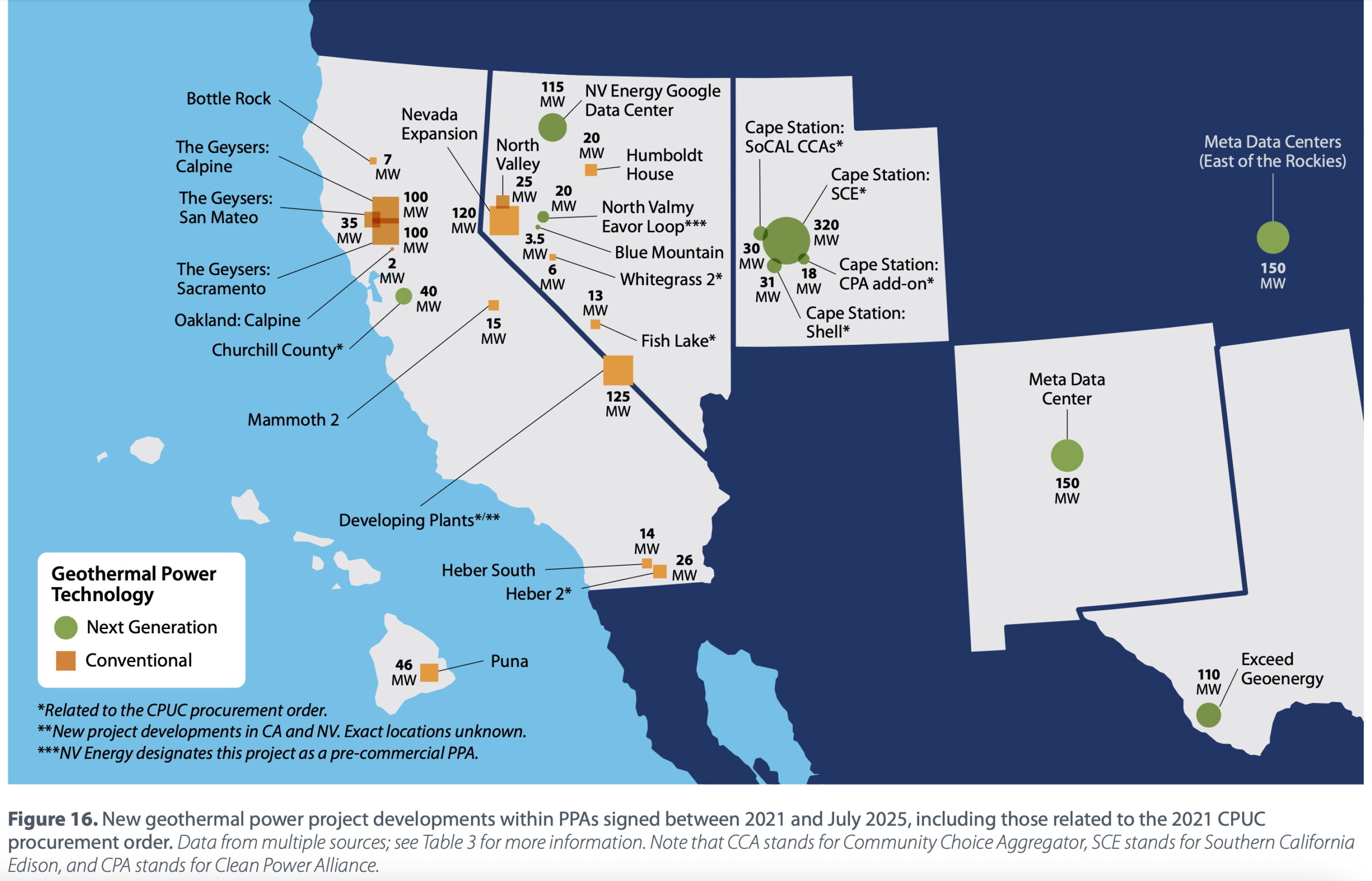
The NLR report shows that a number of enhanced geothermal projects in the Western U.S. have secured power purchase agreements since 2021, as shown by the green circles in the image below, even though the NLR estimates that in 2024 such projects had an LCOE of about $140/MWh. The report says that a California Public Utilities Commission procurement order in 2021 for any type of geothermal power has resulted in a number of PPAs signed for projects in California, Nevada and Utah.
The U.S. Department of Energy, in a 2024 “liftoff” report on enhanced geothermal, projected that the technology’s costs could decline to $60-70/MWh by 2030, “offering profit margins of $10 to $30 per MWh at current prices.”
Among the firms developing enhanced geothermal in the U.S. are Fervo Energy, which is developing 20 GW of projects, and Mazama Energy.
Geothermal atlas
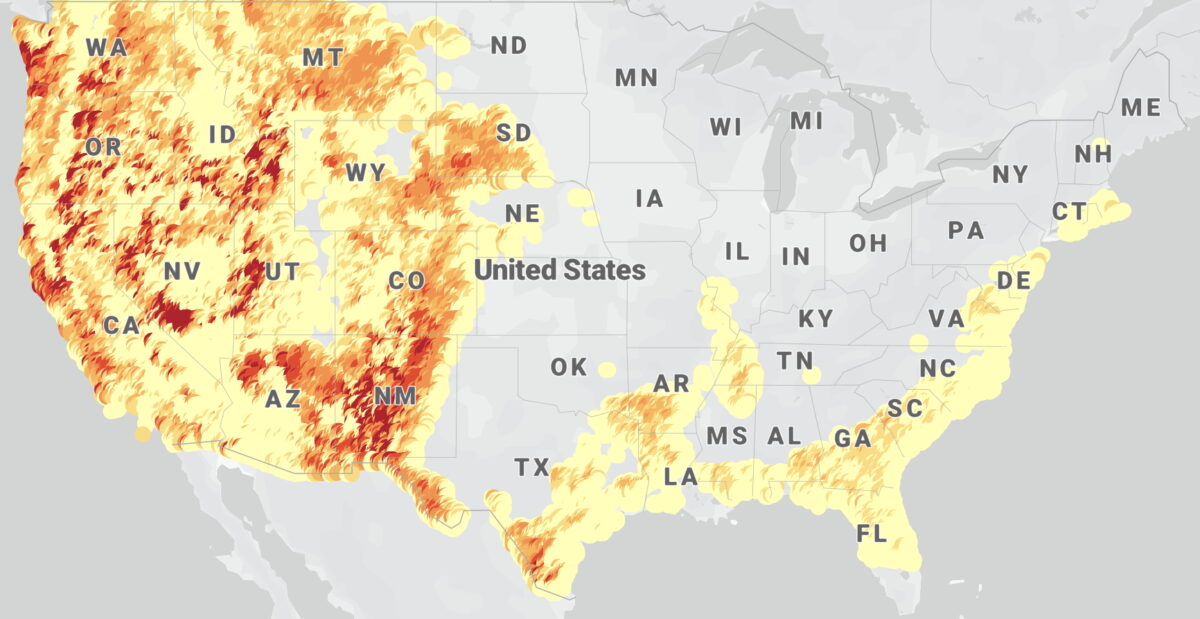
The National Laboratory of the Rockies has also published a geothermal energy atlas showing the potential for enhanced geothermal deployment, as shown in the featured image above, and other types of geothermal technology. The interactive atlas provides “complex geothermal geospatial data,” NLR said.
The NLR report also noted that geothermal heat pumps are now used for 1.3 million residential housing units and commercial buildings.
Renewables plus EGS
A paper by five researchers at Stanford University has calculated that if future costs of enhanced geothermal systems are low, using EGS in an otherwise 100% renewable energy system would lower private and social energy costs. But if future EGS costs are high, using the technology would raise the system cost above that of a 100% renewables system. If future costs of EGS are moderate, using EGS would result in costs similar to that of a 100% renewables system.
But the paper noted that in an energy system with EGS, net land requirements decrease, “benefiting small countries the most.”
This content is protected by copyright and may not be reused. If you want to cooperate with us and would like to reuse some of our content, please contact: editors@pv-magazine.com.






By submitting this form you agree to pv magazine using your data for the purposes of publishing your comment.
Your personal data will only be disclosed or otherwise transmitted to third parties for the purposes of spam filtering or if this is necessary for technical maintenance of the website. Any other transfer to third parties will not take place unless this is justified on the basis of applicable data protection regulations or if pv magazine is legally obliged to do so.
You may revoke this consent at any time with effect for the future, in which case your personal data will be deleted immediately. Otherwise, your data will be deleted if pv magazine has processed your request or the purpose of data storage is fulfilled.
Further information on data privacy can be found in our Data Protection Policy.