




In the residential solar sector, the industry has long sought the “holy grail” of vertical integration, creating a single point of contact for hardware, software, and energy management.
While Tesla has been a dominant player in storage with the Powerwall, a market leader with its inverter, and in electric vehicles, the company has historically relied on third-party solar panels.
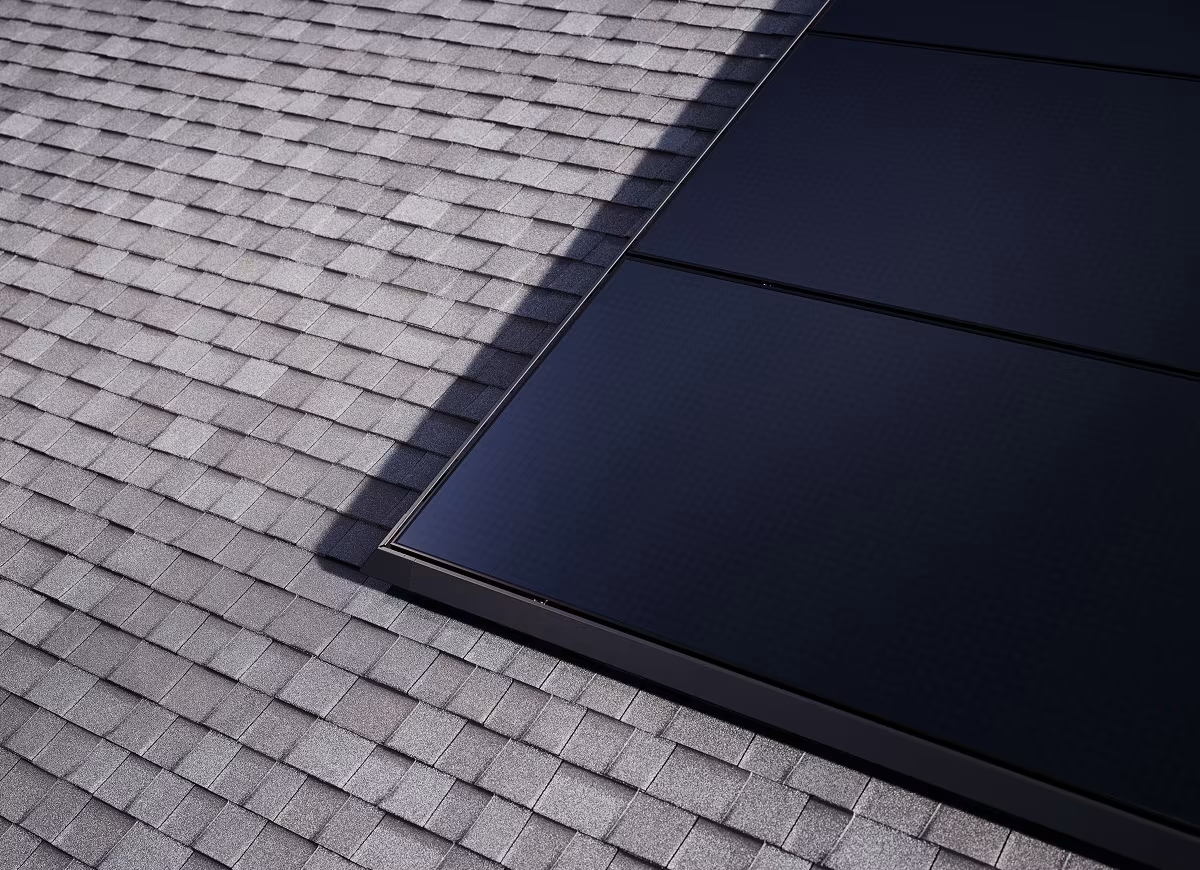
With the launch of the Tesla Solar Panel (TSP-415 and TSP-420), the company is closing that loop. The company’s new modules, assembled at its Gigafactory in Buffalo, New York, represent a significant shift toward a proprietary, integrated ecosystem designed to solve the common rooftop challenges of shading, aesthetic clutter, and installation friction.
“This panel completes the full package of the residential energy ecosystem,” Colby Hastings, senior director, Tesla Energy, told pv magazine USA. “It is based on our long history of innovation and engineering when it comes to solar.”
Domestic manufacturing
Tesla said the new modules are assembled at its Buffalo, NY facility, the same site where it continues to produce Solar Roof components, which inspired the design of the panel. The factory is currently scaling to an initial capacity of over 300 MW per year.
This domestic assembly allows Tesla to leverage federal manufacturing incentives while securing a local supply chain for its growing network of installers.
Power zones
The most technically significant departure from industry norms in the TSP series is the implementation of 18 independent “Power Zones.” Standard residential modules typically utilize three bypass diodes, creating six distinct zones. In traditional architectures, a single shadow from a chimney or vent pipe can effectively “shut down” large swaths of a string’s production.
Tesla’s design essentially triples the granularity of the module. By dividing the electrical architecture into 18 zones, the panel behaves more like a digital screen with a higher pixel count; if one “pixel” is shaded, the remaining 17 continue to harvest energy at near-peak efficiency.
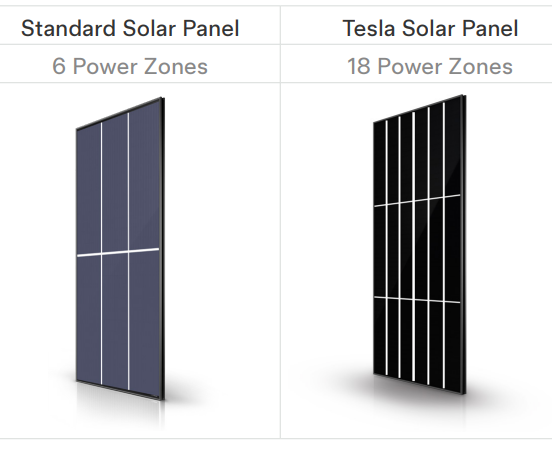
While high-density substring architectures have been explored in the utility space, Tesla’s specific 18-zone layout is unique to the residential market, engineered to deliver optimizer-like performance without the added cost and potential failure points of module-level power electronics (MLPE) on the roof.
Inverters, batteries, and mounts
The TSP modules are designed to pair specifically with the Tesla Solar Inverter and Powerwall 3. While Tesla offers these as a unified “Home Energy Ecosystem,” they are not strictly sold as a single, inseparable bundle. However, the hardware is optimized to work as a package; for instance, the panel’s 18-zone design is specifically tuned to perform with Tesla’s string inverter technology.
Tesla is not keeping this technology exclusive to its own crews. While Tesla’s direct installation business leads the rollout, the package is available to Tesla’s network of over 1,000 certified installers.
This “installer-first” approach is further evidenced by the new Tesla Panel Mount. The new rail-less mounting system, made of black anodized aluminum alloy, uses the module frame itself as the structural rail.
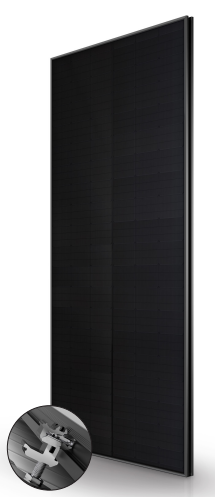
Image: Tesla
By eliminating traditional rails and visible clamps, Tesla said the system is 33% faster to install. The mount sits closer to the roof and is enhanced by aesthetic front and side skirts, maintaining the “minimalist” look Tesla consumers expect.
Product specs
The modules are competitive with the current Tier 1 market, pushing into the 20% efficiency bracket while maintaining a robust mechanical profile, said the company.
| Parameter | TSP-415 | TSP-420 |
| Nominal Power (Pmax) | 415 W | 420 W |
| Module Efficiency | 20.3% | 20.5% |
| Open Circuit Voltage (Voc) | 40.92 V | 40.95 V |
| Short Circuit Current (Isc) | 12.93 A | 13.03 A |
| Max System Voltage | DC 1000V | DC 1000V |
| Weight | 22.3 kg (49 lbs.) | 22.3 kg (49 lbs.) |
| Dimensions | 1805 x 1135 x 40 mm | 1805 x 1135 x 40 mm |
The new Tesla Solar Panels are now available nationwide.
Solar roof
For those wondering about the Tesla Solar Roof, the company maintains that the glass tile product remains a core part of its “premium” offering for customers needing a full roof replacement.
The cascading cell technology used in the new TSP modules, which overlaps cells to eliminate visible silver busbars, was originally designed in its Solar Roof product. Tesla is essentially taking the aesthetic and electrical innovations of its luxury roof product and integrating it into a traditional module form factor.
Virtual power plant
Tesla also highlighted the ability for virtual power plant (VPP) participation to increase value for its customers. VPPs coordinate the dispatch of energy stored in Powerwalls, acting as a distributed energy network.
“We’re working more closely with utilities than ever to ensure that these assets participate in virtual power plants and support the grid and opening up new value streams, both for utilities and consumers that have these assets at home,” said Hastings. “We announced recently that we have a million Powerwalls deployed worldwide and 25% of those are enrolled in a virtual power plant program of some kind.”
Market strategy
The timing of this launch comes at a volatile moment for U.S. solar. With the passage of the “One Big Beautiful Bill” Act (OBBBA), the industry is navigating the early expiration of the 25D residential credit at the end of 2025 and the sunsetting of the 48E commercial credit.
Tesla’s move now is an opportunistic play for standardization and soft-cost reduction. By controlling the entire stack, Tesla can drive down customer acquisition and labor costs, which currently represent the largest portion of a system’s price tag.
“Utility rates across the country are going up, electricity is becoming increasingly unaffordable for homeowners,” said Hastings. “We’re still very bullish on the future of distributed energy here in the United States.”
This content is protected by copyright and may not be reused. If you want to cooperate with us and would like to reuse some of our content, please contact: editors@pv-magazine.com.




Great info.
The best energy for environment conservation
Outdated tech based on the low efficiency. Should be 25%. No one will care until someone makes a 400+ watt panel that ships ups/FedEx cheap.