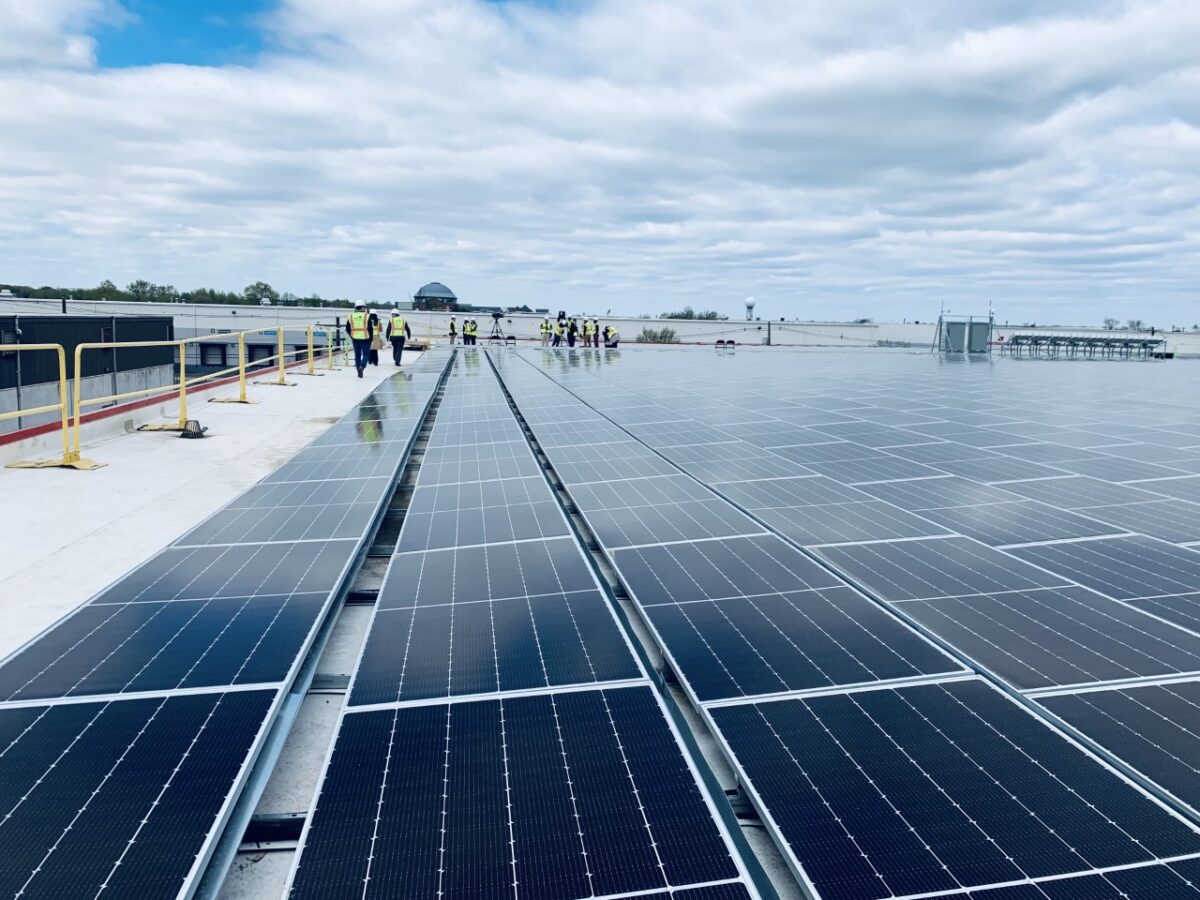





Community solar enables renters and homeowners without the means to invest in rooftop solar to enjoy the benefits of clean, low-cost electricity. Many states have created policies that support community solar, yet not all policies are equal.
ILSR finds that states with the strongest solar policies prioritize four central principles: tangible benefits for participants, flexible ownership structure, synergy with other renewable energy policies, and access for all residents. renewable energy policies, and access for all residents.
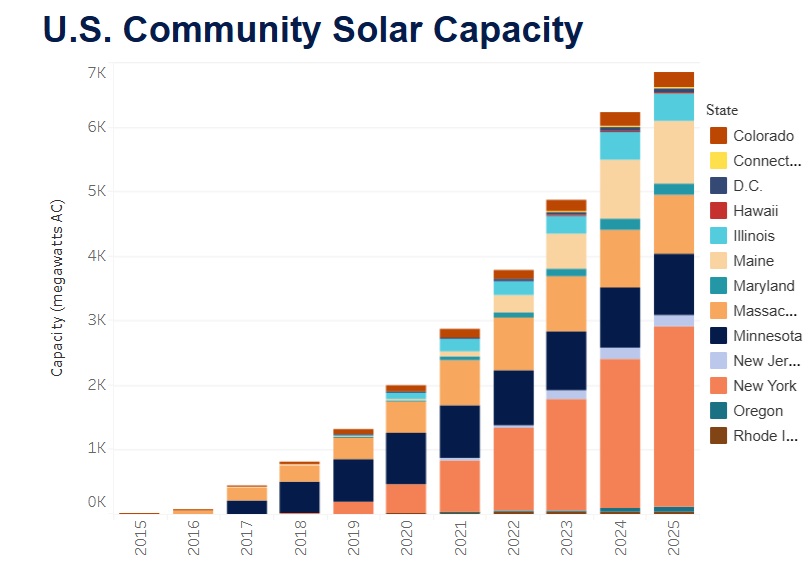
ILSR tracks the solar programs state by state and it provides quarterly reports on the status of the state policies. Its tracker at looks community solar capacity by state, how the community solar market has grown by state, and how much each state contributes to total U.S. community solar capacity.
The Q3 2025 report found the only community solar grew by more than 1% were New Jersey, New York and Oregon.
New Jersey
With 7 MW added, New Jersey’s community solar capacity grew 4% in Q3 2025 for a total of 187 MWac.
New Jersey passed its first community solar legislation in 2018 resulting in the Community Soar Energy Program, which became permanent in 2023. The program is available to customers of the state’s four investor-owned utilities: PSE&G, JCP&L, ACE, RECO. The Energy Information Administration reports that these utilities serve nearly 96% of the state’s electric ratepayers.
In August, 2025 New Jersey Gov. Murphy signed a new law to more than triple the capacity it currently has online and in the pipeline for a total of 3.25 GW of available capacity in 2025.
New York
With 145 MW of community solar added in Q3, New York’s community solar capacity grew 5% quarter over quarter for a total of 2.7 GW.
The Empire State passed its first community solar legislation in 2015. Called the Community Distributed Generation (CDG) program, it is recognized as one of the most successful community renewable energy programs in the country, often leading in annual added capacity. The program is available to the state’s investor-owned utilities: Central Hudson, Consolidated Edison, New York State Electric & Gas, Niagara Mohawk Power (National Grid), Orange and Rockland Utilities, and Rochester Gas and Electric. PSE&G Long Island, which operates the grid on behalf of the Long Island Power.
CDG operates under the state’s NY-Sun program, which has a goal of 10 GW of solar by 2030.
[Also read New York redirects surplus solar funds after 10 GW distributed solar goal.]Oregon
Oregon added 2 MW of community solar, or 2%, in Q3 for a total of 84 MWac. The Oregon Community Solar Program was created in response to legislation that passed in 2016 and launched in 2020. The following year the Oregon Public Utility Commission approved its first projects.
The program is small, with a total capacity of 161 MWac, which amounts to 2.5% of the utilities’ gross sales in 2016. Despite its size, however, it is relatively successful, ILSR reports, with over 90% of the program’s capacity allocated as of late 2025. Subscriptions are available to retail customers of the state’s three investor-owned utilities: Portland General Electric (PGE), Pacific Power, and Idaho Power. ILSR reports that as of late 2025, the PUC is considering a program expansion of up to 50 MW.
Maine
Maine is somewhat of an anomaly because it grew 29% in Q4 2024, but since then has held steady with about 1% growth a quarter for a total of 966 MW in Q3. Maine’s Gov. Janet Mills signed LD 1777 into law, which among several changes, made community solar and other front-of-the-meter projects ineligible for net metering. This legislation will end the state’s community solar program in January 2026; however, the state’s energy officials are tasked with developing a new renewable energy incentive plan by September 2026.
ILSR reports that it will continue to include data from Maine in the tracker because projects under development when Maine still had a community solar program may still come online.
Massachusetts deserves a mention because, as a long-time leader in community solar, the state issued final regulations for its Solar Massachusetts Renewable Target program, SMART 3.0. This new program stipulates that all community shared solar projects must enroll a minimum of 40% low-income customers. Alternative community solar projects, such as utility and municipal aggregation community solar projects must enroll 100% low-income customers.
Additionally, community solar projects under SMART 3.0 must guarantee meaningful benefits to community solar customers, with at least a 10% discount for market-rate residents and at least a 20% discount for low-income residents.
Massachusetts’ growth was not included in this tracker because, according to ILSR, the reporting system for community solar projects that come online under the new SMART program is still in development. Nevertheless, Massachusetts’ community solar operating capacity stands at 905 MWac.
Growth rates in all other states declined largely due to lack of supportive policies. Ingrid Behrsin, senior researcher and the author of the tracker told pv magazine USA that “The health of community solar depends on the state policies that support it. States need to be proactive about encouraging community solar, such as by ending capacity limits on the sector.” It’s not a coincidence that community solar grew in New Jersey. She said that as a result of “recent legislation [that] required the state to open up an additional 3 GW of community solar — it’s the only state whose quarter-over-quarter growth rate increased.”
ILSR reports that community solar needs supportive state policy that allows non-utility developers to build and own community solar facilities, establishes a fair price for utilities to pay for community solar power, and sets up a process for billing and crediting subscribers. To further energy democracy, the report contends that states should design community solar programs that promote racial and economic equity.
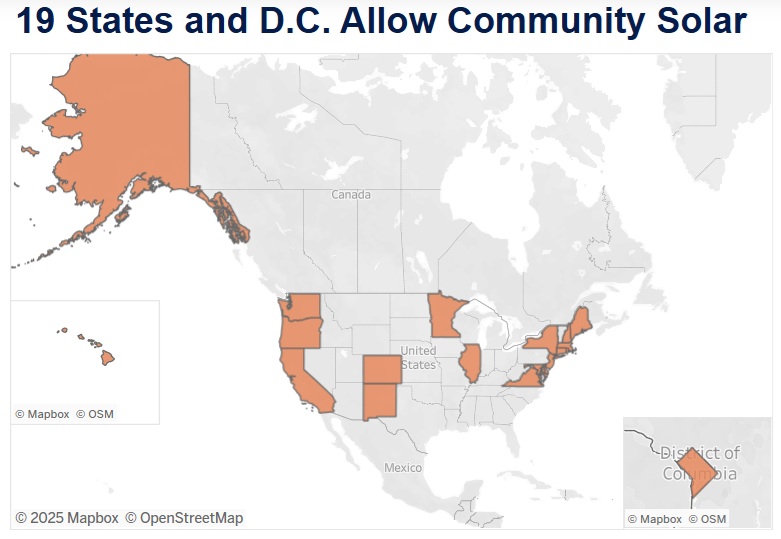
Several states were not able to be tracked because they don’t have accessible or regularly maintained datasets. These include Alaska, California, Delaware, New Hampshire, New Mexico, Virginia, or Washington. In addition, ILSR was unable to track Maryland’s Q3 progress because its community solar data was not released in time.
This article was amended on 12/12/25 to reflect that ILSR tracks capacity of both utility-owned and non-utility community solar, but only in states that allow non-utility ownership.
This content is protected by copyright and may not be reused. If you want to cooperate with us and would like to reuse some of our content, please contact: editors@pv-magazine.com.



By submitting this form you agree to pv magazine using your data for the purposes of publishing your comment.
Your personal data will only be disclosed or otherwise transmitted to third parties for the purposes of spam filtering or if this is necessary for technical maintenance of the website. Any other transfer to third parties will not take place unless this is justified on the basis of applicable data protection regulations or if pv magazine is legally obliged to do so.
You may revoke this consent at any time with effect for the future, in which case your personal data will be deleted immediately. Otherwise, your data will be deleted if pv magazine has processed your request or the purpose of data storage is fulfilled.
Further information on data privacy can be found in our Data Protection Policy.