





Innovation doesn’t always have to mean “deep tech” and new materials. pv magazine sat down with Gismo Power CEO Antonia Ginsberg-Klemmt about her company’s approach and market potential.
Can you give me a little bit of background on Gismo Power’s carport appliance and how it came about?
During my undergraduate studies at New College of Florida, I was driving every day to class and parking under the Florida sun. There were EV chargers on campus, also positioned in the blazing hot sun. And I began to wonder why they didn’t have solar as well.
My dad explained that additional ‘soft costs’ associated with permanent structures for things like testing and permitting can add up to three times or more the price for the actual hardware, especially somewhere like Florida where you have hurricanes and such to be prepared for.
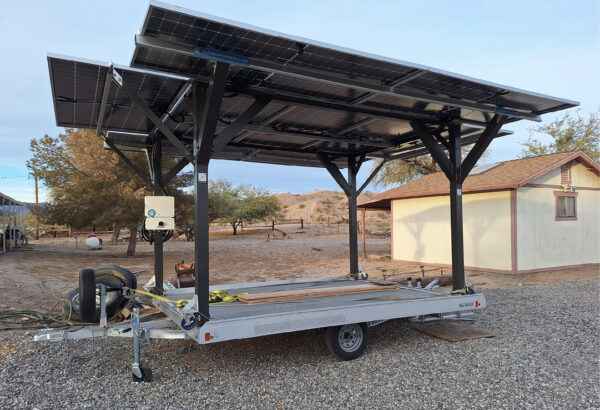
It occurred to us, why not just put it on wheels? Make it a non-permanent structure that can be moved or stored. We patented it, and I ended up writing both my bachelor’s thesis and my master’s thesis in mechanical engineering on it. Gismo Power kind of exploded from there. It’s been an adventure ever since.
Where are you at now in terms of commercial rollout and manufacturing capacity?
Manufacturing is the easy part. The hard part is regulatory. That’s our main hurdle right now. We can’t really scale a grid-connected version yet, because we have this regulatory side that’s pushing against us as a plug-in solar application.
We are actively working with UL and Lawrence Berkeley National Lab on writing a new UL standard for plug-in solar appliances. And we won’t be the only people to benefit from that. Anybody could then veer away from hardwired designs to connection via a plug, as long as they use components or connections that will be certified safe. If that happens, we can talk about scaling.
If we have to hardwire or go off-grid, our design is less differentiated from other solar carports out there. For us, it’s now about handling the regulatory aspect. We’re pushing on that and starting to see success. Utah was the first state to approve legislation for up to 120 W of plug-in solar. Republican Representative Raymond Ward suggested it and he got unanimous approval. That’s a step in the right direction, and we want to see that eventually in all 50 states.
But you have been able to install systems already?
Our very first legally permitted, grid-connected, plug-in system is at the Oglala Lakota tribe in Pine Ridge, South Dakota. It was the first to be approved by the local utility, Lacreek Electric. Our second approved system is in Las Vegas with NV Energy. We’ve found with the regulators that including an EV charger can be a kind of trojan horse, because there is a lot of support for expanding EV charging infrastructure. We call it an EV charger that happens to have solar attached to it, and the conversations around approval seem to get easier.
When you say plug-in, is it really that simple? Does it need to be installed by a professional?
You would need a professional to install a 240 V, 40 A outlet on a dedicated circuit. But that’s the full extent of the electric work you would need done. Our system can be fully assembled prior to delivery. If a customer prefers it to be hardwired or off-grid, we could do that. But plug-in offers the best return on investment and makes the most sense. We just need the regulatory approval.
How customizable is the design? Do you work with standard PV modules or any specialized components?
We are component agnostic, we can modify our frame to fit any kind of panel. Now we are using bifacial 705 W panels. These are the ones you would usually find in utility-scale applications. Because we only have nine panels, we want the maximum power per surface area. I wouldn’t recommend less powerful panels, but we can do that easily. Staying component agnostic also means less impact from tariffs or other supply chain constraints, although it does make it more difficult to maintain a solid price point.
We have a taller system that an F-150 truck can park underneath, because we saw demand for that as well. The sizing and the frame is more or less all customizable, but we do recommend our size, which is built to fit inside most garages, so it can be stored or transported easily.
Can it integrate with a rooftop PV system as well?
Our best experiences have been with customers who have existing rooftop PV systems and existing connection agreements. They already have approval for the bidirectional feed-in, so it’s basically just an extension.
Our system is designed for sunny driveways and parking lots, and for those who are renting and don’t own their sunny driveway or business parking lot. We have found that the potential for solar in spaces like these is bigger than rooftop, because there are so many rooftops that aren’t suitable for solar, just because of shading or structural integrity.
Regulatory challenges aside, how is demand so far? Do you see a lot of interest?
We have a whole backlog of people who want them – mostly residents with existing rooftop systems. But these are homeowners and we want to target renters as well. My thought for now is that if we have a beachhead market of individuals with existing agreements, that should help jump-start manufacturing and implementation and bring prices down.
We have had interest from other places as well. I was accepted to speak at the New York Transit Tech Lab about the option to incorporate our carport into powering electric buses. There are a lot of different niches where people have reached out to us. There is a lot of interest out there. But now there’s the question of the tax incentives as well. We will soon launch a pre-order campaign, to finish deployment by 2027 and take advantage of the investment tax credits.
This content is protected by copyright and may not be reused. If you want to cooperate with us and would like to reuse some of our content, please contact: editors@pv-magazine.com.



By submitting this form you agree to pv magazine using your data for the purposes of publishing your comment.
Your personal data will only be disclosed or otherwise transmitted to third parties for the purposes of spam filtering or if this is necessary for technical maintenance of the website. Any other transfer to third parties will not take place unless this is justified on the basis of applicable data protection regulations or if pv magazine is legally obliged to do so.
You may revoke this consent at any time with effect for the future, in which case your personal data will be deleted immediately. Otherwise, your data will be deleted if pv magazine has processed your request or the purpose of data storage is fulfilled.
Further information on data privacy can be found in our Data Protection Policy.