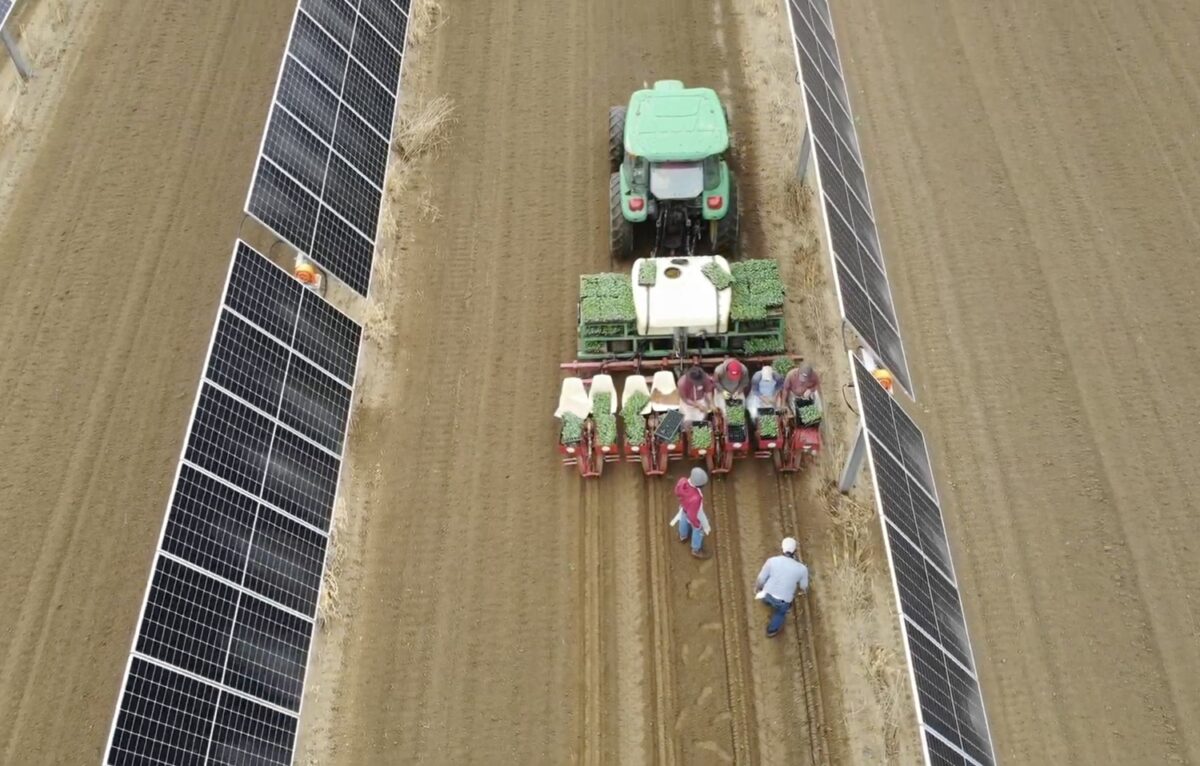





At the 400-acre Czajkowski Farm in Hadley, Massachusetts, three generations of farmers have grown crops that provide produce to institutions and retail outlets, including UMass Amherst Dining Services, Springfield Public Schools, Trader Joe’s, Whole Foods, and their squash noodles can be purchased up and down the East Coast.
Three years ago, a solar project sprouted on the land. The agrivoltaic project was developed through a partnership with Joe Czajkowski and Hyperion Systems, a Massachusetts-based solar installer that specializes in agrivoltaics.
The farm’s 375 kW ac dual-use array sits on 2.2 acres and consists of three SMA inverters and 832 bifacial JA Solar modules on a FlexRack single-axis tracker. To accommodate crop height, the trackers sit 10 feet above ground when they’re horizontal and are spaced 27 feet east-west post-to post.
One advantage of using trackers with stow capability is that they can be set in vertical position to make room for farm equipment passing through. Czajkowski has been able to operate his equipment for subsoiling, tilling, harrowing, cultivating, and spraying. In addition, he operates his tractor both north to south (parallel with the module rows) and east to west (perpendicular to the module rows) throughout the array.
In a conversation with pv magazine USA, Czajkowski said there are several benefits of incorporating solar with his farming operation, not the least of which is income. The land is leased from Hyperion Systems, and Czajkowski receives regular lease payments. Czajkowski noted that with two out of three farmers in Massachusetts operating at a loss, “it adds cash flow that otherwise you wouldn’t get.” Farmers need the extra income because they don’t have pensions, he said. “This will provide my pension.”
It’s also a community solar project, and the electricity supports 35 area homes as well as the farm, which is an added benefit. Community solar is when area ratepayers subscribe to a portion of the electricity produced by the array, often at a locked-in price.
The system also qualifies as an Agricultural Solar Tariff Generation Unit (ASTGU) under Solar Massachusetts Renewable Target (SMART) Program, which provides per-kWh tax incentives for solar projects up to 7.5 MW for individual dual-use agricultural projects.
Furthermore, the project benefits the town in the extra tax revenue, “and all towns could use that extra income,” Czajkowski said.
Sustainability is another benefit. The farm uses a lot of electricity, and now it is coming from the sun. The farm also practices regenerative agriculture, and because the site is a sandy, windswept knoll, Czajkowski spreads organic matter each fall to build up the soil health and the shade from the array can reduce water evaporation in the soil. With much of the northeast experiencing a severe drought in the summer of 2025, Czajkowski said the crops received much-needed shade from the solar modules.
One downside for farmers is that the solar posts take up some plantable land, but Czajkowski is taking an innovative approach by teaming up with a mushroom farmer to plant mushrooms directly beneath the modules and in between the racking posts. He said not only will it add a crop to the previously unusable space, but the blocks of sawdust they’re grown in will help to keep weeds down around the posts.
Agrivoltaics is the subject of many scientific studies, and this Hadley farm participated in a University of Massachusetts-led Department of Energy Solar Energy Technologies Office research grant project with in-field data collected from 2023-2025 growing seasons. The study had both agronomic and economic focuses, the results of which have not yet been published.
Hyperion Systems also conducted a study on the farm with American Farmland Trust on the leaching of metals from the posts and racking. Jake Marley, CEO of Hyperion Systems said they found no signs of trace metals and all levels of elements were lower than USDA and other standards.
Overall, the results Czajkowski have experienced are positive and he believes there’s a place for solar on every farm. In fact, at Czajkowski’s farm there are many places for solar, as he’s working with Hyperion Systems on three additional arrays on different fields.
Czajkowski concluded that while he might plant crops on a field for 65 days out of the year, he’s getting no benefit on the other 300 days. “Now we can benefit from that field year ‘round.”
This content is protected by copyright and may not be reused. If you want to cooperate with us and would like to reuse some of our content, please contact: editors@pv-magazine.com.



By submitting this form you agree to pv magazine using your data for the purposes of publishing your comment.
Your personal data will only be disclosed or otherwise transmitted to third parties for the purposes of spam filtering or if this is necessary for technical maintenance of the website. Any other transfer to third parties will not take place unless this is justified on the basis of applicable data protection regulations or if pv magazine is legally obliged to do so.
You may revoke this consent at any time with effect for the future, in which case your personal data will be deleted immediately. Otherwise, your data will be deleted if pv magazine has processed your request or the purpose of data storage is fulfilled.
Further information on data privacy can be found in our Data Protection Policy.