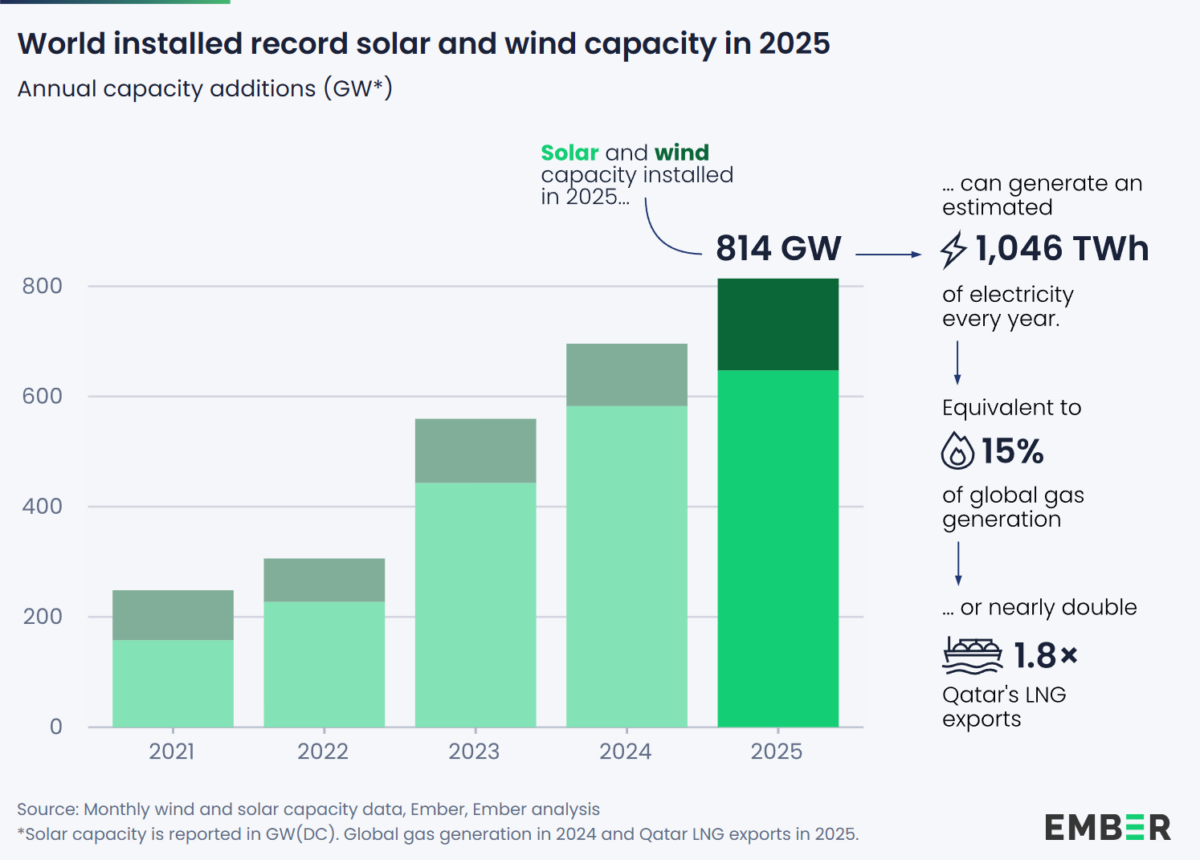





Ember, a global think tank based in England & Wales, has released a new report on the growth in solar and wind capacity across the globe in 2025. The report highlights additions of 647 GW of solar power generation and 167 GW in new wind capacity, a ratio of about 3.9-to-1.
Those numbers represented a year-over-year increase of 11% for solar — up from 582 GW added in 2024 — and 47% for wind, from the previous year’s 113 GW. The increase in the growth rate of wind reflects recent reports of record-setting capacity additions for offshore wind installations.
The report says overall total capacity represented by both wind and solar has now reached 4,174 GW, more than 4 terawatts.
In addition to the report, Ember is highlighting its new Wind and Solar Capacity Data Explorer and API, through which users can track month-over-month and year-over year capacity additions across 25 countries and economic divisions on the basis of absolute value and per-capita installed capacity (in GWdc) from December 2020 to the present day.
Context from the research
The report authors note that capacity additions of wind and solar represent enough energy generation capability to displace more than a seventh of global gas generation — equivalent to annual gas import costs of roughly $138 billion.
“The scale and speed of solar’s expansion is unlike anything seen before in the power sector. Along with accelerating capacity additions for wind, these technologies are on track to become the backbone of the global electricity supply,” said Leonard Heberer, a data analyst with Ember. “As they scale up, they will strengthen energy independence, reduce reliance on fragile fossil fuel supply chains, and help insulate consumers from price spikes in fossil fuel prices driven by geopolitical instability,” he added.
However, another Ember visualization tool based on a dataset of the world’s electricity generation over time reveals that although the relative percentage of total global electricity generation represented by fossil fuels like coal and gas has shrunk slightly from previous highs, the absolute value of the electricity those sources represent (in TWh) remains at or near all-time highs.
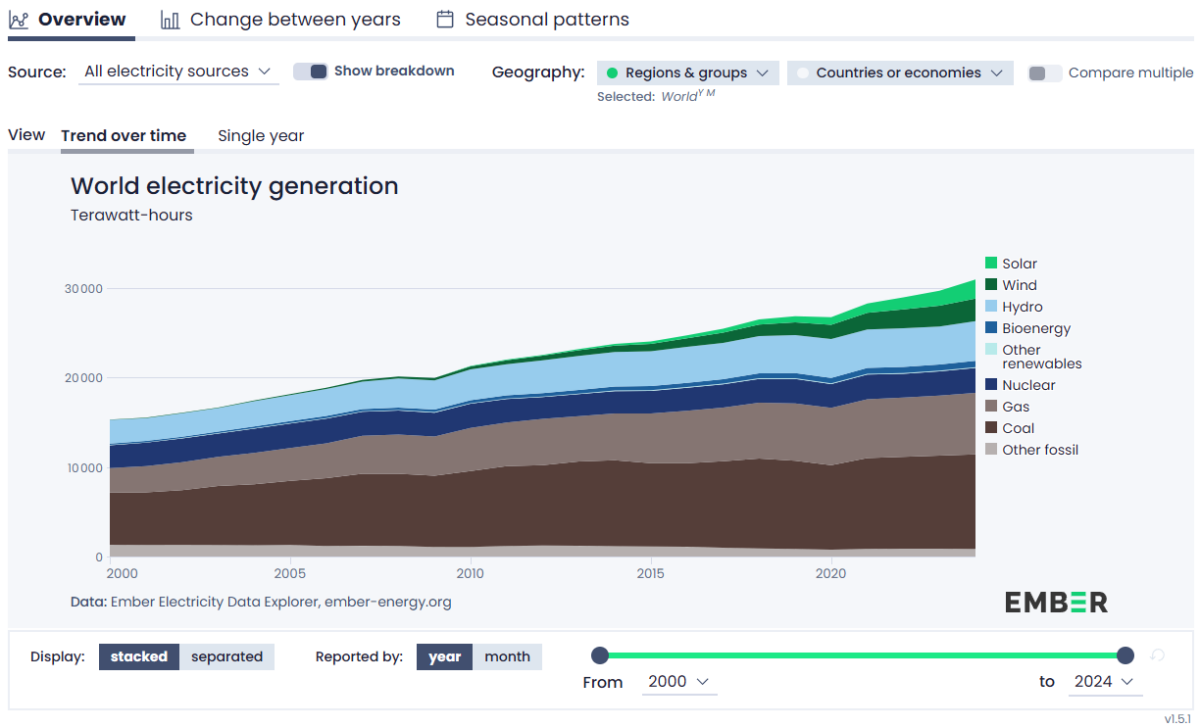
Image: Ember Energy Research, CC-BY-4.0
For example, while generation from coal has shrunk to just over 34% of the world’s total electricity, from a high of 40.8% in 2007, it accounted for 10,539 TWh of energy in 2025, compared to 8,052 in 2007, while total electricity generation has risen from 19,714 to 30,930 TWh over that time period.
This content is protected by copyright and may not be reused. If you want to cooperate with us and would like to reuse some of our content, please contact: editors@pv-magazine.com.







By submitting this form you agree to pv magazine using your data for the purposes of publishing your comment.
Your personal data will only be disclosed or otherwise transmitted to third parties for the purposes of spam filtering or if this is necessary for technical maintenance of the website. Any other transfer to third parties will not take place unless this is justified on the basis of applicable data protection regulations or if pv magazine is legally obliged to do so.
You may revoke this consent at any time with effect for the future, in which case your personal data will be deleted immediately. Otherwise, your data will be deleted if pv magazine has processed your request or the purpose of data storage is fulfilled.
Further information on data privacy can be found in our Data Protection Policy.