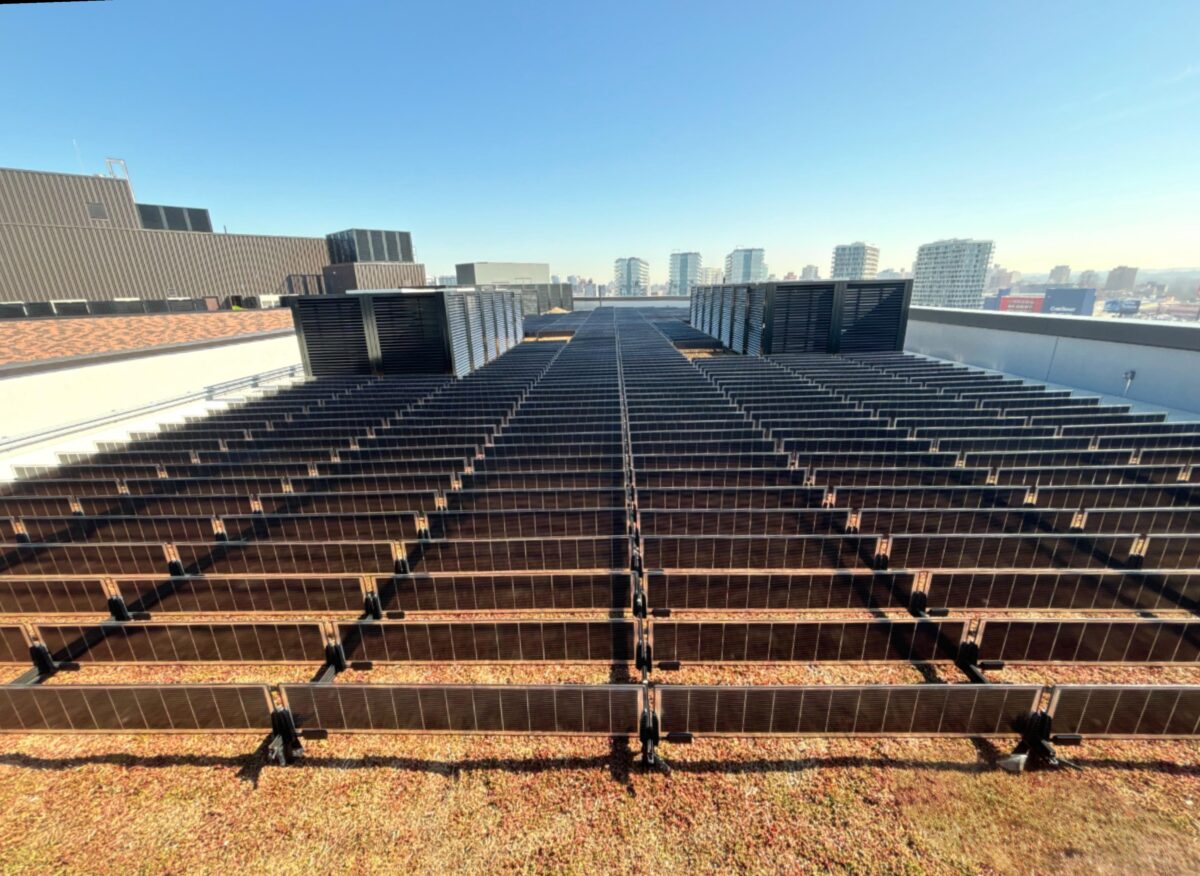





Vertical solar specialist Over Easy Solar has deployed its first rooftop vertical solar installation in the U.S..
The installation is combined with a green roof within the Willets Point industrial neighborhood in Queens, New York, on top of a building belonging to an undisclosed owner. It was delivered by Over Easy Solar’s partner Sempergreen USA, North America’s largest producer and supplier of pre-grown vegetation mats for green roofs.
The 100 kW vertical array uses Over Easy Solar’s xM3 VPV Unit, a prefabricated vertical bifacial system designed for flat rooftops. It features four units of 256 W each, heterojunction technology (HJT) solar cells from Huasun with 95–96% bifaciality and a mounting system requiring no ballast or roof penetration.
“Due the unique wind uplift resistance, this superlight system (2.4 bs/sqft) can be combined with a green roof without any additional ballast concerns,” commented Dick Bernauer, VP Sales of Sempergreen USA. “If you have a generic flat roof that has low loadbearing capacity, this is a great solution as well.”
Trygve Mongstad, Founder and CEO of Over Easy Solar, told pv magazine the vertical system allows both rainfall and sunlight to reach the full vegetated surface, maintaining stormwater retention and plant health, which he explained is something that would be compromised with traditional ballasted systems.
He added that the project was originally planned with a conventional tilted PV layout, but this was changed to a vertical configuration to meet New York City’s Department of Environmental Protection priorities for green roof performance.
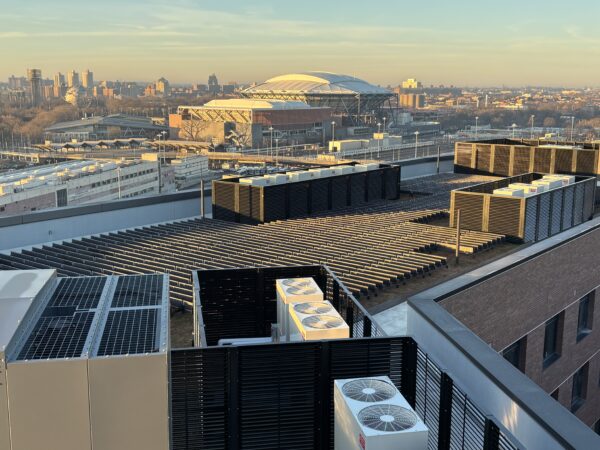
Mongstad also told pv magazine that the specific energy yield of a vertical bifacial solar installation is similar to that of a conventional installation.
“A 100 kWp installation with vertical solar panels in New York would deliver from 100,000 to 140,000 kWh per year, depending on factors like albedo, azimuth and local shadowing,” Mongstad explained. “A conventional ten-degree-tilt east-west oriented flat roof solar installation of 100 kWp would deliver about 116,000 kWh per year in New York, using the same radiation data.”
“Talking in specific yield, vertical solar installations range from 1,000 to 1,400 kWh/kWp/year and conventional flat roof solar east-west systems yield about 1,300 kWh/kWp/year,” he added.
Mongstad also shared that Over Easy Solar has begun to develop an energy yield portal which allows users to explore the effect of albedo, azimuth and location on vertical bifacial solar systems. The company has now added data from New York, alongside figures from Berlin, Madrid, Oslo and Tromsø.
Last September, Over Easy Solar broke its own record for the world’s largest rooftop vertical solar array with a 320 kW system in Tromsø. Earlier in the year, a case study from the company found vertical rooftop solar panels can outperform conventional rooftop solar systems during snowy months, with energy yield up to 30% higher.
In January, Sydney-headquartered Smart Commercial Energy announced it was teaming up with Over Easy Solar to launch the Norwegian company’s vertical rooftop solar system into the Australian market.
This content is protected by copyright and may not be reused. If you want to cooperate with us and would like to reuse some of our content, please contact: editors@pv-magazine.com.



By submitting this form you agree to pv magazine using your data for the purposes of publishing your comment.
Your personal data will only be disclosed or otherwise transmitted to third parties for the purposes of spam filtering or if this is necessary for technical maintenance of the website. Any other transfer to third parties will not take place unless this is justified on the basis of applicable data protection regulations or if pv magazine is legally obliged to do so.
You may revoke this consent at any time with effect for the future, in which case your personal data will be deleted immediately. Otherwise, your data will be deleted if pv magazine has processed your request or the purpose of data storage is fulfilled.
Further information on data privacy can be found in our Data Protection Policy.