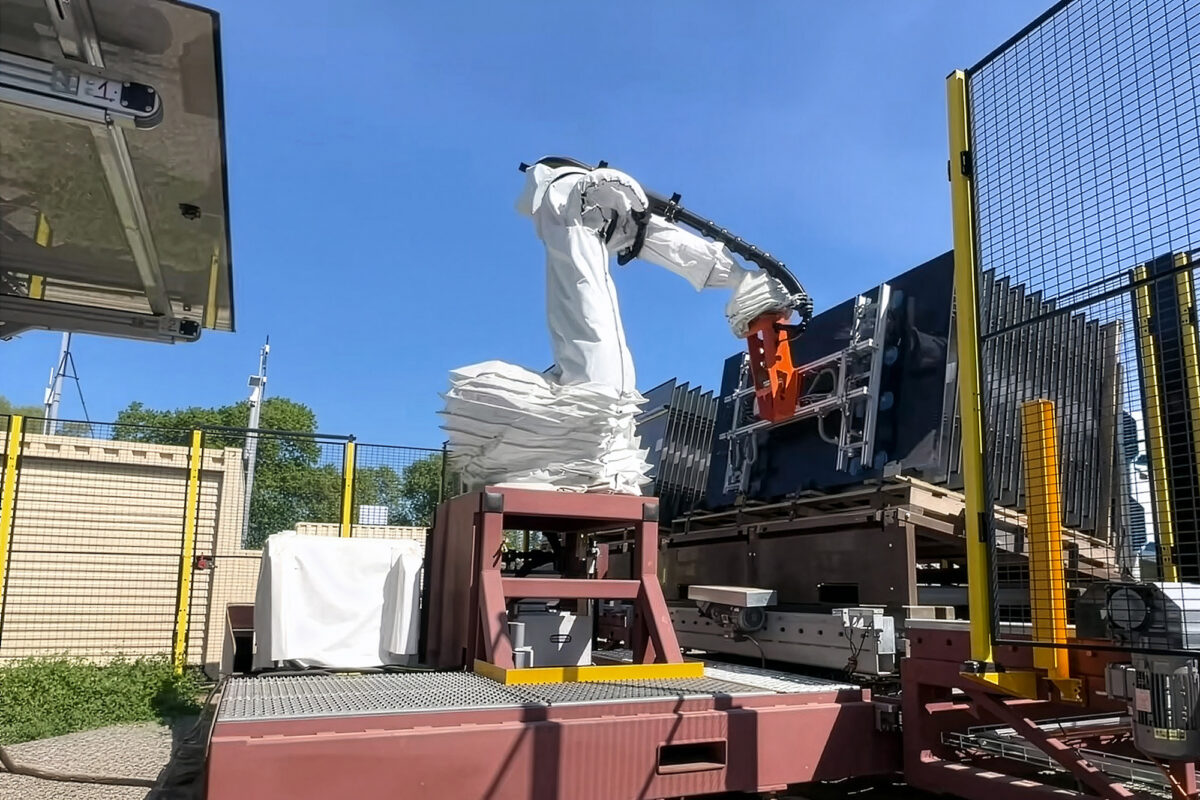





California-based engineering and construction technology firm Terabase Energy says its new Terafab V2 automated solar array construction system has completed field testing and is ready for commercial service. The Terafab process solar panel and tracker torque tube assemblies onsite and deploys them on prepositioned tracker mounts using AI-assisted robotics.
In addition, Terafab has established a partnership with California-based energy consulting firm PowerUQ to integrate the latter’s uncertainty analysis software with the former’s PlantPredict solar modeling tools. The developments represent significant investments in solar plant technology at a time when new large-capacity power projects face shifting economic incentives.
The core of the upgraded Terafab factory system is an outdoor assembly and inspection center that is erected on active construction sites. The current version of the factory is optimized for First Solar Series 7 panels and Nextpower trackers.
Palleted panels are paired with steel tubes and in the field and run through an automated inspection line that performs quality control. Defects are caught in real time. Robotic arms load approved assemblies from the line onto unmanned rovers that drive them out to their appointed locations in the array field for manual placement.
Matt Campbell, CEO and co-founder of Terabase Energy told pv magazine USA that he has been working for ways to streamline solar construction since his days at SunPower a decade and a half ago. Earlier efforts involved prefabricating tracking module assemblies in the factory and shipping them to the site, but the weight and dimension limits imposed too many compromises on the process.
“We decided, ‘Hey, let’s do prefab, but we’re going to do it on-site because of the shipping density problem.’ But then we inherit these other problems,” Campbell said. “It’s hard to do outdoor robotics. Plus, we essentially take a factory assembly operation and set it up on site, where we have to fight through rain, hail, wind, tornadoes, dust, ants, bees, snakes, badgers, rats. Literally.”
Terabase’s research and development efforts have resulted in factory line that is hardened against the elements and nature’s creatures. Palleted modules and tracker frame components are shipped to the construction site. One robot unpacks them and moves module and torque tube assemblies through the inspection and loading point. Campbell says Terafab V2 has a two-minute cycle time that could ideally place 20 MW per week per line if running continuously. Campbell says there are two deployable factories available now with a third to be ready by the end of the year. He expects 10 factories to be available in the second quarter of 2027.
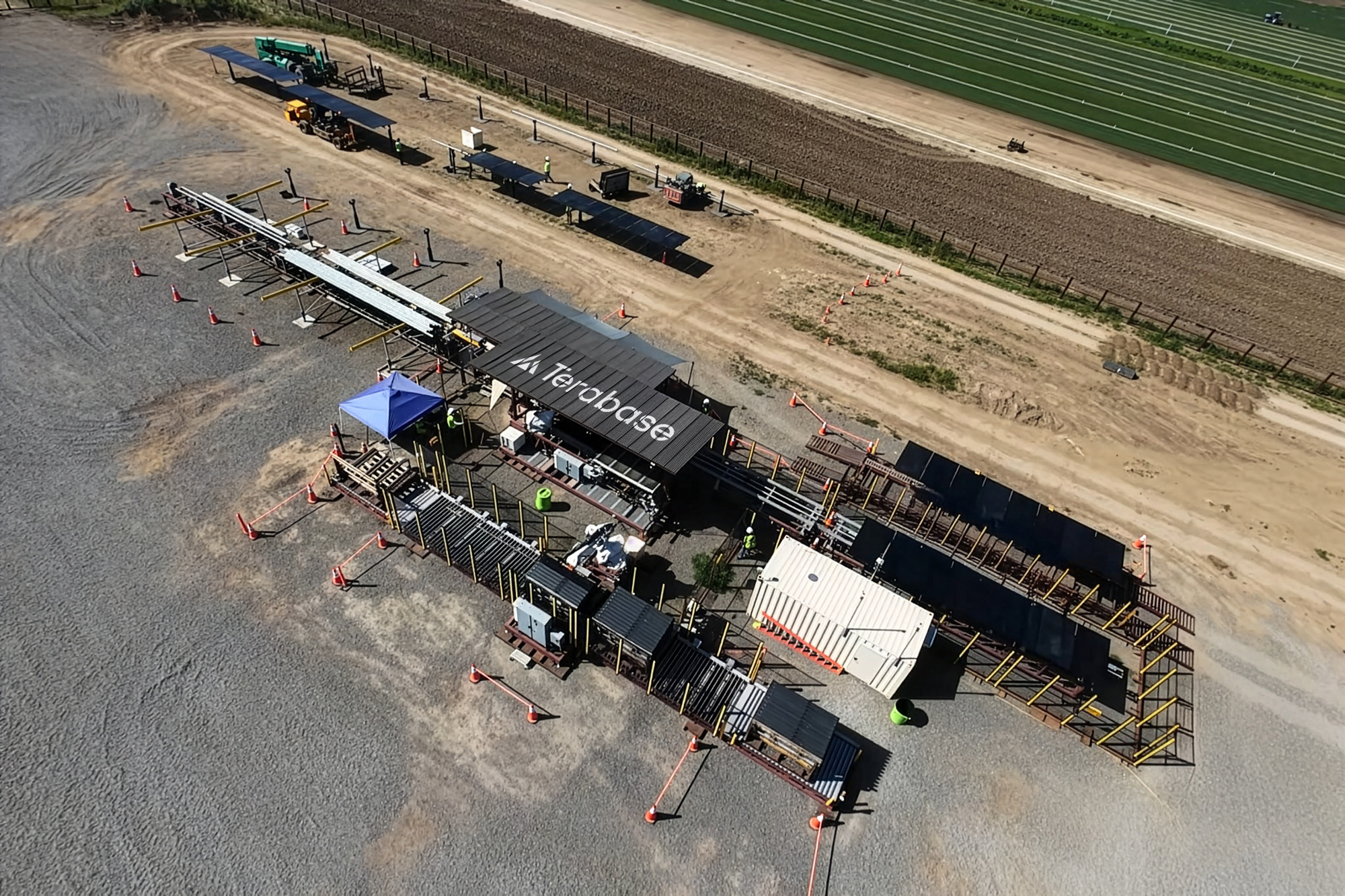
Terabase has used the first version of the Terafab system to install 40 MW of tracking solar over across multiple commercial projects in the U.S. With the addition of AI-assisted management software and automated robotics, the company expects to install hundreds more megawatts of solar in 2026.
“The new version is more compact than the original, so you can you can move it in four hours,” he said. “It’s pretty nimble and has a higher level of automation. The factory is twice as fast, and you can run multiple lines per site. My goal is to install a gigawatt in 10 weeks. The way you could do that is if we send four or five Terafabs to a site and run them 24 hours. We could do that.”
With the current version of the system, workers manually unload the panel-tube assemblies from the rovers and install them onto mounts, which have been pre-placed. Terabase says a future version of the system, due in 2027, will automate the process of fitting assemblies onto tracker mounts. Campbell said versions of Terafab capable of handling panels using silicon modules and other tracker components are forthcoming.
Terafab V2 was financed largely through a $130 million series C investment round led by Softbank last year. Campbell said the investment has enabled the company to pursue research and development on a number of initiatives designed to bring down the cost and time required to install large-scale solar.
“Well, the original goal of the company is in the name, ‘Terawatt Baseload Energy,’” Campbell said. “When we started the company, I asked, ‘What do we need for solar to be a terawatt-scale source of baseload energy?’ And the conclusion was, we need to be able to build it 10 times faster for half the cost.”
Another example of this investment in new technology can be found on the company’s engineering and analysis side of the business, with PlantPredict’s integration agreement with PowerUQ. The integration enables a solar productivity analysis in PlantPredict to be loaded into PowerUQ for an uncertainty quantification analysis to forecast plant performance over time taking additional factors into account.
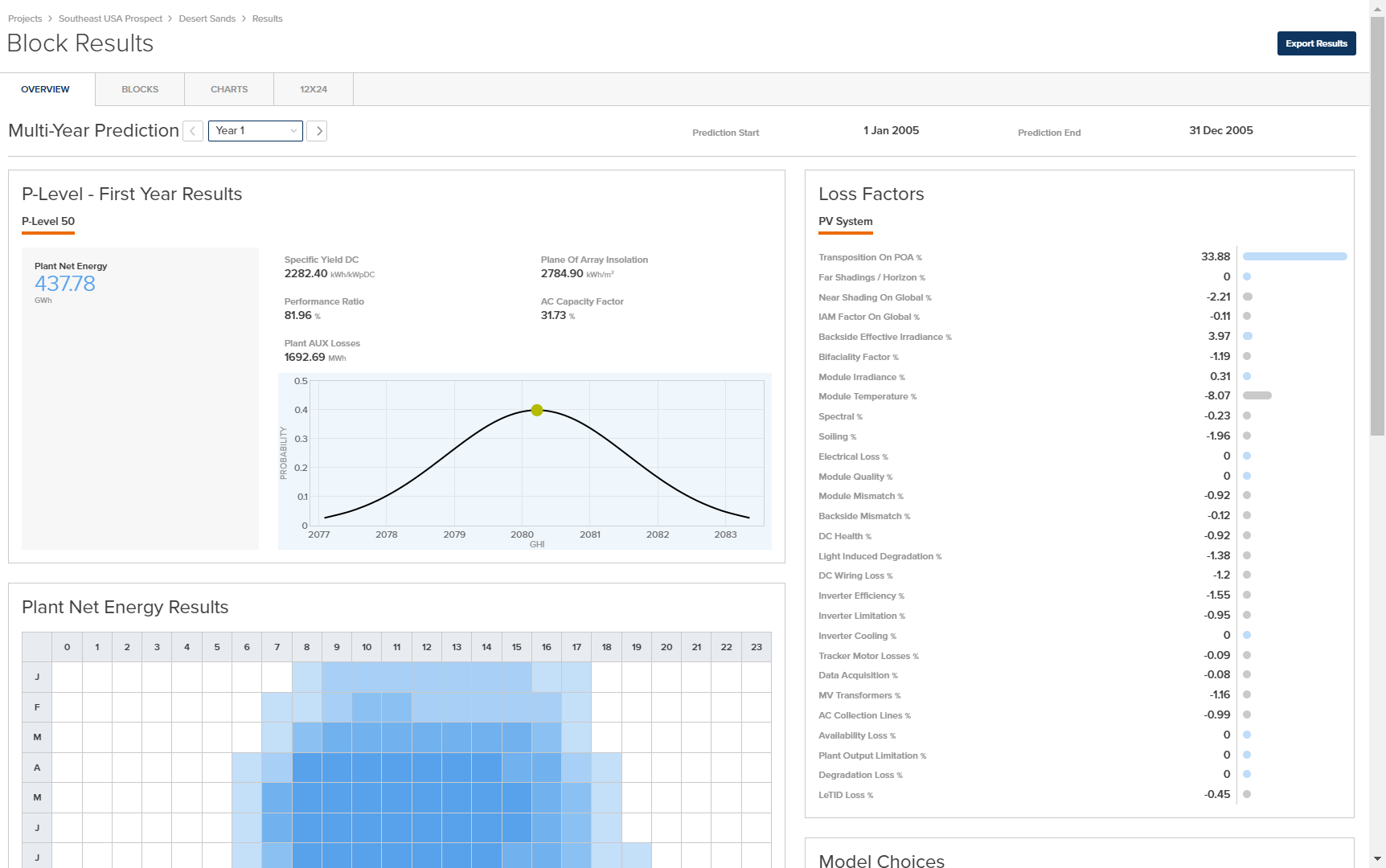
David Spieldenner, director of PlantPredict sales at Terabase, told pv magazine USA that his company’s software represents an expansion of desktop photovoltaic analysis tools such as PVSyst by using cloud computing to enable more extensive analyses. Access to high-end computing enables PlantPredict to use parallel processing across many data centers to produce very granular results.
“We unlock the power of the cloud to do very advanced 3-D sub-hourly simulations,” he said.
Chetan Chaudhari, co-founder and CEO of PowerUQ, told pv magazine USA that while PlanPredict is a very high-fidelity, accurate physics model with its shading engine and different model chains that it considers while calculating energy production, its focus has mainly been on first year energy generation. Historically this has been worked, he added, because most of the plant value came from project’s tax credits and the high power purchase agreement rates it could command.
“But now that that’s kind of going away” Chaudhari said. “There are a lot more market pressures. We are seeing more news about the underperformance of these solar assets over their lifespans. This is the time for the industry to move away from just looking at the first-year generation and basing all the financial calculations on that. We need to be able to think about the project as a 20-year, 30-year asset that you’re investing billions of dollars in.”
The function of PowerUQ is to analyze factors that introduce variability into plant output models and evaluate the risks these impose on the project. Examples of such uncertainty are the performance of components over time, curtailment policies of utilities that dampen production, and the impact of El Niño weather events. A PowerUQ analysis of a PlantPredict model could show a range of probabilities for output scenarios and the risk levels associated with them.
“As we’re moving forward, we want to make sure people don’t get results that they don’t trust,” Spieldenner said. “PowerUQ is going to help people better understand the implications of the deeper results they are getting out of PlantPredict.”
This content is protected by copyright and may not be reused. If you want to cooperate with us and would like to reuse some of our content, please contact: editors@pv-magazine.com.




By submitting this form you agree to pv magazine using your data for the purposes of publishing your comment.
Your personal data will only be disclosed or otherwise transmitted to third parties for the purposes of spam filtering or if this is necessary for technical maintenance of the website. Any other transfer to third parties will not take place unless this is justified on the basis of applicable data protection regulations or if pv magazine is legally obliged to do so.
You may revoke this consent at any time with effect for the future, in which case your personal data will be deleted immediately. Otherwise, your data will be deleted if pv magazine has processed your request or the purpose of data storage is fulfilled.
Further information on data privacy can be found in our Data Protection Policy.