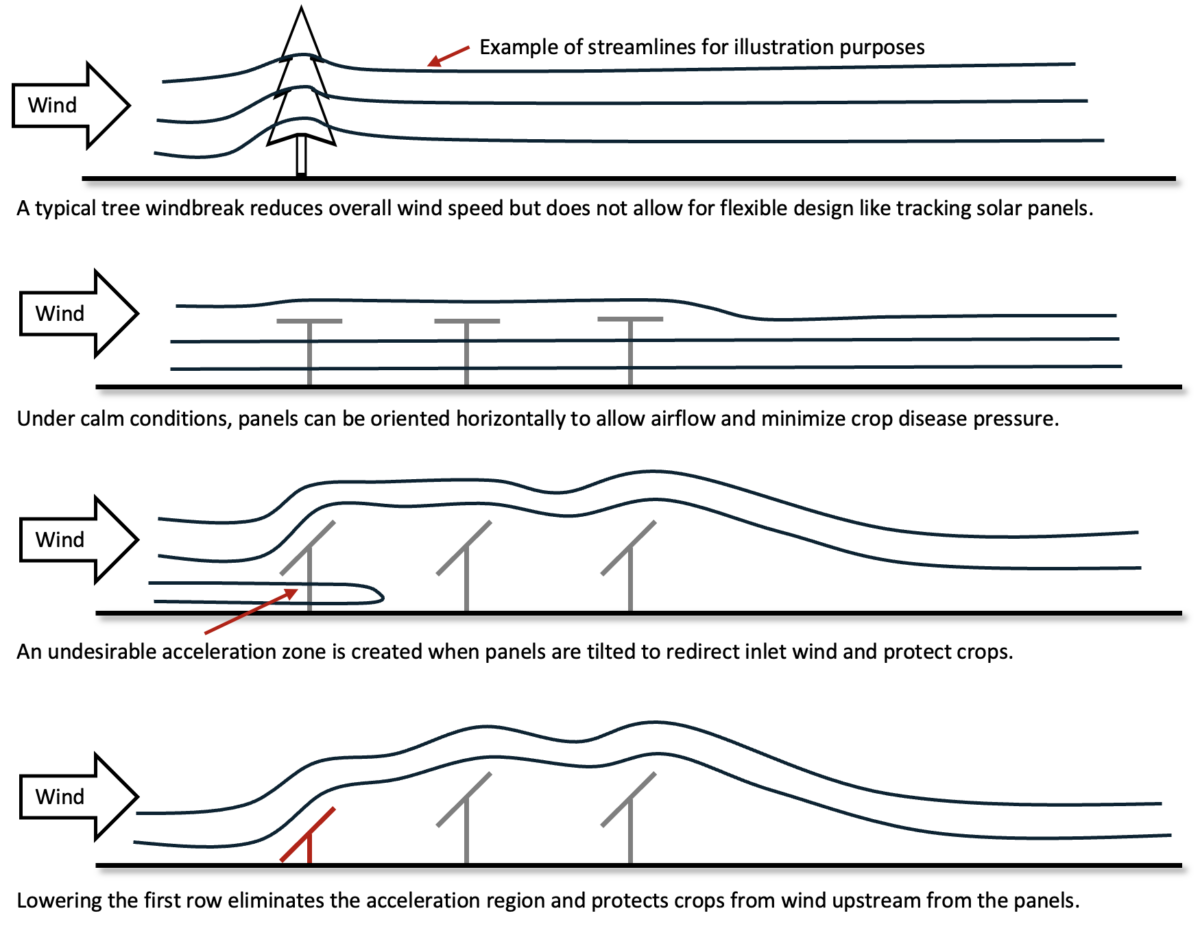





Researchers from Cornell University in the United States have used computational fluid dynamics (CFD) modeling to evaluate how different agrivoltaic designs protect crops from wind damage, comparing conventional tracking solar panels with a natural tree windbreak.
“Airflow under solar panels is a key consideration for agrivoltaic systems. If conditions are too windy, crops can be damaged; if too calm, crops risk mildew,” corresponding author Max Zhang told pv magazine. “We quantified wind speed below solar panels in various configurations and compared it with traditional agricultural windbreaks. The results help identify strategies to achieve optimal airflow beneath solar panels in agrivoltaic systems.”
The team explained that by adjusting panel tilt in horizontal single-axis tracking (HSAT) systems, agrivoltaic setups can either block damaging winds or allow airflow for aeration, depending on crop needs and weather conditions.
The CFD model uses Reynolds-averaged Navier–Stokes (RANS) equations in ANSYS Fluent engineering software to simulate airflow around solar panels. Panels were explicitly modeled, while racking structures and gaps were simplified. The simulation domain was divided into three zones, allowing refined meshing near the panels and coarser grids elsewhere. A grid independence study ensured accuracy without excessive computational cost.
The researchers also modeled a natural tree windbreak as a homogeneous porous medium in ANSYS Fluent, using a momentum sink to capture flow resistance, primarily from inertial effects. Inlet wind speeds ranging from 5–35 m/s were simulated to represent different levels of crop and soil damage, enabling a direct comparison with agrivoltaic windbreaks. The agrivoltaic scenarios included HSAT panels with tilt angles from 0° to 90°, as well as a new lowered-first-row (LFR) design at 60° to improve airflow over downstream panels.
Both windbreak types were simulated with identical boundary conditions to ensure a fair comparison of wind reduction performance. The agrivoltaic system length of 20 rows mirrors typical tree windbreak spacing, providing maximum wind protection while reflecting realistic agricultural design constraints.
“The simulations revealed three wind zones beneath the solar panels,” Zhang said. “First, wind speeds increase under the leading rows of panels. Then, wind slows in the shelter zone, providing protection. Finally, downwind, wind speeds gradually recover to initial levels. In very windy conditions, solar panels reduced wind speeds by up to 70% in the shelter zone, compared with virtually no protection from a single row of trees, which represents a conventional windbreak.”
“Our study highlights the benefits of tracking solar panels, which follow the sun throughout the day,” Zhang added. “Compared with a stationary windbreak, tracking panels can be oriented to provide protection in windy conditions while allowing airflow during calm periods. The new lowered-first-row design offers an aerodynamic solution to the acceleration zone found in other agrivoltaic scenarios, achieving up to 86% protection in the shelter zone under extreme wind conditions.”
This content is protected by copyright and may not be reused. If you want to cooperate with us and would like to reuse some of our content, please contact: editors@pv-magazine.com.



By submitting this form you agree to pv magazine using your data for the purposes of publishing your comment.
Your personal data will only be disclosed or otherwise transmitted to third parties for the purposes of spam filtering or if this is necessary for technical maintenance of the website. Any other transfer to third parties will not take place unless this is justified on the basis of applicable data protection regulations or if pv magazine is legally obliged to do so.
You may revoke this consent at any time with effect for the future, in which case your personal data will be deleted immediately. Otherwise, your data will be deleted if pv magazine has processed your request or the purpose of data storage is fulfilled.
Further information on data privacy can be found in our Data Protection Policy.