





Why are data center developers so interested in solid-state transformers?
It is not just that the world is building more AI data centers, we are making them smarter and they’re able to support more complex AI models. To do that, there are a lot of advances from the GPU side – the compute part of the data center.
For example, Nvidia is pushing the market to very, very high density of compute racks. The current infrastructure can’t sustain such high density. If we talk about what we see today in most data centers, it’s probably around maybe 10 kW per compute rack, which is like a residential solar inverter. The next generation that is starting to enter AI data centers is maybe around 100 kW per rack. The generation after that, which SolarEdge is aiming to meet with our solution, is going to be around 1 MW per rack – but on the same footprint data centers have today. Current infrastructure physically cannot sustain that.
Should we therefore expect a switch to full DC architecture for data centers in the near future?
Nvidia and other hyperscalers are going in that direction – that the industry needs to change the whole infrastructure to DC.
Today AC runs through the data center to the very edge of the compute rack itself, where it is turned into DC, because the chips work in DC. Data centers get AC all the way from the grid, they transform from medium voltage to low voltage – usually around 480 V – and then do a series of conversions until they get to very low AC voltage that they then turn into DC. But this cannot continue for high density racks. They need to get higher voltage DC, around 800 V. Changing the infrastructure inside the data centers to allow 800 V, for example, straight to the rack, would effectively enable the next generation of compute.
Where do solid-state transformers fit into this new DC architecture?
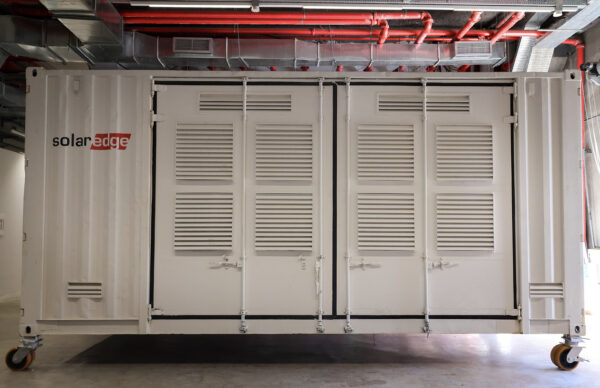
An SST does not just replace the transformer; it also replaces the converter. It’s like a transformer and inverter together in one single device. This is the fundamental difference between SST and a traditional transformer in terms of the application. Another meaningful difference are the internal components. So in a solid-state transformer, we actually use solid-state components. For example, SolarEdge is working with Infineon Technologies as our component provider and they have very advanced silicon carbide switching components, like we also see in some inverters. They provide very high-quality silicon carbide chips which allow the transformer to be much, much smaller and more efficient than the traditional transformers you see today.
What are the main challenges to developing an SST that’s commercially competitive?
So first is the efficiency, because in a data center – it’s also true in other systems, like in solar systems – the efficiency is very, very important. In a data center, every fraction of a percent that you can squeeze means more compute and more money for the data center. Or you can look at it from the other direction and say you need less electricity to run a certain amount of computing. Either way you look at it, optimizing efficiency is a pure gain.
Another thing that might be a challenge is the connection to medium voltage. These are very high voltages and not easy to work with, especially for companies who are not used to them. We put a lot of emphasis in our design and research on making sure that we can connect up to 34.5 kV. It’s much easier to design a product that works up to 10 kV, and while that’s still very high – it’s still medium voltage. The difference is substantial in terms of design complexity but also in terms of value for the customers if they really want to be flexible to connect when they want, where they want.
There are long waiting lists for traditional transformers. Should we expect the same from SSTs?
The manufacturing process for SSTs more closely resembles inverters – conventional transformers are often custom-built, requiring orders to be placed years in advance. Our SST design utilizes subcomponents designed for mass production and modularity. This approach will allow us to efficiently address customer requirements by leveraging pre-manufactured components for rapid delivery.
When does SolarEdge expect to have its AI-ready SST product on the market?
We will be ready for the next generation of AI rigs, the ones that require 800 V DC, which are expected around 2027. So we plan to be there in time and we are confident we can achieve it.
And does a full DC-based architecture open doors for solar and battery energy storage?
You can integrate solar and storage into the system and it will probably be more native than we have today. If you read what Nvidia or other hyperscalers have stated on how they see the industry, they do talk about integrated storage within the data center. Today you have UPS [uninterrupted power supply] inside the data center, but it runs on AC. You now have the opportunity to run everything on DC.
I’m actually very excited because I feel like solid-state transformers and the whole move to a DC-based system in data centers is the natural way of things. We basically live in a DC world and artificially insert AC in between. We are finally starting to get rid of this legacy system to really unlock the full benefits of DC – simplicity and the efficiency.
This content is protected by copyright and may not be reused. If you want to cooperate with us and would like to reuse some of our content, please contact: editors@pv-magazine.com.

By submitting this form you agree to pv magazine using your data for the purposes of publishing your comment.
Your personal data will only be disclosed or otherwise transmitted to third parties for the purposes of spam filtering or if this is necessary for technical maintenance of the website. Any other transfer to third parties will not take place unless this is justified on the basis of applicable data protection regulations or if pv magazine is legally obliged to do so.
You may revoke this consent at any time with effect for the future, in which case your personal data will be deleted immediately. Otherwise, your data will be deleted if pv magazine has processed your request or the purpose of data storage is fulfilled.
Further information on data privacy can be found in our Data Protection Policy.