




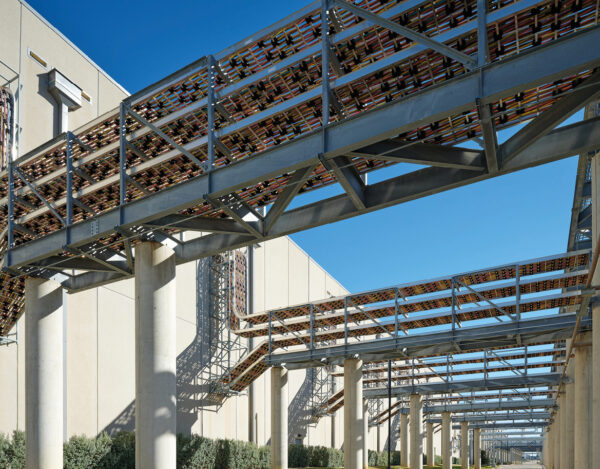
Speed to power is the biggest prerequisite for data center developers in the United States. It takes 12 to 24 months on average to build a data center, whereas securing a connection to the electricity grid can take up to three times as long.
“In today’s market, power solutions for high-demand applications like data centers are required on timelines that were unthinkable just a few years ago,” said Josh Tucker, director of engineering in the energy storage group at Burns & McDonnell, a Missouri-headquartered engineering, procurement and construction (EPC) company. “To meet this need for speed, on-site generating capacity and behind-the-meter distribution are becoming standard considerations.”
Through BYOC programs, data centers directly procure the clean energy storage capacity needed to meet firm-service requirements through power purchase agreements, virtual power plants (VPPs), or on-site resources.
“We view the ‘bring your own capacity’ (BYOC) trend as a direct response to the primary driver in the data center market, which is speed,” said Justin Gruetzner, director of onsite power at Burns & McDonnell. “Developers cannot afford to wait years for a grid connection.”
Deciding factor
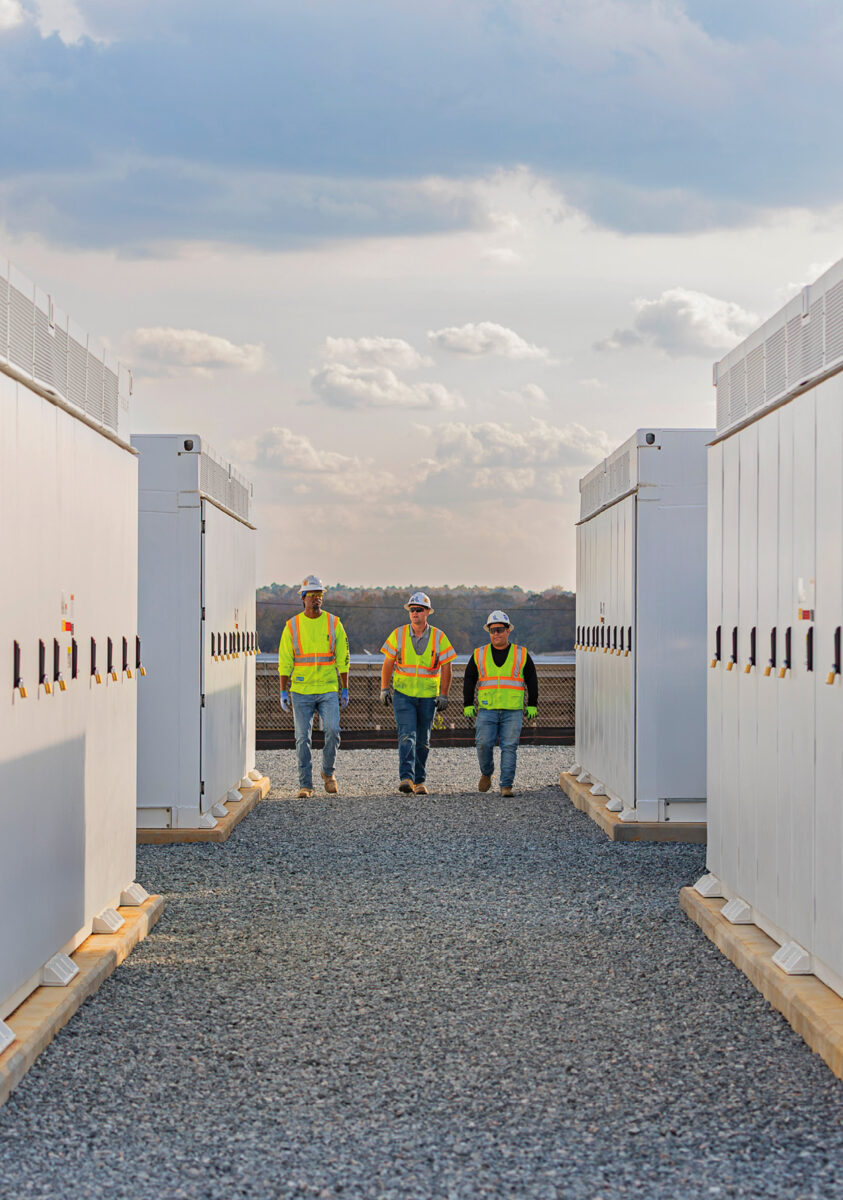
Gruetzner sees data centers moving forward with their own behind-the-meter power generation to accelerate power delivery. Batteries play a critical role in supporting reliability by providing spinning reserve to manage load fluctuations given their ability to ramp up or down and transition between generation and load nearly instantaneously. A BESS can also provide redundancy, support UPS needs, provide black start functionality and deliver peak shaving capacity.
“Even when developers are able to secure a viable path to a grid connection, batteries can be the key to getting final approval,” said Tucker. “We’ve seen cases where the grid can support the facility’s load for most of the year but falls short during a handful of peak hours. In those cases, installing an on-site BESS to cover that small deficit can be the deciding factor in getting the interconnection approved.”
Gruetzner and Tucker don’t see any sign of the BYOC trend slowing down.
“Looking ahead, we believe this trend will only grow,” Tucker told pv magazine. “The enormous and rapid power demands of new data centers, especially those supporting AI, will continue to require an innovative approach to power. As long as speed to market remains the top priority, on-site batteries will be an indispensable tool for data center developers, whether they’re building an islanded microgrid or to secure a faster connection to the main grid.”
Flexibility is key
Flexible grid connections (FGCs) are another way to speed up the process of securing power. Camus Energy, a California-based provider of orchestration software for analyzing grid conditions, defines FGC as a pathway to planning and approval. It should not be mistaken for a demand response scheme, which comes into play after grid connection. FGCs are essentially a compromise between utilities and developers. They enable developers to use more capacity by agreeing to be flexible during periods of grid stress. It’s another reason why utilities might agree to a grid connection in the first place.
Camus’ Google-funded Dec. 2025 whitepaper, titled “Flexible Data Centers: A Faster, More Affordable Path to Power,” demonstrated that data centers could shorten the wait for grid connection by three to five years by combining BYOC arrangements with FGCs.
“Together, these mechanisms replace the traditional ‘build first, connect later’ model with a different approach: connect now, operate flexibly during the hours the grid is constrained,” the paper stated. “This approach aligns the data center’s need for rapid access to power with the utilities or ISO’s obligations to maintain reliability and ensure affordability. Flexible connections address transmission bottlenecks, while BYOC addresses generation bottlenecks.”
The authors tested their approach using system, utility, and site-level modeling applied to six real candidates within one PJM utility’s territory. As well as Camus, the study had input from Princeton University’s Zero Lab team and software company Encoord.
According to the authors, this is the first publicly available study to combine real utility transmission system data, system-level capacity expansion modeling, and site-level capacity optimization to evaluate how flexibility can accelerate data center interconnections.
Steven Brisley, one of the lead authors of the report, explained that the methodology demonstrated provides a repeatable blueprint that any utility can follow using the tools and data already available for new load studies.
He believes regulators and utilities will embrace flexibility in 2026 as “the need for speed isn’t going away any time soon.” Brisley and his co-authors have begun flexible interconnection planning studies for several real-world data center sites with utility and developer partners.
Early movers
Some utilities, like Portland General Electric (PGE) in Oregon, have already implemented FGC and BYOC models with batteries. For example, to speed up the delivery of the Hillsboro data center in an area of Oregon known for semiconductor manufacturing, PGE worked with its developer Aligned and battery specialist Calibrant to devise a compromise that worked for all parties.
“When we started working with Aligned, we looked at different flexible options. The best option for where they’re located, on the grid and for what their plans were, ended up being this 30 MW/ 60 MWh battery solution,” said Isaac Barrow, senior manager commercial energy offerings at PGE.
“We were able to model their battery, optimize the siting of the battery, present them a scenario that said, if you build this, this is the acceleration that we can provide to you, the interconnection, and ultimately they moved forward with it, signed the contract and that battery is now in active development.”
It is due for completion in 2027 and PGE is now using this flexibility approach for all its large load customers, said Barrow.
“We’ve really leaned into batteries as a utility asset to our system,” Barrow added. “It’s the typical utility problem of a very high peak, and so you have to build to the peak. And you can use flexible resources to reduce the amount of peak, and so you can serve more base load, and run the entire system more efficiently.”
Before the Oregon utility interconnects large loads, it undertakes a system impact study, followed by facility and flexibility studies. The entire study process generally takes four to six months. Barrow explains it is in that facility and flexibility process that they look at what flexible solution is most appropriate. The solution needs to be both within the customer’s ability and desire to deliver as well as aligning with the utility’s grid needs and ability to meet the customer’s demands in the system in that specific location. “It’s a bespoke study process, and we’re actively doing that process right now for the Hillsboro cluster, the next round of expansion of the Hillsboro data center area,” he told pv magazine.
Barrow said the average wait time for a grid connection in PGE depends on the type of build and where it is located on the network. “We work very hard to make sure that our timelines match their construction timeline,” he said of negotiations with data center customers, adding: “It doesn’t always happen perfectly, but we realize that speed to market is very important for the industry.”
Power partnership
It seems like utilities and data center developers are constantly at loggerheads over grid space, but Barrow disagrees. “I would definitely not portray our relationship with data center customers as adversarial. I don’t think we’re pitted against each other. I view it much more as an opportunity for partnership.”
Despite PGE’s embrace of FGC models, Brisley said some utilities and developers question whether FGCs and BYOC approaches can be adopted quickly and consistently enough to meet the industry’s near-term needs. “Many love the concept, but see regulatory uncertainty, tooling gaps, and the historically slow pace of change for utilities as barriers.”
Data centers could play a positive role, but only if regulators and utilities “step up,” according to Charles Hua, founder and executive director of PowerLines, a nonprofit campaigning for modernized utility regulation. Hua explained that new sources of electricity demand can improve affordability, but only if utilities leverage them to make the grid more efficient and spread system costs over a larger number of users, lowering per-unit electricity prices for all customers.
Hua claimed that the current regulatory model does not incentivize utilities to prioritize grid efficiency. As Burns & McDonnell’s Tucker pointed out, today’s hyperscale AI data center developers prioritize speed to power and low-cost convenient solutions. This includes BESS in the form of BYOC and FGC models, but it also includes gas turbines.
“At the end of the day, it’s really a get what you can get when it comes to power generation,” he said.
However, Tucker believes long-term demand for BESS will remain robust because it addresses problems that gas turbines cannot – problems that utilities like PGE need addressed.
“BESS provides the critical ancillary and reliability services that thermal generation alone cannot,” said Tucker, adding “Batteries offer instantaneous response for load smoothing, which is vital for power-intensive AI applications.” Tucker sees energy storage systems as the only viable technology for the large-scale UPS systems that data centers require. He explained BESS can provide the essential grid balancing services that facilities seeking a grid connection need for them to secure an interconnection permit.
Not a competition
“Ultimately, we do not see this as a competition between batteries and gas turbines, but rather as the need for a diversified power portfolio.” Tucker said the most resilient and effective solutions will rely on a mix of technologies, and the future is likely a hybrid solution pairing on-site gas generation for bulk power with a BESS component to handle reliability, load-following and grid support. “This approach delivers both speed to market and the sophisticated power quality these critical facilities require,” he explained.
His Burns & McDonnell colleague Gruetzner agreed on the hybrid solution being the most likely model for the market going forward. “The reality is that the immense land required for solar or wind to meet the 24/7 power demands of a large facility is a significant hurdle for this to be the sole strategy for meeting clean energy goals,” he said.
While acquiring land for data centers and their associated power needs happens at an earlier stage than the grid connection phase, it is an equally complicated process. Jeremy Solomon is president and founder of Learnewable, a company offering AI-based tools for developers to assess risks associated with renewable energy developments.
Learnewable recently added a strand for data center developers so they can more easily speed up development and add on-site renewable energy generation.
Solomon said the company added the data centers intelligence tool due to demand. Learnewable’s software scrapes the internet – from social media platforms to legal documents – collecting and collating relevant publicly available data on variables such as potential objectors, social risks, community support, permitting rules, influential stakeholders and more.
“We worked with a psychologist on this tool,” said Solomon, adding that granular data helps developers communicate better with local communities and address their concerns as opposed to dismissing them.
Thermal battery startup ExoWatt has introduced its own response to the land constraints issue. ExoRise is marketed as a turnkey solution for data centers that incorporates the company’s thermal battery system, the P3. Nic Bustamante, chief data center officer at ExoWatt, said the team has already seen a lot of interest in the new product from hyperscalers and utilities.
“It’s a very timely offering for us in the United States market,” he told pv magazine, adding that the company is looking at deploying the solution in places with high solar irradiance. It is currently working on a pilot due for completion in late 2026.
Bustamante said using thermal energy storage technology serves as a key selling point for ExoWatt.
“We think our battery, being a thermal battery, is incredibly competitive for the large-scale utility storage application. We build our batteries to last the full life cycle of the P3 box itself,” he said, arguing that thermal batteries have a longer lifecycle than lithium-ion batteries in a conventional data center setting, due to how frequently they are cycled.
Bustamante added that locating generation such as solar with data centers is difficult in suburban areas where land is more valuable and space is at a premium. Historically, data centers have mostly opted to connect renewables to the grid to offset their emissions, but consuming solar natively is possible for developers that choose the ExoRise system with the P3 battery, he said. The data center can connect directly to the system in this scenario. But Bustamante said the more widely used offsetting model is also possible.
“The market has been asking for more than just power dirt, more than even a building shell. They want to see delivery of turnkey facilities,” said Bustamante.
Solomon said he has seen promising results from the data-driven approach. Although Learnewable’s data center intelligence tool is new, he has seen even the most strident initial local objectors can be persuaded that renewable projects are workable after all. He hopes renewable energy-powered data centers can be included in this category.
For the moment, 100% renewable energy-powered data centers are rare. Burns & McDonnell’s Gruetzner said the land scarcity issue plus the need for speed to power means they see the future in hybrid power strategies.
“It is not about a single solution, but about intelligently combining on-site power, renewables, battery storage, and grid resources,” said Gruetzner.
This content is protected by copyright and may not be reused. If you want to cooperate with us and would like to reuse some of our content, please contact: editors@pv-magazine.com.





By submitting this form you agree to pv magazine using your data for the purposes of publishing your comment.
Your personal data will only be disclosed or otherwise transmitted to third parties for the purposes of spam filtering or if this is necessary for technical maintenance of the website. Any other transfer to third parties will not take place unless this is justified on the basis of applicable data protection regulations or if pv magazine is legally obliged to do so.
You may revoke this consent at any time with effect for the future, in which case your personal data will be deleted immediately. Otherwise, your data will be deleted if pv magazine has processed your request or the purpose of data storage is fulfilled.
Further information on data privacy can be found in our Data Protection Policy.