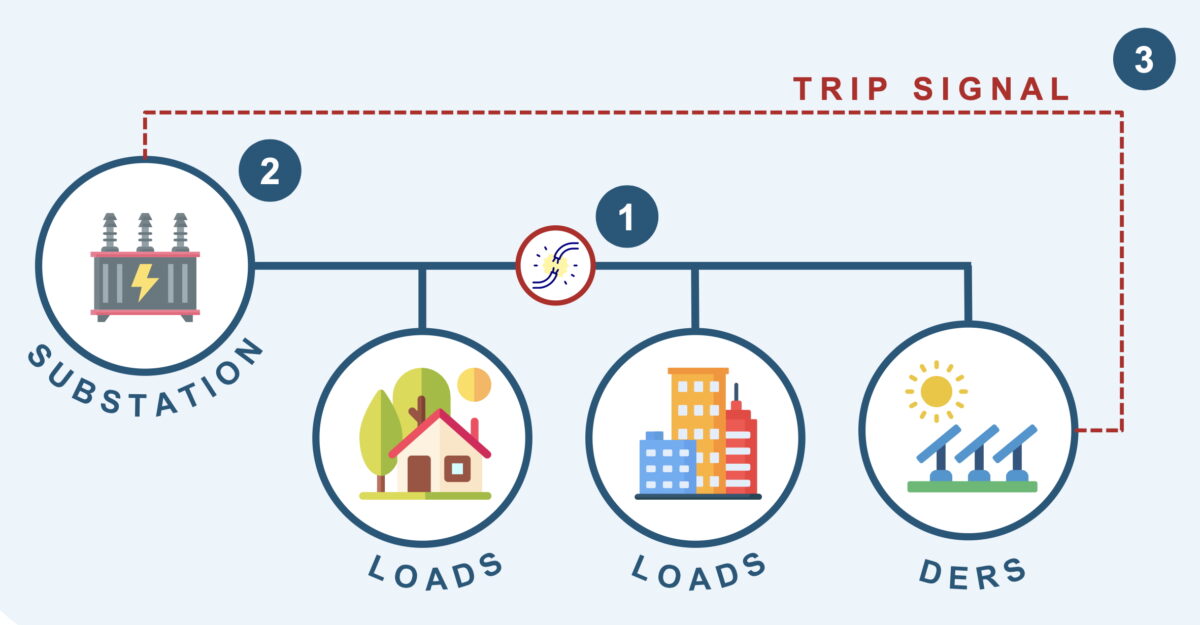





Inverter-based detection functionality that can shut off a distributed solar project’s generation in the event of a power outage “is a viable alternative to direct transfer trip in many cases,” says a report from Sandia National Laboratories.
Utilities in 14 states have required direct transfer trip infrastructure for at least some distributed solar projects, the Coalition for Community Solar Access has found.
The costs of direct transfer trip, CCSA said, typically include substation equipment upgrades costing $1 million to $2.5 million, and installation of a communication medium that costs $200,000 per mile where a fiber-optic line is required. As a result, “many solar project developers have had to withdraw projects,” CCSA said.
Sandia’s report says that a combination of two inverter-based functions, “undervoltage relaying coupled with unintentional islanding detection,” is a viable alternative to DTT, because “UV + UID is a mature technology, it is far less expensive than DTT, and it is part of the distributed energy resource certification process, which provides operational confidence.”
Undervoltage relaying, the report says, refers to the “UV2” inverter function specified in the IEEE 1547-2018 inverter standard and modified by IEEE 1547-2020a, while unintentional islanding detection is also required by IEEE 1547. Both functions are tested as part of third-party certification of inverters under the UL 1741 standard.
CCSA has proposed that state regulators adopt the IEEE 1547-2018 standard.
The Sandia report noted “certain disadvantages” to the “UV + UID” approach, one being that it operates within 160 milliseconds or less only for low-impedance fault situations.
The fastest requirement for de-energization stated by any utility was 160 milliseconds in all cases, primarily to ensure safety in a downed-wire situation, the report says. Sandia lab staff consulted with utilities in preparing the report, under the U.S. Department of Energy’s Interconnection Innovation Exchange (i2X) program.
The IEEE 1547 standard requires the UID function to de-energize a distributed resource within two seconds, and requires the UV2 function, triggered by a voltage below the UV2 threshold, to de-energize the resource within 160 milliseconds.
Another reported “disadvantage” of “UV + UID” is that it requires utilities to rely on third-party equipment for a critical protection function. “A statement that was made often by some utilities” during stakeholder consultations was that “‘Utility systems must be protected by utility equipment,’” the report says.
Each DER equipment manufacturer uses a proprietary UID method, and the report notes that the utility National Grid requires that only DERs equipped with specific UID methods may interconnect to its grid.
The Sandia report presents a wealth of technical detail but is written and illustrated in a manner accessible to a non-technical audience.
Among the report’s conclusions are:
- A DTT system may respond slowly or not at all for fault conditions that do not cause any line-ground or line-line voltage to drop below 50% of nominal.
- Assuming a low-impedance fault such that system voltages drop below 50% of nominal, both DTT and UV + UID can meet a 160 millisecond de-energization requirement, as can the “power line carrier permissive” approach.
- Utility-side “impedance insertion” facilitates impedance detection, activating inverter-resident UV + UID functionality.
- “Voltage-supervised reclosing” prevents asynchronous reclosing of the circuit.
- Updated anti-islanding screens, such as those presented in the report, “will have a tendency to require the use of specific active UID methods.”
More research is needed, the report says, on the topics of:
- UID with grid-forming inverters (as the report considered only grid-following inverters)
- Lower-cost, non-point-to-point communications options for DTT
- High-impedance fault detection
- Ways to reduce the cost and improve the performance of an approach based on wide-area broadcast of a utility reference signal, and of the “power line carrier permissive” approach.
The Sandia report, written by Michael E. Ropp, is titled “Direct Transfer Trip With Distributed Energy Resources, and Alternatives.”
This content is protected by copyright and may not be reused. If you want to cooperate with us and would like to reuse some of our content, please contact: editors@pv-magazine.com.



By submitting this form you agree to pv magazine using your data for the purposes of publishing your comment.
Your personal data will only be disclosed or otherwise transmitted to third parties for the purposes of spam filtering or if this is necessary for technical maintenance of the website. Any other transfer to third parties will not take place unless this is justified on the basis of applicable data protection regulations or if pv magazine is legally obliged to do so.
You may revoke this consent at any time with effect for the future, in which case your personal data will be deleted immediately. Otherwise, your data will be deleted if pv magazine has processed your request or the purpose of data storage is fulfilled.
Further information on data privacy can be found in our Data Protection Policy.