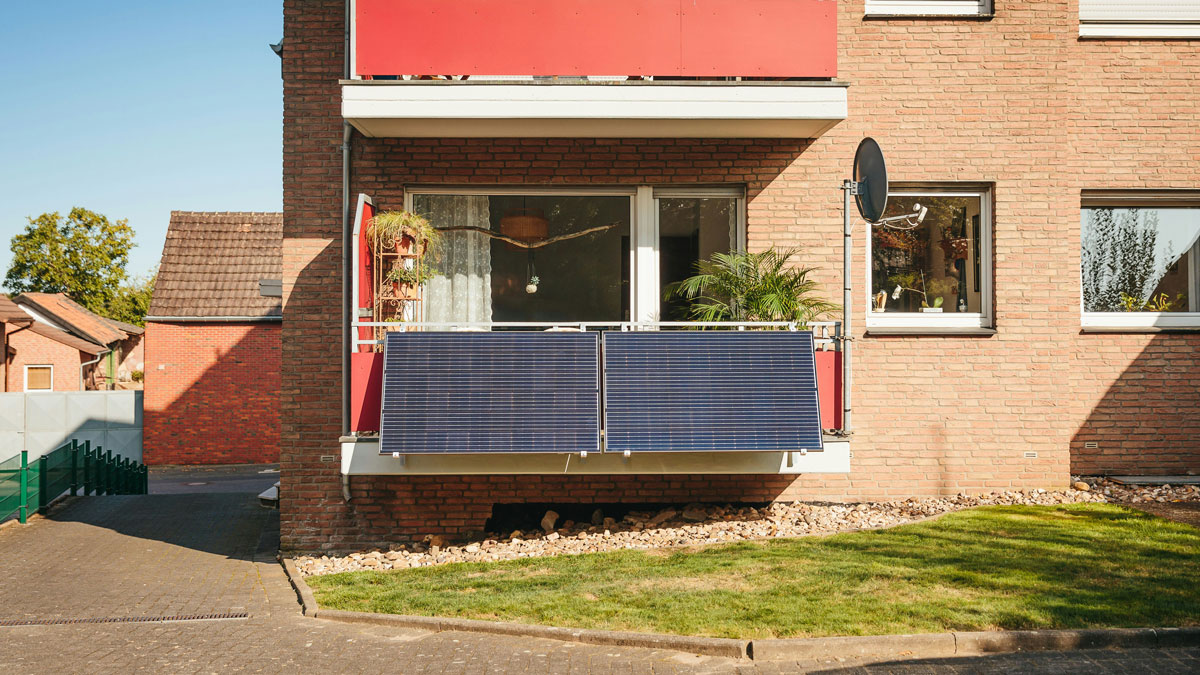





APsystems has launched direct sales of its EZ1-LV plug-in microinverter, making the device available to homeowners across the U.S. through an online store.
The microinverter is designed for use in so-called “balcony solar” and other plug-in solar installations, and allows users to simply connect solar panels directly to an outlet in their home or apartment and send electricity through the home’s wiring.
The EZ1 was originally announced in 2023, and was previously available only through the company’s partner installer and distributors. Although it has now begun direct sales of the EZ1, APsystems says it has reinforced its commitment to those partners.
The company sells only the EZ1 units through its website, at a current price of $325, and directs DIY customers who want more complete solutions to its network of “kitting distributors” that offer the EZ1 alongside compatible solar panels, extra cables, and even zip ties for mounting onto a balcony. Partner pricing for the EZ1 starts at $295.
Installers who wish to offer full-service plug-in solar installations to their customers can register as partners and be listed on an interactive map hosted on the APsystems website.
The EZ1 is covered under a 12-year standard warranty, with the stipulation that the unit must be registered through the APsystems EMA portal.
Operation and compatibility
The EZ1-LV is the 3rd-generation of the plug-in solar microinverter from APsystems, designed to work in the U.S. market. Other versions are available for use overseas.
The company says using the EZ1 is as simple as connecting two solar panels to the unit’s DC ports, plugging the power cord into the wall, and using their app to commission the unit over wi-fi and start sending power into the wires in your home. After operation begins, users monitor the system’s production in the app over bluetooth or wi-fi.
The EZ1 has two MPPT channels that each accept the output of a solar module with a voltage of between 26V and 60V, at 18A max current, which corresponds well with many residential-size solar modules. The company says the EZ1 reaches a peak efficiency of 97.3% and has a maximum output of roughly 900 watts
APsystems recommends using modules with between 315 and 660 watts of peak power output.
Legal considerations
While the EZ1 may be available to customers around the country, the legality of using plug-in solar devices is something of a regulatory grey area.
Most U.S. states don’t have laws that address this specific kind of plug-in solar device, but utility rules across the country prohibit any source of generation from interacting with the grid without a formal interconnection agreement. Although the output wattage of devices like the EZ1 is small, the potential for electricity to be transmitted to the grid exists.
Utah is the only state that has passed a law to formally allow plug-in solar panels connected to residential wiring behind the meter, but as of this writing, similar bills are being considered in at least 24 other states.
Of those states, Virginia and Vermont appear to be the closest to becoming the second state to pass plug-in solar legislation, as bills have passed at least one chamber of those states’ bicameral legislatures.
This content is protected by copyright and may not be reused. If you want to cooperate with us and would like to reuse some of our content, please contact: editors@pv-magazine.com.





The National Fire Protection Code requires any solar panel system be terminated at the power distribution center or panel with the appropriately sized copper wire with the appropriate separate circuit braker. Grounding of the metal frames be done with two 8-foot-long grounding rods pounded into the ground alongside the termination point and the grounding wire, going back to the solar panels be attached to the grounding buss on the panel. This could be accomplished by using an already installed single outlet receptacle on the deck or patio. If a dedicated circuit is feeding a duplex receptacle and only one solar panel system is used, then changing the duplex receptacle out to a single receptacle would provide the safety. The termination breaker must be labeled as “Solar Disconnect” and the outside of the panel must be labeled “Solar Disconnect inside” for fire departments to shut down the feed just like the “Main ” is provided for the utility power shut down.