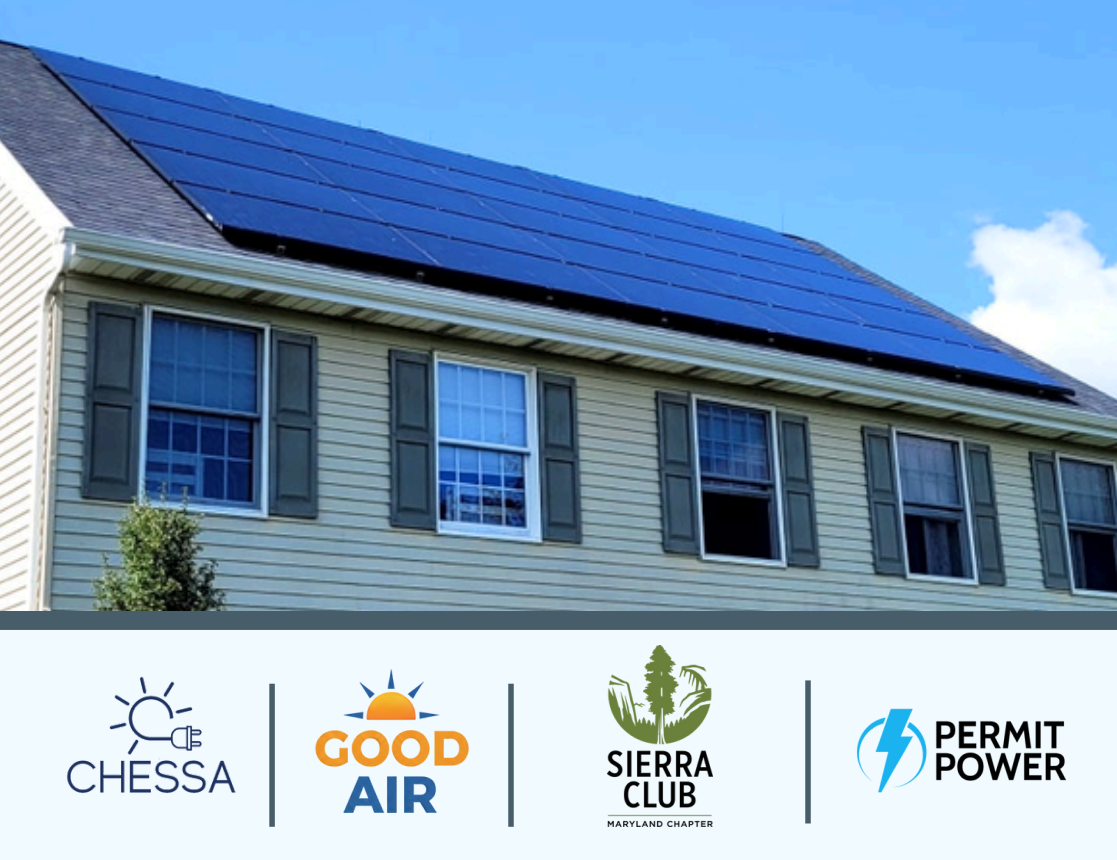





A new report by Sierra Club Maryland Chapter, the Chesapeake Solar and Storage Association (CHESSA), Permit Power, and Good Air, entitled Unleashing Maryland’s Residential Solar Market, calls for a “holistic modernization” of the state’s policy and regulatory environment for rooftop solar and battery systems, citing 10-day average permit wait times, inconsistent regulations and fees and utility interconnection friction that creates “double billing” scenarios for customers.
The report’s authors assert that despite the 2024 passage of the Brighter Tomorrow Act and governor Wes Moore’s 2025 executive order on Building an Affordable and Reliable Energy Future, the state hasn’t done enough work on rooftop solar policy to meet its ambitious Regional Portfolio Standard (RPS) requirement that 14.5 percent of all electricity sold in Maryland must be from solar resources by 2030.
Permitting bottlenecks and fee disparities
The report’s data paints a stark picture of the administrative hurdles facing Maryland installers. The statewide average for solar permit approval stands at 10 business days—double the national average. Average permit issuance timelines stretch to over 40 days in multiple places, with Queen Anne’s County being the outlier at 60 days.
Fee inconsistency is another major pain point. The report notes that permit fees for identical scopes of work can range from $100 to over $900 depending on the jurisdiction (and varies widely even within some jurisdictions).
This variability creates business uncertainty and forces installers to spread the increased costs they incur from following the more expensive and time consuming processes of some jurisdictions to customers in jurisdictions where the burdens are lower, a practice the report authors call the “feedback loop of inefficiency.”
While the Brighter Tomorrow Act encouraged the adoption of automated permitting software like SolarAPP+, the report authors contend that adoption has been uneven and the rules are too open to interpretation.
Interconnection friction and “double bills”
Beyond permitting, the report highlights severe inefficiencies in the utility interconnection process, particularly with major utilities like BGE and Pepco.
Installers reported that opaque processes and responsiveness issues frequently leave systems sitting idle for weeks after installation. In some cases, utilities require multiple site visits — up to four for a single battery system — where a single visit would suffice.
These delays have financial consequences for homeowners. The report describes a “double bill” scenario where customers must begin paying their solar loan installments while still paying a full utility bill because their system has not yet received Permission to Operate (PTO).
“The only thing that got in my way… was BGE,” said one Harford County homeowner quoted in the report. “The extra two weeks I bought electricity from them, I’m sure they are giving Christmas bonuses with that money”.
Key recommendations
To meet Maryland’s climate targets and decrease electricity costs, the report outlines several policy recommendations:
- Require jurisdictions to implement software that provides instant code compliance checks and permit issuance
- Require AHJs to offer remote inspection options (via photo or video) to eliminate scheduling delays
- Cap fees for permitting and interconnection with the money saved by consistency and automation
- Allow certified installers to pull electric meters themselves to avoid waiting for utility trucks, a practice already common in other markets
- Adopt consistent building codes statewide and prevent HOAs from placing restrictions on solar to eliminate the patchwork of local amendments
- Establish statewide interconnection best practices
- Add an enforcement mechanism to penalize non-compliant jurisdictions.
The report authors assert that If the state were to adopt all their recommendations, the increased efficiencies would drive down the cost of a typical rooftop solar installation by more than $1,900 by 2030 and $4,600 by 2040, and generate 23 percent more rooftop solar installations statewide in the next 15 years.
This content is protected by copyright and may not be reused. If you want to cooperate with us and would like to reuse some of our content, please contact: editors@pv-magazine.com.




I do not understand why we keep focusing on accelerated residential permits. We wait 2 months or so for a utility permit. We cannot move forward without both. So reducing the time from 10 days to 5 days on a municipal permit is totally irrelevant as you will still be waiting 50 more days for utility approvals.
Focus on reduced time for utility approvals.