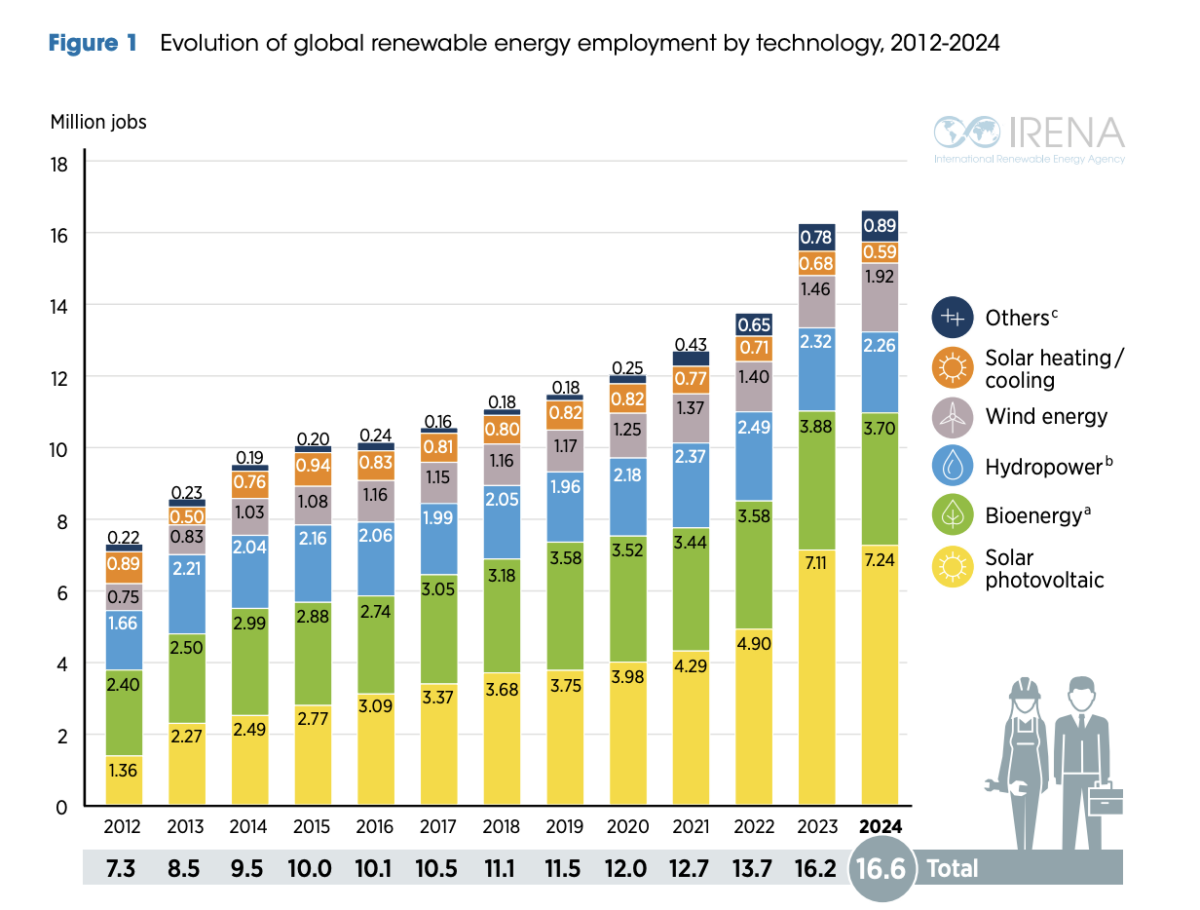





Worldwide solar employment in 2024 reached 7.24 million, up from 7.11 million in 2023, according to analysis by the International Renewable Energy Agency (IRENA).
IRENA’s Renewable Energy and Jobs Annual Review, developed in collaboration with the International Labour Organization (ILO), highlights that solar holds the lion’s share of renewable energy jobs worldwide. The entire renewable energy sector employed 16.6 million people directly and indirectly in 2024, an increase on 2023’s 16.2 million.
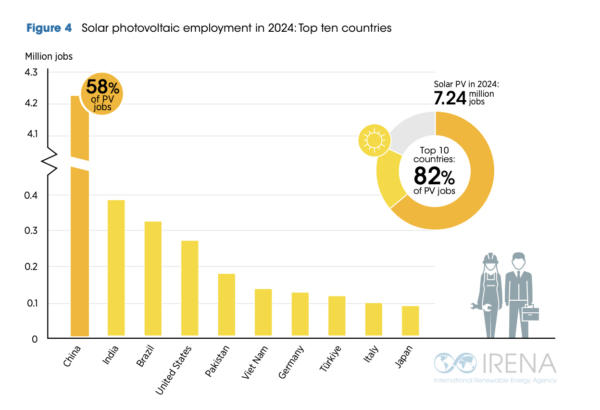
China is responsible for over 4.2 million, or 58%, of PV jobs worldwide. This figure is down on the 4.59 million solar jobs reported in China in 2023, and is made up of around 2 million positions in PV manufacturing and 2.2 million in solar construction, installation and operations and maintenance.
India and Brazil place second and third, with an estimated 384,900 and 323,800 PV jobs, while the United States and Pakistan round out the top five.
Vietnam, Germany, Türkiye, Italy and Japan complete the ten countries with the largest solar job markets. Cumulatively, these ten countries account for around 6 million solar jobs, equivalent to 82% of the global total.
IRENA’s analysis adds that Asian countries hosted 75% of the world’s solar jobs in 2024. Europe took a 11.3% share, with the EU accounting for 10.6%. The Americas held 9.6% of the global job market, with all other regions making up the remaining 3.7%.
While the report highlights that global employment figures reached new highs in 2024, it also points out that employment growth slowed significantly.
In the report’s forward, IRENA Director-General, Francesco La Camera, and ILO Director-General, Gilbert F. Houngbo, explained that China reported a lower number of jobs than in 2023 as rising labour productivity and economies of scale contributed to reducing job intensity, offsetting increases seen in other countries.
Despite this decrease, China remains home to an estimated 7.29 million of renewable energy jobs. Outside of China, the report says imbalances in job offerings across the world reflect both diverging levels of commitment and investment, as well as the uneven capacity to act, given varying industrial and supply chain structures, technological dependencies and availability of skilled labour.
Economies of scale, automation and technological innovation, excess equipment manufacturing capacity and grid bottlenecks are highlighted as other factors that are limiting employment growth.
The report also notes a lack of diversity as an ongoing factor in the renewables job market. IRENA’s report on renewable energy and gender, published in October, found women hold 32% of full-time jobs in the renewable energy sector. While ahead of the oil and gas (23%) and nuclear energy (25%) industries, the percentage lags behind the global workforce average of 43.4%. IRENA’s latest report adds that people with disabilities are only just beginning to receive more opportunities in the renewables sector.
La Camera and Houngbo stressed that workforce development is increasingly critical to the success of the energy transition.
“The report highlights the need to expand training, job opportunities and career perspectives for population groups that are in danger of being left behind,” the pair wrote. “It is crucial to understand that beyond issues of equity and fairness, industry must not overlook their talents, insights and perspectives. It is the human element – the workers in a broad spectrum of occupations and with a wide range of skillsets – that ultimately will secure the success of the energy transition.”
This content is protected by copyright and may not be reused. If you want to cooperate with us and would like to reuse some of our content, please contact: editors@pv-magazine.com.


By submitting this form you agree to pv magazine using your data for the purposes of publishing your comment.
Your personal data will only be disclosed or otherwise transmitted to third parties for the purposes of spam filtering or if this is necessary for technical maintenance of the website. Any other transfer to third parties will not take place unless this is justified on the basis of applicable data protection regulations or if pv magazine is legally obliged to do so.
You may revoke this consent at any time with effect for the future, in which case your personal data will be deleted immediately. Otherwise, your data will be deleted if pv magazine has processed your request or the purpose of data storage is fulfilled.
Further information on data privacy can be found in our Data Protection Policy.