





The U.S. energy storage industry continues to mount impressive year-on-year growth, according to a quarterly report from Wood Mackenzie and the American Clean Power Association (ACP).
In Q3 2025, over 5.3 GW of energy storage was installed nationwide. Third-quarter installations increased 31% year-over-year. Q2 2025 remains the record quarter for deployments, with deployments decreasing in Q3 by 6% quarter-over-quarter.
Through three quarters, the industry has exceeded the total deployment of the full year 2024, said the report.
“Strong growth in the U.S. energy storage market reflects a simple reality: meeting rising demand and keeping the grid reliable increasingly requires storage,” said John Hensley, senior vice president of markets and policy analysis, ACP.
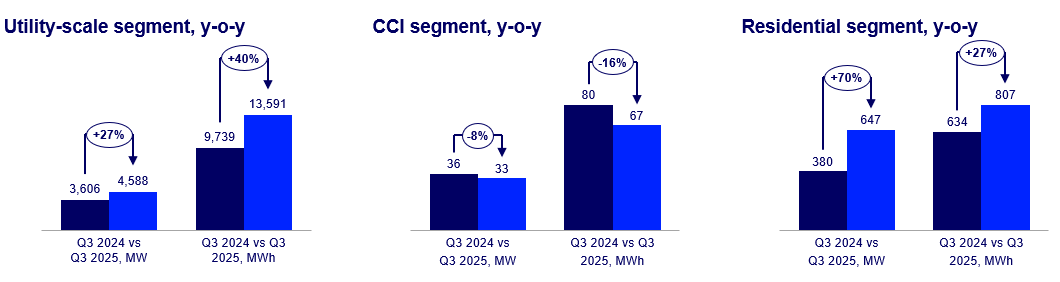
The utility-scale segment was the primary driver of capacity totals, with 4.6 GW of the 5.3 GW total carried by this segment, representing 27% year-over-year growth. Texas and California represented 82% of total utility-scale storage deployment.
The residential energy storage market continues to make strides, installing 647 MW in Q3, marking the seventh consecutive growth quarter for the segment. Residential energy storage deployments grew 70% year-over-year in Q3. Wood Mackenzie projects Q4 2025 will set a record for the residential sector as customers accelerate installations ahead of the Section 25D tax credit expiration. The residential segment’s shift toward third-party ownership models, which accounted for 57% of the market in Q3 2025, is helping to mitigate the impact of the Section 25D expiration, said the report.
Community, commercial and industrial battery energy storage declined 8% year-on-year for Q3, installing 33 MW. California represented 54% of installations in this segment. Wood Mackenzie said Illinois and Massachusetts have emerged as key markets for the segment. California’s Net Billing Tariff (NBT), Massachusetts’ Solar Massachusetts Renewable Target (SMART) 3.0, and Illinois’ rebate programs are expected to sustain steady deployment through 2029, said the report.
Wood Mackenzie increased its five-year forecast for utility-scale storage deployments by 15% compared to its projections released in the first half of 2025. It said that the market may plateau or even decline in 2026 and 2027.
“Although domestic battery manufacturing continues to ramp up to meet new tariffs and non-foreign entities of concern (FEOC) requirements for the Investment Tax Credit (ITC), Wood Mackenzie projects near-term supply chain adjustments and constraints will drive an 11% contraction in the US utility-scale storage market in 2026 and an 8% decline in 2027,” said the report.
However, Wood Mackenzie expects strong recovery, with double-digit year-over-year growth in 2028 and 2029 as U.S. domestic manufacturing capacity comes online.
The firm forecasts nearly 93 GW of storage deployment across the U.S. in the next five years.
“Despite new federal policies and tariffs, the market fundamentals remain exceptionally strong,” said Allison Feeney, research analyst at Wood Mackenzie. “Continued access to the ITC, cost-competitive domestic cell manufacturing, merchant revenue potential, state policy and load growth are driving our increased five-year outlook.”
This content is protected by copyright and may not be reused. If you want to cooperate with us and would like to reuse some of our content, please contact: editors@pv-magazine.com.






By submitting this form you agree to pv magazine using your data for the purposes of publishing your comment.
Your personal data will only be disclosed or otherwise transmitted to third parties for the purposes of spam filtering or if this is necessary for technical maintenance of the website. Any other transfer to third parties will not take place unless this is justified on the basis of applicable data protection regulations or if pv magazine is legally obliged to do so.
You may revoke this consent at any time with effect for the future, in which case your personal data will be deleted immediately. Otherwise, your data will be deleted if pv magazine has processed your request or the purpose of data storage is fulfilled.
Further information on data privacy can be found in our Data Protection Policy.